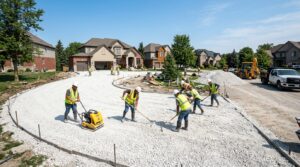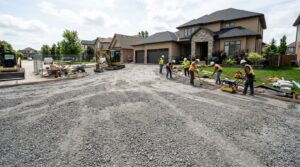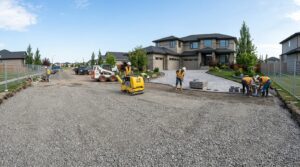
Your driveway paver base is the part you never see once the pavers go down. It’s also the part that decides whether those pavers stay flat under a loaded SUV five years from now or dip, shift, and gap after the first rainy season. We’ve been installing driveways across Sarasota, Bradenton, and Venice since 2000, and the base is where we spend the most time on every project. It’s where the most damage gets buried by crews in a hurry.
If you’re comparing quotes or planning a driveway, you’re probably weighing depth, material, and cost. Here’s what each layer does, why Florida’s sandy soil and summer downpours change the calculation, and how to tell whether a contractor’s proposal actually accounts for the ground your driveway sits on.
Jump to:
What the Base Layer Actually Does
A paver driveway isn’t a slab. It’s a flexible system where individual pavers interlock under confinement, and every layer beneath them plays a structural role. The crushed rock base has three jobs.
It spreads the concentrated weight of a tire across a wider area of soil so the subgrade doesn’t compress unevenly. It provides a compacted platform that won’t shift when pavers flex under load. And it moves water toward the edges of the driveway rather than letting it pool underneath.
A standard cross-section from top to bottom: pavers (typically 2 3/8 inches thick for residential), a 1-inch bedding sand layer, 6 to 12 inches of compacted crushed aggregate, and the prepared subgrade. Polymeric sand fills the paver joints and transfers load between units. Edge restraint keeps the entire field locked in place. Remove any one element and the system unravels.
The base is the thickest single layer. It accounts for more material, more labor, and more truck loads than any other component. When a crew cuts corners, this is where they do it, because the homeowner can’t see the difference until the pavers start moving.
How Deep the Base Needs to Be
Six inches of compacted crushed aggregate is the minimum for a residential driveway on strong, well-drained soil. That figure comes from CMHA’s base-depth guidance, and it assumes favorable conditions: the soil holds its shape, water drains, and the vehicles are standard passenger cars. Similar depth considerations apply to patio base thickness, though vehicular loads require more robust preparation.
The catch: “favorable” doesn’t describe every driveway site. CMHA suggests adding roughly 50% to the minimum for each condition that isn’t ideal. Weak soil adds depth. Poor drainage adds depth. Freeze-thaw exposure adds depth (not our problem in Florida, but relevant if you’re reading from further north). When all three factors are present, the recommended base can reach 15 inches.
For most Sarasota-area driveway paver projects, we install 8 to 10 inches of compacted base. Our sandy soil drains well, which works in our favor, but it’s also loose and doesn’t always provide the bearing strength that a northern clay-loam might. If the site was recently filled (common in newer subdivisions around Lakewood Ranch and Palmer Ranch), or if we find organic material during excavation, we go deeper or replace unsuitable soil before the first aggregate goes in.
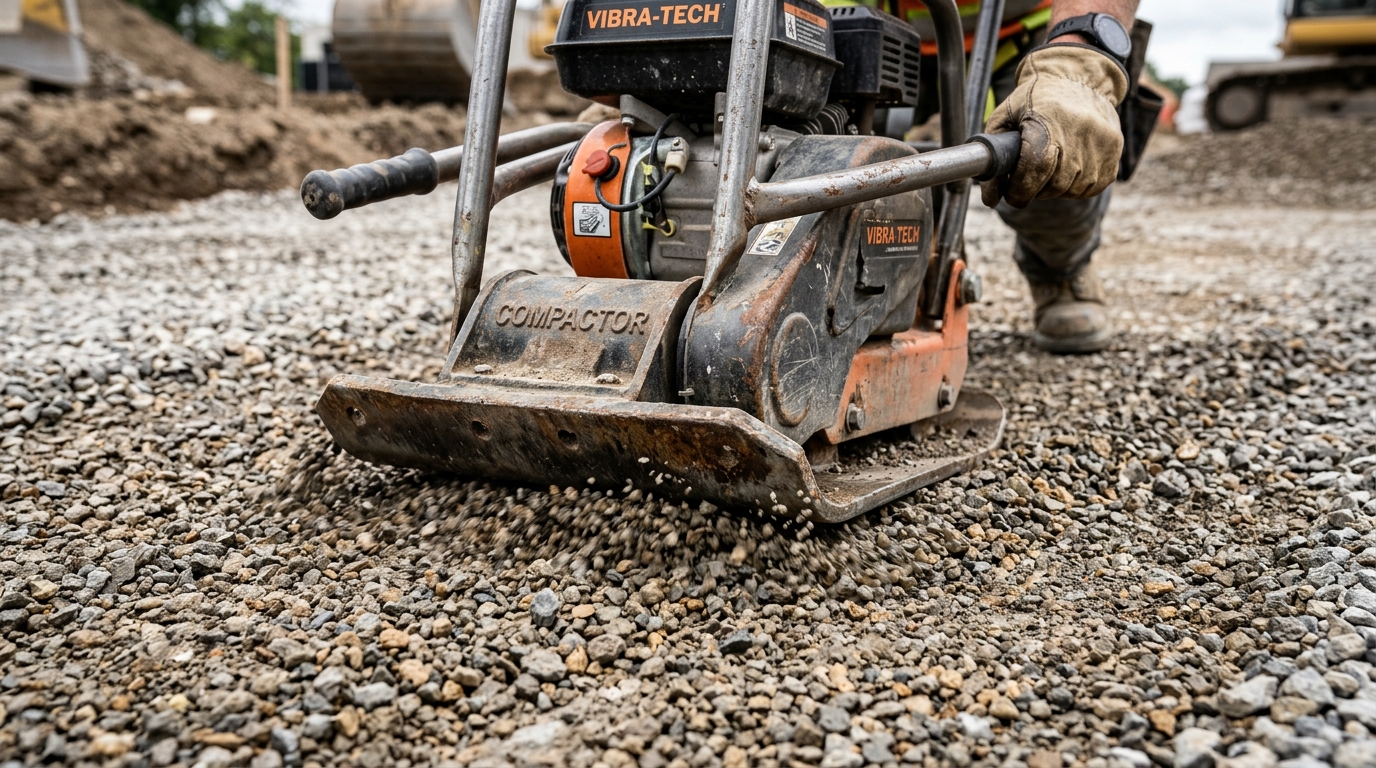
One detail that trips people up: compacted depth is not the same as dumped depth. Loose aggregate compacts roughly 15 to 20 percent when you run a plate compactor over it. If someone says they’re putting down 6 inches and they dump 6 inches of loose rock, you’re getting closer to 5 after compaction.
Choosing the Right Aggregate
Not all gravel is base material. A driveway paver base needs angular, well-graded crushed stone, the kind accepted as road base by local departments of transportation. In Florida, that’s typically crushed limerock graded so that smaller particles fill the gaps between larger ones. When compacted, the angular faces lock together and resist lateral movement under tire loads.
What doesn’t work: pea gravel, river rock, and uniformly sized drain rock. These materials roll under a plate compactor instead of locking. A driveway built on round gravel will shift under vehicle loads within months.
For a standard sand-set driveway, we use dense-graded crushed rock compacted in lifts. Each lift is no more than 4 inches of loose material, compacted before the next lift goes on. CMHA’s construction guidance calls for at least 98% of Standard Proctor density in residential vehicular applications, with Modified Proctor preferred under heavier or constant traffic. If the total base is 8 inches compacted, that means at least two compaction passes through the full sequence, not one dump-and-flatten.
Open-graded stone (like #57) serves a completely different purpose. It belongs in engineered permeable paver systems where the base doubles as a stormwater reservoir. Putting open-graded stone under conventional pavers doesn’t create a permeable driveway. It creates an unstable one.
Bedding Sand: The Thin Layer That Causes Big Problems
Between the compacted base and the pavers sits a 1-inch screeded layer of bedding sand. It’s a setting bed, not a structural layer. Its job is to cushion the pavers and allow minor adjustments in height across the field.
The sand specification matters more than most homeowners realize. CMHA calls for concrete sand meeting ASTM C33: washed, hard, durable, with a controlled gradation. What it explicitly warns against: masonry sand, limestone screenings, and stone dust.
CMHA’s bedding-sand technical bulletin documents a failure case where fines migrated into drainage paths, the base lost its ability to shed water, wet bedding liquefied under vehicle load, pumped up through the paver joints, and the driveway rutted. That’s an extreme outcome. We’ve seen milder versions on driveways where someone used the cheapest sand available: depressions that develop along tire tracks within a year or two, long before anyone expected maintenance.
In Sarasota’s climate, where a summer afternoon can drop two inches of rain in an hour, the bedding layer will get saturated. Using a sand that holds water instead of releasing it turns every heavy rain into a loading event on the paver field.
Compaction, Slope, and Drainage in Sarasota’s Climate
Compaction is not a single pass with a plate compactor. Proper compaction means working in 4-inch loose lifts, running an appropriately heavy plate compactor across each lift in overlapping passes, and checking the result before adding the next layer.
We check compaction by walking the surface and watching for any give or bounce. We also pour water across the finished base to confirm it sheets toward the edges rather than pooling. Any depression deeper than about a quarter inch gets reworked before bedding sand goes down.
Slope is the other half of drainage. CMHA’s typical minimum is 1.5%, which translates to about 3/16 of an inch per foot. On a 20-foot-wide driveway, that’s roughly 3.6 inches of fall. In Sarasota, we typically aim for 2% because our summer storms produce intense, short-duration rainfall that overwhelms shallow grades.
The base grade must match the finished paver grade. If you grade the base flat and try to create slope with the bedding layer, you end up with bedding sand that varies from half an inch in one spot to two inches in another. Thick bedding sand compresses unevenly under load, and dips follow.
Transitions matter too. Where the driveway meets the street, the base needs to be cut to match the existing curb or apron height so the finished paver surface sits flush, not proud and not recessed. At the garage end, the pavers should be level with or slightly below the garage slab so water drains away from the structure, not toward it. These transitions require measurements and grade shots before excavation begins, not adjustments on install day.
One factor specific to our area: Florida’s water table can sit within a couple feet of the surface during the wet season (June through September). If the excavation hits standing water, compaction quality drops and the aggregate loses bearing strength. On low-lying lots, we add a geotextile fabric between the subgrade and the base to keep fine soil particles from migrating up into the aggregate and weakening it over time.
Calculating How Much Base Material to Order
This is the part most online guides skip, and it’s the part that determines whether your material delivery matches your excavation.
The formula: area (in square feet) multiplied by depth (in feet) equals volume in cubic feet. Divide by 27 to convert to cubic yards.
For a 600-square-foot driveway with an 8-inch compacted base:
- 600 x (8 / 12) = 400 cubic feet
- 400 / 27 = 14.8 cubic yards of compacted aggregate
You don’t order compacted volume. You order loose volume. With a compaction factor of 15 to 20 percent, multiply by roughly 1.2. That brings the delivery to about 17.8 cubic yards. Crushed limerock in Florida typically runs 2,400 to 2,600 pounds per cubic yard, so you’re looking at approximately 21 to 23 tons for the base alone.
Add 1 inch of bedding sand: 600 x (1 / 12) / 27 = 1.85 cubic yards. Bedding sand is lighter per yard than aggregate but still needs its own delivery.
Then there’s excavation. If you’re removing depth for 8 inches of base, 1 inch of bedding, and roughly 2.5 inches of paver, you need to dig about 11.5 inches below the planned finished grade. On a 600-square-foot driveway, that’s roughly 18 cubic yards of soil to haul away. In a residential Sarasota neighborhood, that usually means one or two dump-truck loads. If access is tight (a narrow side yard, a gate, a mature oak you need to work around), the logistics of truck access can add time and cost to the project.
Tree roots deserve their own mention. A large live oak within 15 feet of the driveway edge can send roots under the base within a few years. Those roots lift the aggregate, crack the paver field, and create trip hazards. If the root system is already established, we discuss options on site: adjusting the driveway footprint, installing a root barrier, or shifting the layout. No base depth is thick enough to permanently resist a vigorous Florida root system.
Permeable Driveways Need a Different Base Entirely
If stormwater management is part of your goal (some Sarasota-area developments encourage or require reducing impervious surface), permeable pavers are a real option. But the base beneath a permeable driveway is a fundamentally different design.
A conventional base uses dense-graded aggregate that locks together and sheds water to the edges. A permeable interlocking concrete pavement (PICP) system uses open-graded stone with uniform particle sizes and large void spaces. Water passes through the paver joints into a bedding course of small stone (typically ASTM No. 8), then through a base course (typically No. 57), and into a deeper subbase reservoir of larger stone (No. 2, 3, or 4) sized for traffic load and water storage.
These are two separate engineered assemblies. You cannot swap one aggregate type for another and change systems. CMHA’s guidance on standard pavers over open-graded aggregate explicitly limits that combination to pedestrian applications.
PICP can work well. A USGS-monitored installation in Madison, Wisconsin, recorded roughly 60% reduction in total suspended solids and 42% average metal-removal efficiency. But that same study found winter sand application clogged the surface within about a year. A five-year study in Ontario documented significant infiltration decline across permeable surfaces, with partial recovery after vacuum cleaning.
In Sarasota, we don’t deal with freeze-thaw or winter sanding, which removes two major failure modes. But we do get heavy sediment from nearby construction, pollen in spring, and organic debris year-round. A permeable driveway here needs a sediment management plan and periodic maintenance to keep the joints functional.
Reservoir depth depends on storage requirements and how quickly the underlying soil drains. On a well-drained sandy site, the reservoir can be shallower. Over clay or marl (which exists in pockets across Sarasota County), the reservoir needs more depth and may require an underdrain. EPA’s permeable pavement guidance confirms that clay soils may need deeper stone reservoirs and supplemental drainage infrastructure.
What a Solid Driveway Quote Should Include
The base is where the detail in a quote matters most. A line item that says “gravel base” isn’t enough. Here’s what we include in every driveway installation proposal, and what you should expect from any crew:
- Aggregate type and source (e.g., crushed limerock from a named local quarry)
- Compacted base depth, not loose depth
- Number of compaction lifts
- Bedding sand specification (ASTM C33 or equivalent)
- Excavation depth and plan for soil disposal
- Subgrade preparation (organics removal, re-compaction, geotextile if needed)
- Finished slope direction and percentage
- Edge restraint type and method
- Joint sand type (polymeric sand for vehicular applications)
If the proposal skips compaction lifts or finished slope, ask. If the base depth is listed at 4 inches on a sandy Florida lot, ask why. If the bedding sand isn’t specified by name or standard, ask what they plan to use. Consumer cost estimates for driveway pavers in 2026 range from $10 to $30 per square foot installed, and the spread between the low end and the high end often comes down to what’s happening under the pavers.
A driveway base built right in Sarasota’s conditions will last decades. We’ve pulled up 15-year-old driveways for expansions where the base underneath was still solid, level, and draining. The pavers above looked nearly new after a cleaning and reseal. That doesn’t happen by accident. It happens because someone invested the time in excavation, aggregate selection, compaction in lifts, proper slope, and the right sand.
If you want to know exactly what your driveway needs, a free estimate starts with our crew walking your site and checking the soil, the grade, the drainage, and the access. The details a photo can’t show are usually the ones that matter most.
Frequently Asked Questions
How deep should a driveway paver base be in Florida?
Six inches of compacted crushed aggregate is the industry minimum on strong, well-drained soil. In Sarasota’s sandy ground, we typically install 8 to 10 inches to account for lower bearing strength and heavy seasonal rainfall. Sites with recent fill or poor drainage may need more.
Can I use pea gravel or river rock as a driveway paver base?
No. Round aggregates don’t interlock under compaction. A driveway base needs angular, well-graded crushed stone (like limerock) that locks together when compacted. Round gravel shifts under tire loads and leads to visible settlement within months.
What is the difference between a conventional and a permeable paver base?
A conventional base uses dense-graded crushed aggregate designed to compact tightly and shed water sideways. A permeable base uses open-graded stone with large voids that store and infiltrate stormwater. They are separate engineered systems with different aggregates, bedding, joint materials, and drainage designs.
How much base material do I need for a 600-square-foot driveway?
At 8 inches compacted depth: 600 x (8/12) / 27 = about 14.8 compacted cubic yards. Add 15 to 20% for compaction loss when ordering, bringing the delivery to roughly 17 to 18 cubic yards, or approximately 21 to 23 tons of crushed limerock.
Is stone dust acceptable as bedding sand under driveway pavers?
CMHA warns against stone dust and limestone screenings in vehicular bedding. These materials break down under water and tire flex, can liquefy, and pump through paver joints during heavy rain. Use concrete sand meeting ASTM C33 for any driveway bedding layer.
How can I tell if a contractor is skimping on the base?
Ask for compacted depth (not loose), the number of compaction lifts, and the aggregate specification. If the quote lists “4 inches of gravel” with no lift count, no sand spec, and no slope percentage, critical details are missing. A proper vehicular base in Florida should show at least 6 inches compacted, installed in lifts of 4 inches or less.