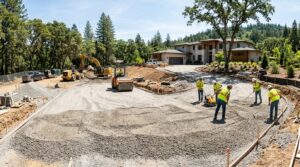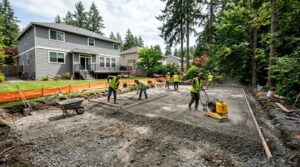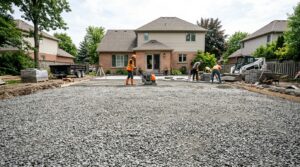
You need a number before you order crushed rock or hand a deposit to a contractor. Here it is: most residential patios need 4 to 8 inches of compacted aggregate base. CMHA sets the minimum at 4 inches of compacted aggregate for pedestrian pavers on well-drained soil. That minimum doubles when the soil drains poorly or the lot was recently filled.
We have been building patio pavers across Sarasota, Venice, Nokomis, Bradenton, and Osprey since 2000. After more than two decades, the pattern is consistent: patios that sink or shift almost always have a base problem, not a paver problem. Understanding paver base thickness before you hire anyone (or pick up a shovel yourself) saves you from rebuilding the same patio twice.
Jump to:
What Paver Base Thickness Actually Measures
A paver patio is not pavers sitting on dirt. It is a layered system, and each layer serves a separate function. When someone says “base thickness,” they mean one specific layer, not the total hole you dig. Understanding what paver base is used for clarifies why thickness matters for long-term performance.
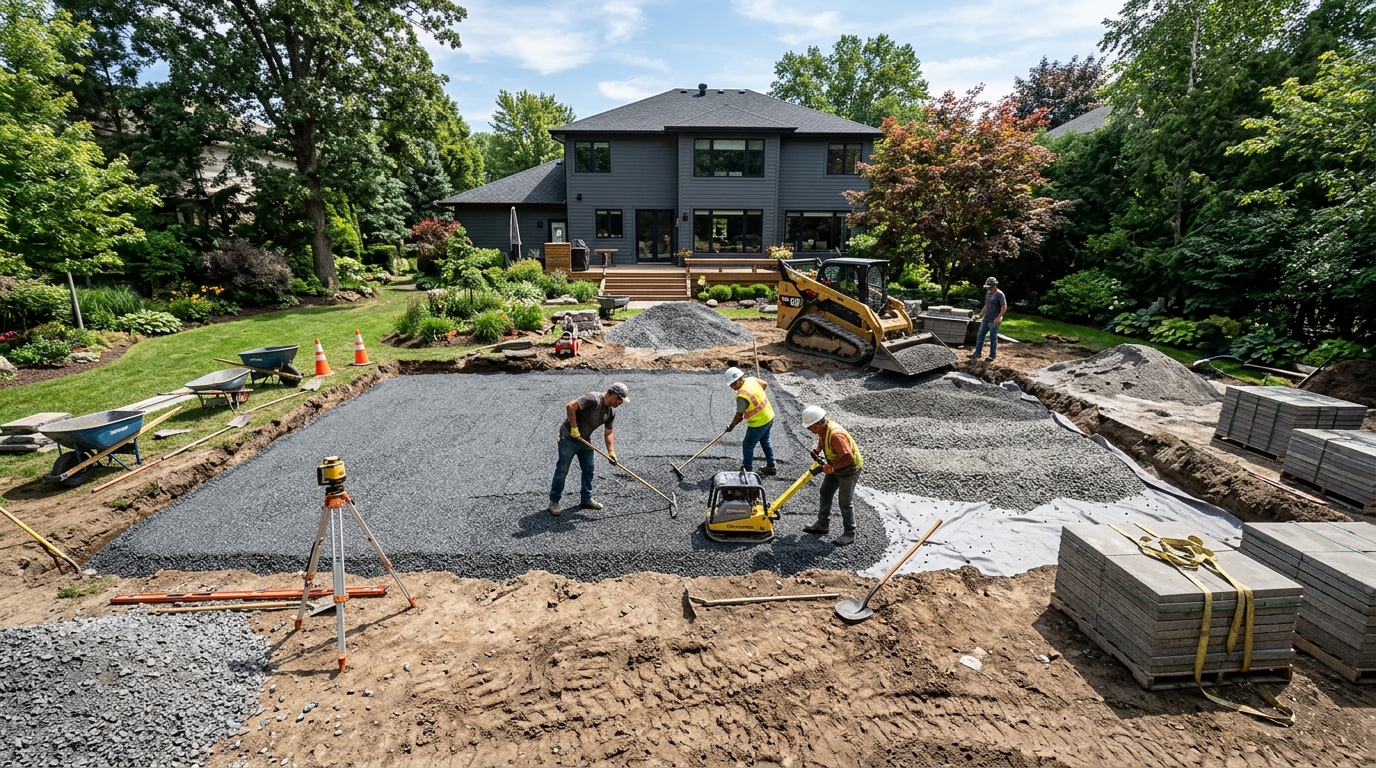
Here is the stack, bottom to top:
- Subgrade: the native soil, cleared of roots, organic material, and debris, then compacted. This is your foundation’s foundation.
- Geotextile fabric (when needed): a separation layer that keeps fine soil particles from migrating up into the aggregate. Essential on silty or filled lots.
- Aggregate base: crushed rock, typically a dense-graded mix from about 3/4-inch stone down to fine particles. This is the structural layer. “Base thickness” refers to this layer alone.
- Bedding sand: a nominal 1-inch layer of washed concrete sand that seats the pavers. It is not structural. It is not a substitute for aggregate.
- Pavers: the surface material, typically 2-3/8 inches thick for pedestrian use.
- Edge restraints, polymeric sand in the paver joints, and drainage slope complete the assembly.
This distinction matters because one of the most common mistakes is treating bedding sand as base material. We have torn out patios where someone spread 3 inches of sand directly over dirt, set the pavers on top, and called it finished. That patio shifts the first time someone drags a heavy planter across it. Sand does not distribute load. Compacted crushed rock does.
Base Depth by Soil and Site Condition
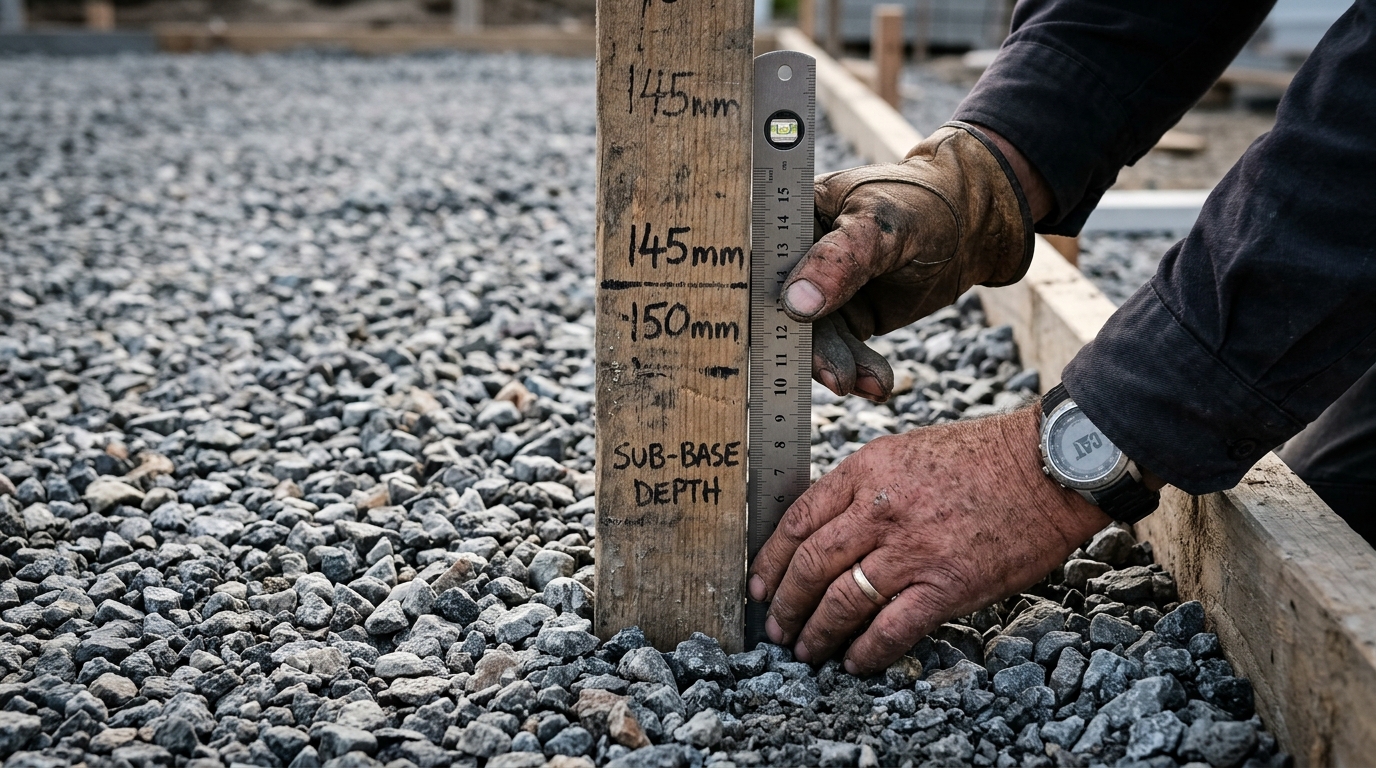
There is no single “correct” base thickness. The number changes with soil type, drainage, site history, and what sits on the patio. Here is how the depth breaks down:
| Site condition | Compacted base depth | Why |
|---|---|---|
| Well-drained sandy soil, established lot | 4 to 6 inches | Favorable drainage; Belgard’s general guidance for pedestrian pavers |
| Average residential lot, mixed soil | 6 to 8 inches | Standard manufacturer guidance for established residential sites |
| New construction or recently filled lot | 8 to 10 inches | Fill soil has not fully consolidated; needs deeper load distribution |
| Clay soil or poor drainage | 8 inches minimum | Clay holds water and swells; the base must compensate |
| Driveway (vehicle traffic) | 10 to 14 inches | Vehicle loads demand significantly more support than foot traffic |
One rule runs through every row: the worse the drainage, the thicker the base. Extra inches of crushed rock give water a path to move through the system instead of pooling under the pavers and softening everything above.
Why Sarasota’s Sandy Soil Changes the Calculation
Most paver base guides are written for climates that freeze. Sarasota does not freeze. That eliminates the freeze-thaw cycle that forces northern installers to add 4 or more extra inches of base just for frost protection. It is one of the reasons paver patios here can perform well with a 4- to 6-inch base when conditions cooperate.
But “sandy soil” does not automatically mean “good base conditions.” Here is what we actually encounter across Sarasota County.
Filled lots near the coast and waterways are everywhere. Builders routinely bring in fill to raise the grade above flood elevation. That fill can be clean sand, muck, construction debris, or a mix of all three. Last year we dug into what the homeowner called a “sandy lot” in Nokomis and hit three inches of organic muck twelve inches down. Muck compresses. A 4-inch base sitting on muck is a 4-inch base with nothing solid beneath it.
Parts of Sarasota sit just a few feet above the water table, especially during the wet season from June through October. When groundwater rises into your base layer, the crushed rock loses much of its structural capacity. A geotextile separation layer and proper slope become non-negotiable in those zones.
Then there is the rain itself. Sarasota averages around 55 inches of rainfall per year, and most of it arrives in intense afternoon storms between June and September. Your patio’s slope and the base’s ability to shed water matter more here than in a climate where rain falls gently and spreads across twelve months. We slope every patio at minimum 1/4 inch per linear foot away from the house (about 2% grade). On a 20-foot-wide patio, that means the far edge sits roughly 5 inches lower than the side against the house.
The takeaway for Sarasota homeowners: sandy soil usually puts you in the 4- to 6-inch range for a straightforward patio, but only after confirming there is no fill, muck, or water-table issue below. When the soil history is unclear, stepping up to 6 inches is cheap insurance. The cost of 2 extra inches of crushed rock is trivial compared to tearing out and rebuilding a settled patio.
Compaction Turns Gravel into a Base
Dumping 6 inches of crushed rock on the ground does not create a 6-inch base. Compaction does. Without it, aggregate is loose stone waiting to shift.
CMHA calls for compacting the aggregate to at least 98% of standard Proctor density. That is a lab-defined benchmark, but the practical translation is straightforward: compact in lifts (layers) of no more than 4 inches at a time, using a plate compactor rated above 5,000 pounds of force. An 8-inch base means at least two separate lifts, each compacted before the next layer goes on.
This is where many DIY projects and low-bid contractors cut corners. Spreading the full depth in one pass and running a small rental plate compactor over the top once does not produce the same result. The bottom half stays loose. The surface looks flat. Six months and a few heavy storms later, the pavers dip.
A simple field check we teach homeowners who want to verify their contractor’s work: walk across the compacted base. If your boot leaves a visible imprint, the material is not compacted enough. Our crew uses a straightedge and level to confirm the surface is within 3/8 inch over 10 feet before any bedding sand goes down.
Calculating Excavation Depth and Material
Knowing the base thickness gives you one number. You still need total dig depth and material volume to plan the project or evaluate a bid.
Total dig depth = compacted base + bedding sand + paver thickness.
For a typical patio with a 6-inch compacted base, 1-inch bedding layer, and 2-3/8-inch pavers, that comes to about 9-3/8 inches below finished grade. Round up to 10 inches to account for subgrade correction.
Aggregate volume (in cubic yards) = patio area in square feet × base depth in inches ÷ 324.
Here is a quick reference for a 300-square-foot patio, a common size for a rear patio in Sarasota:
| Compacted base depth | Cubic yards of aggregate | Total dig depth (1″ sand + 2-3/8″ paver) |
|---|---|---|
| 4 inches | 3.7 | ~7.5 inches |
| 6 inches | 5.6 | ~9.5 inches |
| 8 inches | 7.4 | ~11.5 inches |
| 10 inches | 9.3 | ~13.5 inches |
Two details these numbers leave out. First, the base should extend at least 6 inches beyond the paver edge on all sides to provide full support and room for edge restraints. That overhang adds area (and material) beyond the patio footprint. Second, loose crushed rock compacts down, typically 15% to 20%, so you need to order more than the compacted volume. Ask your supplier for the material’s loose-to-compacted ratio before placing the order.
Notice that going from 4 inches to 8 inches of base doubles the aggregate volume but does not double the patio’s life expectancy. The right depth matches the soil and drainage you have. Overbuilding on clean sandy ground wastes money. Underbuilding on fill wastes much more.
When Permeable Pavers Need a Different Base
If you are considering permeable pavers for stormwater management, the base design changes fundamentally. A conventional base uses dense-graded aggregate (a range of particle sizes that lock together). A permeable base uses open-graded aggregate: uniform-sized stone with voids between the particles where water collects and drains.
CMHA’s permeable pavement guidance specifies a minimum 6-inch open-graded base for pedestrian applications, but total depth often increases because the base doubles as a water reservoir. How much reservoir you need depends on local rainfall intensity and the subgrade’s infiltration rate.
In Sarasota, where summer storms can drop an inch of rain in 30 minutes, that reservoir capacity matters. On sites with slow-draining subsoil, underdrains may be necessary to move collected water out of the base. More stone alone does not solve a drainage problem when the water has no exit.
A related development worth knowing: CMHA’s October 2025 guidance conditionally allows standard (non-permeable) pavers over open-graded aggregate for residential pedestrian use, creating a hybrid that improves drainage beneath the pavers without committing to a fully permeable system. The tradeoff is maintenance: joint sand migrates into the open-graded stone over time and needs periodic replenishment. It is not a set-it-and-forget-it approach.
Base Failures We Fix on Sarasota Patios
After more than two decades of installing and repairing hardscape in this area, certain patterns repeat. These are the base problems that send homeowners looking for answers.
The most common failure is no base at all. A homeowner or a previous contractor spreads several inches of sand directly on the dirt, sets the pavers on top, and calls it finished. Sand cannot distribute load or resist lateral movement. Within a year, the patio develops ruts and gaps, especially near heavy furniture and along the perimeter where foot traffic concentrates.
Missing edge restraints cause a different problem. Without a concrete or composite restraint anchored through the base into the subgrade, the entire assembly creeps outward. Paver joints open, polymeric sand washes out with each storm, and the perimeter unravels from the outside in.
Single-pass compaction on a deep base is subtler but just as damaging. A crew dumps 8 inches of loose rock and makes one compaction pass from the top. The bottom 4 inches stay loose. The surface looks solid on day one. After a few months of Sarasota’s wet season saturating that lower layer, the pavers dip unevenly. The fix requires removing everything and rebuilding in proper lifts.
Skipping geotextile on filled lots creates a slow-motion failure. Fine-grained fill migrates upward into the voids between crushed rock particles, and over a year or two the base loses both drainage capacity and structural integrity. A nonwoven geotextile between subgrade and aggregate stops that migration. It costs a few cents per square foot. Skipping it can cost thousands when the patio has to come up.
Flat patios fail in the most visible way: standing water. A patio with no slope collects every drop of rain, softens the bedding sand, flushes polymeric sand out of the paver joints, and grows algae across the surface. Every patio we build has at least a 2% slope directing water away from the structure. You can check your existing patio with a 4-foot level: if water ponds anywhere after a rain, the grade was not set correctly.
Frequently Asked Questions
Is 4 inches of base enough for a patio?
Four inches of compacted crushed rock meets the CMHA minimum for pedestrian pavers on well-drained, stable soil. In Sarasota, that usually means an established lot with clean sandy subgrade and no fill history. If the lot was recently graded or filled, or if drainage is poor, increase to 6 or 8 inches.
Can I use sand instead of crushed rock for the base?
No. Sand serves only as the 1-inch bedding layer that seats the pavers. The structural base must be angular crushed rock (dense-graded aggregate) that interlocks under compaction. Sand cannot distribute load and will shift under even moderate foot traffic.
How deep do I need to dig for a paver patio?
Total excavation equals your compacted base depth plus 1 inch of bedding sand plus the paver thickness. For a 6-inch base with standard 2-3/8-inch pavers, that is roughly 9.5 inches below finished grade. Add depth if you need to remove organic material, muck, or other unsuitable soil.
Does a driveway need a thicker base than a patio?
Yes. Driveway pavers carry vehicle loads and typically require 10 to 14 inches of compacted aggregate. A patio supports foot traffic and generally needs 4 to 8 inches. A pedestrian patio specification should never be applied to a driveway.
Do I need geotextile fabric under my patio base?
On clean, well-draining sand it is optional but still good practice. On filled lots, silty soil, or anywhere fine particles could migrate into the aggregate, geotextile is necessary. We install it on most Sarasota projects because it costs very little and prevents a failure that is expensive to reverse.
What maintenance does the base need after installation?
A properly built base requires no ongoing maintenance. Attention goes to the surface: cleaning the pavers, replenishing polymeric sand in joints as it wears, and reapplying paver sealer every two to three years. If you notice pavers sinking or shifting, the base has a compaction or drainage issue that surface work alone cannot resolve.
If you are not sure what lies under your patio site, or whether your soil calls for 4 inches or 8, our crew can walk the area and check what no photo can show: soil type, grade, drainage direction, and fill history. A free estimate tells you exactly what your patio needs before any material is ordered or any ground is moved. Reach out before the rainy season tests your base.