You’ve priced out a paver project, and someone at the supply yard suggested crushed concrete as the base material. It costs less than virgin stone, it’s recycled, and they told you it compacts well. So why are you still researching?
Because “it compacts well” is not an engineering specification. And when a paver base fails, the fix is not a patch. You pull every paver, excavate, recompact, and rebuild from scratch.
We’ve installed crushed concrete base for pavers and virgin aggregate bases across Sarasota, Bradenton, Venice, Nokomis, and Osprey since 2000. Both materials can work. Both can fail. The difference comes down to material quality, how the base is built, and whether the installer understands what Florida’s rain and soil will do to it over the next decade.
Jump to:
What Recycled Crushed Concrete Actually Is
Recycled concrete aggregate (RCA) starts as old concrete: demolished driveways, highways, building slabs, sidewalks. A processing plant crushes it, screens it to a target gradation, and magnetically removes steel. The finished product looks like angular gray gravel with bits of mortar attached to each stone—similar in appearance to a crushed rock base for pavers, though with different material properties.
That angular shape actually helps. Crushed particles interlock under compaction better than rounded river gravel, which is why processed RCA can reach the 95% standard Proctor density that a paver base demands. FHWA’s documentation on reclaimed concrete material confirms generally satisfactory performance when the material is properly processed and graded for a granular base.
There’s also a chemistry benefit most articles skip. Residual unhydrated cement in the attached mortar undergoes a mild secondary reaction when compacted at the right moisture. Over weeks, this re-cementation stiffens the base slightly, almost like a weak natural concrete. It’s not structural in the engineering sense, but it adds stability that loose gravel never develops.
The catch is the word “processed.” RCA from a certified plant with a gradation report and a screened, consistent product is one thing. A pile of broken sidewalk chunks from a demolition crew is another. One is an engineered base material. The other is rubble. The label “crushed concrete” covers both, and the distinction is everything.
How Much a Crushed Concrete Base Actually Saves
Material cost is where RCA wins. Published 2026 aggregate pricing from suppliers in the upper Midwest shows recycled concrete running roughly $7.50 to $8.50 per ton, versus $9.25 to $14.50 per ton for virgin crushed stone. Depending on location, that’s a 19% to 41% material cost reduction.
But raw material is only one line on the bill. Delivery, excavation, compaction labor, edge restraint, bedding sand, and disposal of the old surface don’t change based on which aggregate you choose. On a typical 400-square-foot patio with a 6-inch compacted base (about 7.5 cubic yards), even the most favorable price spread yields material savings of $150 to $300. Real money, but not enough to offset a rebuild if the base doesn’t hold.
In Sarasota, the comparison depends entirely on local availability. Our delivered RCA price fluctuates with the nearest processing facility, trucking distance, and seasonal demand. Some months, the gap between RCA and virgin limerock shrinks to $1 or $2 a ton, and the math stops making sense for a residential job.
One more thing to calculate: RCA is typically lighter per cubic yard than virgin crushed stone because the attached mortar is porous. Equal tonnage doesn’t always mean equal volume. Ask the supplier for a bulk density figure so you’re comparing the same compacted coverage.
Where Crushed Concrete Is Approved and Where It Is Not
Industry guidance draws a clear line between what you walk on and what you drive on.
CMHA’s construction guidance for interlocking concrete pavements allows up to 100% RCA for pedestrian applications: patios, walkways, pool deck surrounds. For driveways and any surface that carries vehicle traffic, CMHA recommends no more than 50% RCA blended with virgin dense-graded aggregate from a certified source.
That 50/50 blend limit exists for a reason. A driveway absorbs repeated, concentrated loads. The variability inherent in RCA (different source concrete, different mortar content, different processing quality) introduces more risk under those loads than it does under foot traffic. Blending with consistent virgin material brings the overall product closer to what the structural design assumes.
Open-graded base systems add another restriction. Belgard’s technical note for open-graded aggregate beneath interlocking pavers specifies clean crushed rock and explicitly excludes recycled aggregate. If your project calls for a draining base, which is common under permeable pavers or in areas with poor soil drainage, the manufacturer’s specification may remove RCA from consideration entirely.
For Sarasota homeowners, the practical takeaway: a 100% RCA base is a legitimate option for most patio and walkway projects. For driveways, use a blend or stick with virgin limerock. And if the design calls for an open-graded system, plan on clean stone regardless of price.
What Goes Wrong With a Crushed Concrete Base in Florida
We’ve seen four failure modes in the field. Every one traces back to material quality, installation shortcuts, or both.
Contaminated or weak fines
Not all RCA is equal, even when it looks similar on the truck. A 2025 Oklahoma study tested three RCA sources (demolished interstate pavement, a US highway, and a commercial recycling plant) against virgin limestone. All three passed coarse-aggregate durability tests. Two of the three failed the minimum fine-aggregate durability index of 40.
That matters because fines fill the voids between larger stones and determine how the base handles load and water. A load of RCA that looks solid at the top of the pile can contain chalky, crumbly fines throughout. Under Sarasota’s summer downpours, those weak fines wash out or compress unevenly, and the pavers above them follow.
Drainage interference from tufa deposits
When water moves through crushed concrete, it can dissolve calcium from the residual mortar and deposit it as a white precipitate called tufa. Over months or years, tufa can clog geotextile fabric and subdrain pipes. A 2025 Virginia field trial found visible precipitation in sections using 100% and 40% crushed concrete, though all pipes continued functioning during the three-year observation period.
A separate Florida DOT study on RCA in French drains concluded that the surrounding soil conditions influenced drainage performance more than the aggregate itself. RCA with higher fines content caused more geotextile clogging, but overall performance remained acceptable over 18 months of monitoring.
For a Sarasota paver project, the practical lesson: if your design includes a French drain, underdrain, or geotextile layer, the RCA’s fines content and the soil conditions at the fabric interface need to be part of the plan, not an afterthought.
Alkaline chemistry and efflorescence
Fresh RCA runs highly alkaline. Iowa State’s technical brief on recycled concrete in pavement bases reports initial drainage pH of 11 to 12. That alkalinity migrates upward through bedding sand and can deposit white efflorescence on paver surfaces. CMHA specifically warns of increased efflorescence risk when RCA is used beneath pavers.
On lighter travertine or light-toned concrete pavers, the staining may not be obvious. On darker paver colors, it stands out. A good paver sealer helps manage what reaches the surface, but it doesn’t shut off the mineral source underneath.
The alkalinity also affects adjacent landscaping, and this is something none of the top-ranking articles address. If your patio border runs alongside gardenias, azaleas, ixora, or blueberries (all acid-loving plants common in Sarasota yards), the elevated pH in drainage runoff can stress or kill them over a season or two. We’ve seen it happen on projects we were called to evaluate after the original installer left.
Using RCA where it doesn’t belong: the bedding layer
This is the most common DIY mistake we encounter. The structural base and the bedding layer have completely different specifications. CMHA’s guidance calls for ASTM C33 concrete sand as bedding material, not masonry sand, not limestone screenings, not stone dust, and not crushed concrete screenings. The bedding layer sits at 1 inch after compaction, screeded flat to give every paver uniform support.
Substituting RCA screenings or concrete dust for proper bedding sand creates an uneven, shifting surface. Pavers rock under foot traffic, joints open up, polymeric sand washes out, and the interlock that holds the entire system together degrades. The base can be perfect and the pavers still fail because the bedding was wrong.
How to Build a Crushed Concrete Paver Base That Lasts
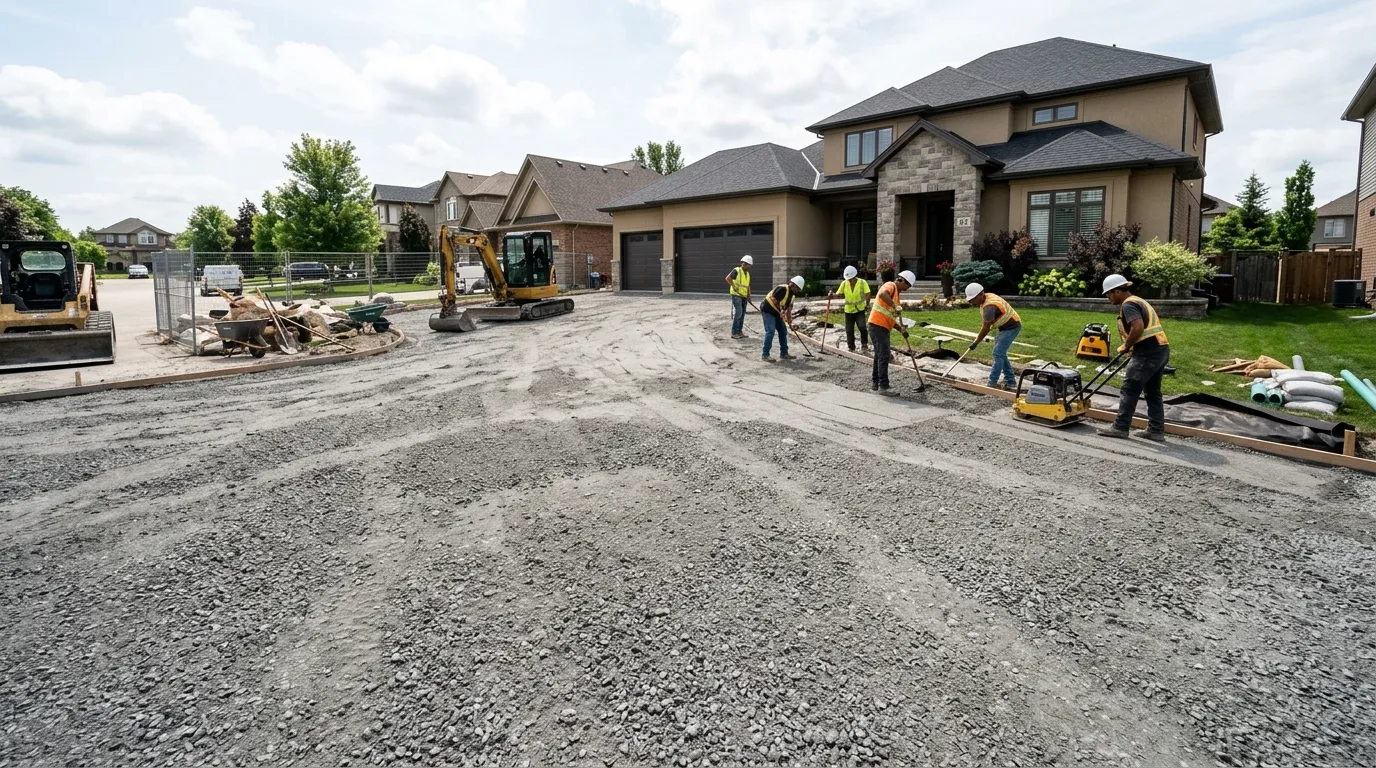
If the material passes inspection, the construction sequence follows standard preparing base for pavers procedures, with a few extra checkpoints specific to recycled concrete.
Excavate to the right depth
CMHA’s base depth guidance recommends 4 inches of compacted aggregate for pedestrian areas and 6 inches for residential driveways. In Sarasota, our sandy subgrade is usually stable enough for those depths on patios and walkways. For driveway work, we typically go 6 to 8 inches based on the soil and expected vehicle weight.
Total excavation includes the base, 1 inch of bedding sand, and the paver thickness (2-3/8 inches for standard pedestrian pavers, 3-1/8 inches for vehicular). A 6-inch base under a standard paver means excavating about 9.5 inches below finished grade.
Prepare the subgrade
Strip all organic material, roots, and loose fill. Compact the exposed soil to at least 98% standard Proctor density per ASTM D698. Sandy Sarasota soil usually cooperates quickly. In areas with imported fill or clay lenses (more common in parts of Bradenton and east Venice), you may need to over-excavate and replace with clean material.
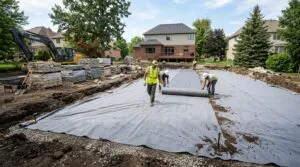
On silty or water-holding soil, lay geotextile fabric before the base. With high-percentage RCA, choose a nonwoven fabric rated for filtration, not just separation, and understand that tufa formation at the fabric interface is a possibility over time.
Place and compact in controlled lifts
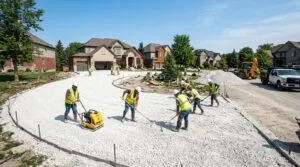
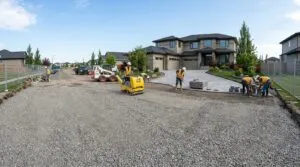
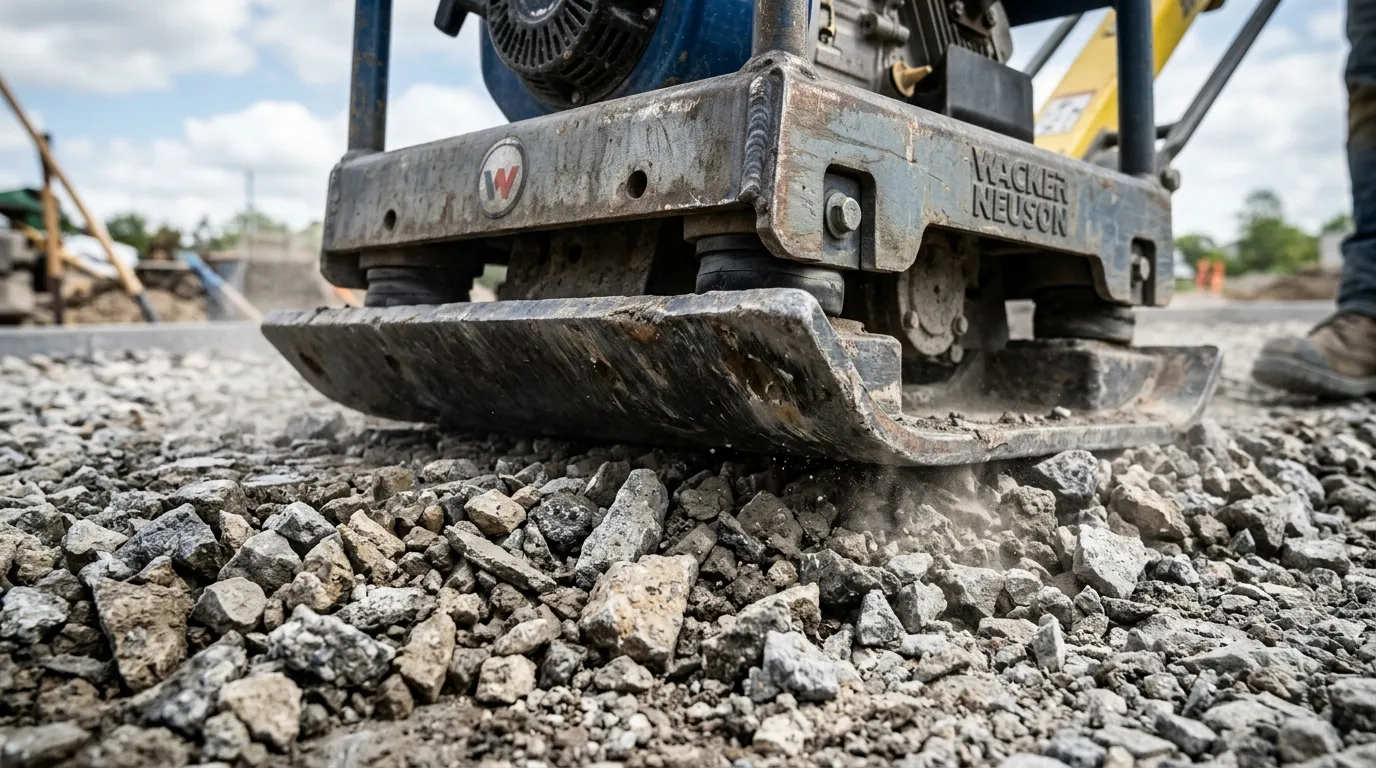
Spread the RCA in 4- to 6-inch loose lifts. Compact each lift with a reversible plate compactor rated at minimum 7,000 pounds of centrifugal force. A small single-direction plate you rent at a hardware store is fine for a stepping-stone path, but it does not deliver enough compactive effort for a structural paver base.
Moisture is critical. RCA absorbs more water than virgin aggregate because the attached mortar is porous. Target moisture content is 8% to 12% for good compaction. In practical terms, the material should feel damp throughout (not dusty, not muddy). In Sarasota’s humidity, freshly delivered RCA often arrives near this range already. If it’s bone dry, mist each lift lightly before compacting.
Screed the bedding layer with the right sand
Use ASTM C33 concrete sand, screeded to 1 inch over the finished base. Set screed rails at the correct elevation, spread the sand, strike it flat. Do not compact the bedding before laying pavers. The pavers settle into the sand during final plate compaction, which is what creates full contact and uniform support.
Lay pavers, restrain edges, fill joints
Install pavers in your chosen laying pattern with consistent 1/16- to 3/16-inch joint spacing. Set edge restraints before final compaction. Fill joints with polymeric sand, mist per the manufacturer’s directions, and make a final compaction pass.
The finished surface needs at least 1.5% slope, directing water away from the house and toward a permeable area or drainage outlet. In Sarasota, where a July thunderstorm drops an inch of rain in 20 minutes, inadequate slope becomes obvious fast.
How to Check RCA Quality Before It Gets Under Your Pavers
Lab testing before every delivery isn’t realistic for a residential project. But a few field checks screen out the worst material before it’s too late.
Look at the pile. Processed RCA should appear as a consistent gray mix with angular particles ranging from coarse to fine. Red brick fragments, tile pieces, rebar, wood, plastic, or drywall in the pile mean the source wasn’t properly sorted. Don’t accept delivery.
Ask for the gradation report. A reputable supplier can provide a sieve analysis showing particle-size distribution. For a dense-graded paver base, you want a well-graded mix from about 3/4 inch down through fines. If the supplier doesn’t have one, their quality control is probably absent too.
Squeeze the fines. Grab a handful from the middle of the pile, not the weathered surface. If the fine material crumbles like chalk dust between your fingers instead of feeling gritty like coarse sand, the mortar fraction is weak. Those fines will degrade further under compaction and water, leading to long-term settlement.
Know the source concrete. RCA from highway and road demolition tends to be higher quality than RCA from mixed commercial or residential building demolition, because road concrete is typically higher strength with fewer contaminants. But as the Oklahoma study proved, highway origin alone is not a quality guarantee. Ask the supplier where the material came from and whether it has been tested.
When to Skip RCA and Use Virgin Aggregate
Crushed concrete base works for many patio and walkway projects. But there are situations where we recommend virgin crushed stone or Florida limerock instead.
Driveways with daily vehicle traffic. If you can’t verify the RCA source and gradation, use virgin aggregate such as a limestone base for pavers or limit RCA to 50% of the base blend. Settlement on a driveway shows up as tire ruts and cracked pavers. The fix costs more than the material savings ever would have.
Projects near acid-loving landscape plants. Azaleas, gardenias, ixora, blueberries, and similar plants common in Sarasota landscapes need acidic soil. Alkaline runoff from an RCA base can raise the surrounding soil pH enough to damage them within a growing season or two.
Permeable paver systems. If your project uses permeable pavers with an open-graded base designed for stormwater infiltration, most manufacturer specs require clean crushed stone. Fines migration and tufa formation in RCA can compromise the drainage the system depends on.
Pool deck surrounds. Pool decks get saturated constantly. Chlorinated splash water interacting with highly alkaline RCA creates chemistry you don’t want adjacent to your pool equipment or coping. We use virgin limerock on pool deck work.
When the local price gap is too narrow. If delivered RCA is only $1 to $2 per ton cheaper than limerock in your part of Sarasota County, the total savings on a residential project might be $50 to $100. That’s not enough to accept any additional uncertainty about the material.
Frequently Asked Questions
Can I use crushed concrete under patio pavers?
Yes. CMHA allows up to 100% RCA for pedestrian applications, provided the material is properly processed, graded, and compacted to specification. Use ASTM C33 concrete sand for the bedding layer, not RCA screenings. Expect slightly more efflorescence risk compared to a virgin aggregate base.
How deep should a crushed concrete paver base be?
Four inches of compacted base for walkways and patios, six inches for residential driveways. These are CMHA starting points. Soil conditions, drainage, and expected load can push the number higher. Total excavation depth also includes 1 inch of bedding sand plus the paver thickness.
Does crushed concrete drain better than virgin stone?
Not automatically. Drainage depends on gradation and fines content, not recycled origin. Dense-graded RCA drains similarly to dense-graded virgin aggregate. For a true draining base, you need an open-graded clean stone system, which most paver manufacturers do not approve for recycled material.
Will crushed concrete cause white stains on my pavers?
It can. RCA is alkaline (often pH 11 to 12 initially), and moisture moving upward through bedding sand can deposit calcium-based efflorescence on the paver surface. Light-colored pavers mask it better. A paver sealer helps manage what reaches the surface but does not eliminate the source.
How much crushed concrete do I need?
Multiply your area in square feet by the base depth in feet, then divide by 27 to get cubic yards. Example: a 400-square-foot patio with a 4-inch base needs 400 × 0.333 ÷ 27 = about 4.9 cubic yards. Ask the supplier for a tonnage conversion using their material’s bulk density, since RCA weighs less per cubic yard than most virgin stone.
Should I put geotextile fabric under a crushed concrete base?
If your subgrade is silty, clayey, or holds water, yes. Use a nonwoven fabric rated for filtration. On clean, well-draining sandy soil (common across most of Sarasota County), fabric is typically unnecessary for a standard dense-graded base. With high-percentage RCA, be aware that tufa deposits can reduce fabric permeability over time.
Getting the base right is the decision that separates a paver project that lasts five years from one that lasts twenty-five. If you’re weighing crushed concrete against virgin aggregate for a project in Sarasota, Venice, Bradenton, Nokomis, or Osprey, a free estimate lets our crew look at your soil, your grade, and your drainage before any material hits the ground. Reach out before the rainy season tests your base.