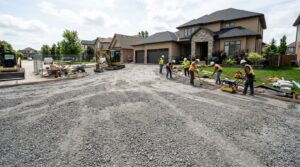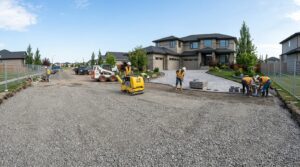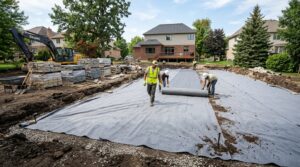
You searched for a limestone base for pavers, and the supply yard will happily sell you one. The problem is that at least four different products qualify as “limestone,” and three of them will fail under your patio within a year. Crusher run, open-graded stone, screenings, stone dust: all crushed from the same quarry rock, all graded for completely different jobs. We’ve torn out installations across Sarasota and Venice where the homeowner ordered “limestone base” and got a product that holds water, shifts under load, and pushes white haze through every paver joint by the second rainy season.
The rock type is not the question. The gradation is. Here’s how to tell the products apart, choose the right one, and install it so it holds up under Florida’s rain.
Jump to:
What “Limestone Base” Actually Means at the Supply Yard
Limestone is calcium carbonate. That tells you the geology. It tells you nothing about particle size distribution, which is what determines whether crushed rock compacts into a stable foundation, drains water freely, or turns to mud when saturated.
Four products share the limestone label at most Florida supply yards:
| Product | Typical size range | What it does | Where it belongs |
|---|---|---|---|
| Dense-graded crusher run | 1.5″ down to dust (fines included) | Interlocks under compaction to form a rigid structural layer | Paver base, 4-6″+ compacted |
| Open-graded stone (No. 57) | 3/4″ to 1″, minimal fines | Angular particles interlock with drainage channels between them | Designed open-graded or permeable assemblies |
| Screenings | 3/8″ minus | Fine fill, levels quickly | Between flagstone joints, surface dressing |
| Stone dust | Powder to 1/4″ | Very fine crushing byproduct | Flagstone leveling (limited use) |
Crusher run and open-graded stone can serve as a paver base. Screenings and stone dust cannot, no matter what the label or the salesperson says. CMHA’s base-and-depth guidance is direct: use approved road-base aggregate, avoid screenings, rounded aggregate, and excessive fines.
Regional names make this worse. “Item 4,” “CR-6,” “3/4-minus,” and “paver base blend” all describe slightly different gradations depending on the quarry. If a supplier can’t tell you the maximum particle size, the percentage of fines, and whether the product conforms to ASTM D2940, you’re guessing.
Why Screenings Fail Under Pavers
This gets its own section because it’s the most common repair we do on patios installed by someone else.
Limestone screenings compact easily. Raked flat, tamped by hand, they feel solid underfoot. A homeowner looks at that surface and thinks the hard part is done. It isn’t.
Here’s what happens over the next six to twelve months in Sarasota’s climate. Afternoon storms dump an inch of rain in twenty minutes. Screenings hold that moisture because the particles are too fine and too uniform to drain laterally. Under the weight of foot traffic or patio furniture, saturated fines shift. They migrate upward through paver joints as a gritty slurry. The surface you thought was stable becomes a network of low spots, rocking pavers, and polymeric sand that won’t hold.
CMHA documents a bus-pavement failure that illustrates the mechanism at scale: heavy rain saturated fine-rich bedding within hours of construction, the material liquefied, and it pumped through surface joints. The pavement rutted immediately. Reconstruction with properly graded bedding (0% passing the No. 200 sieve) solved the problem permanently. The failure wasn’t the pavers or the traffic. It was the fines.
The residential version of that story plays out slower, but the physics are identical. We’ve pulled up screenings layers in Osprey and Nokomis that felt like wet clay two inches beneath perfectly good concrete pavers. The fix: remove the contaminated material, install proper crushed rock base at correct depth, re-lay bedding sand, and reset the pavers. It costs roughly double what the right base would have cost from the start.
Dense-Graded vs. Open-Graded: Two Assemblies, Different Rules
If screenings and dust are off the table, you’re choosing between two legitimate limestone base approaches. Each one works. Neither one is universally better.
Dense-graded crusher run
This is the standard. The mix of angular stone and fines (typically 5-12% passing the No. 200 sieve) locks together under mechanical compaction to form a rigid, load-bearing layer. Water sheds off the surface, not through it. You install conventional concrete-sand bedding on top, then pavers, then polymeric sand in the joints.
We use dense-graded crusher run for most driveways, patios, pool decks, and walkways in the Sarasota area. It’s reliable, widely available, and forgiving during installation as long as you compact in proper lifts.
The requirement: your finished paver surface must slope to shed water. Minimum 1/4 inch per foot (2% grade) away from the house. The base follows that slope. If the base is level and only the bedding creates the pitch, water pools at the base’s low point and stays there.
Open-graded stone (No. 57 base, No. 8 bedding)
Angular particles with connected void spaces between them. Water passes through instead of shedding off. This approach eliminates the trapped-moisture problem that dense-graded bases can develop in poorly drained areas.
The catch: CMHA’s October 2025 guidance limits standard pavers on open-graded aggregate to residential pedestrian projects. Not driveways. Not commercial parking lots. The guidance also calls for geotextile along the excavation bottom and sides, and recommends underdrains where your soil doesn’t infiltrate well.
Open-graded stone still needs compaction. CMHA warns explicitly against assuming it won’t settle. And because the bedding is No. 8 stone chips rather than sand, joint sand can migrate downward into the aggregate if the wrong material or joint-fill method is used.
For actual permeable interlocking concrete pavement (PICP), the assembly is more involved. FHWA describes the typical PICP cross-section: permeable aggregate in the joints, a 2-inch No. 8 bedding course, a 4-inch No. 57 base, and a larger subbase stone sized for stormwater storage. The design drainage period is 48 to 72 hours. That’s an engineered system with specific infiltration and storage calculations, not a standard paver job with wider joints.
How Deep the Limestone Base Needs to Be
All depths below are compacted thickness, not loose. Crusher run compacts roughly 20-25% depending on moisture and gradation. Six inches compacted means spreading closer to eight inches loose before you run the plate compactor.
| Application | Minimum compacted base | Conditions |
|---|---|---|
| Patios, walkways, pool decks | 4 inches | Well-drained soil |
| Residential driveways | 6 inches | Well-drained soil |
| Parking areas | 8 inches | General guidance |
Those are CMHA’s starting points for conventional construction. They assume favorable subgrade conditions. Weak soil, high water, or heavier expected loads push the number up.
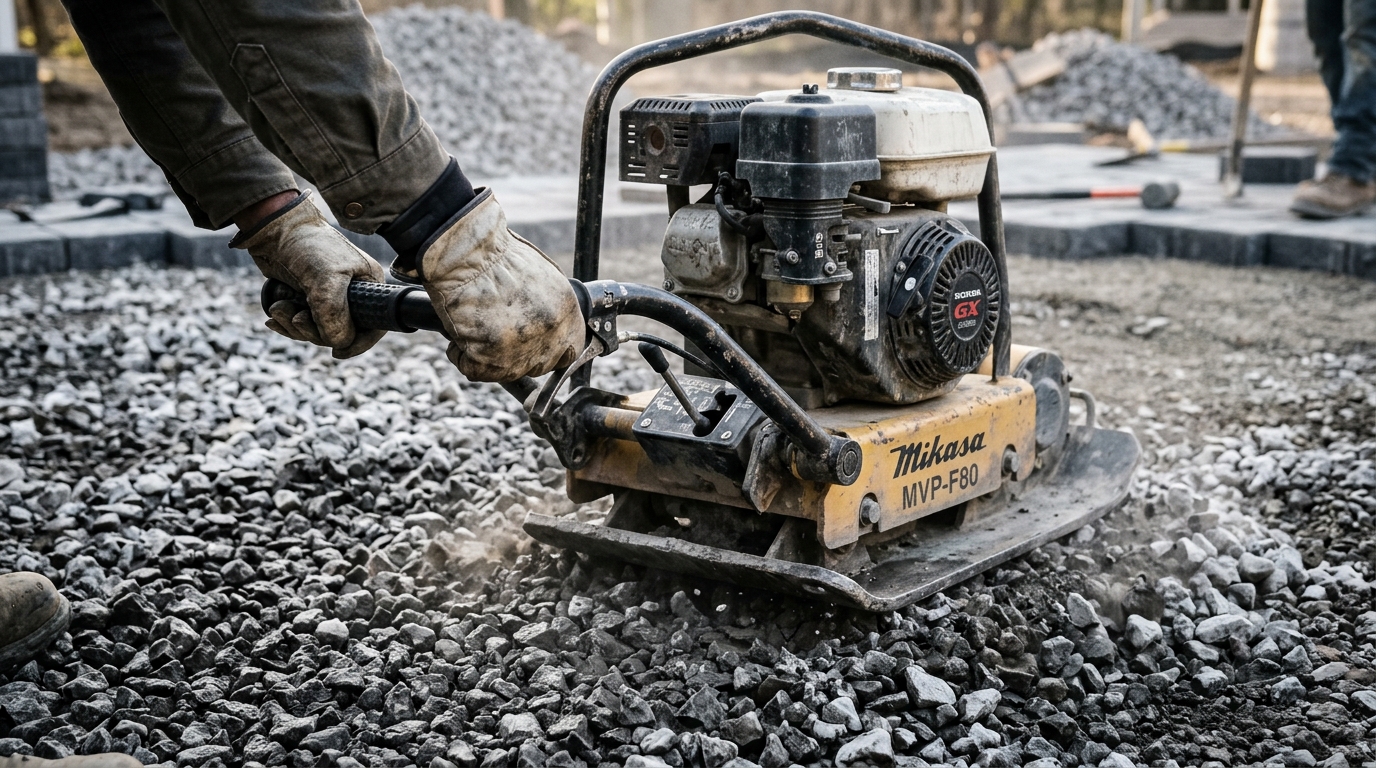
Compaction target: 98% standard Proctor density for pedestrian and residential-driveway bases. That percentage is meaningless without the test it references, and it’s unachievable with a hand tamper. You need a plate compactor. We compact in lifts of no more than 4 inches of loose material at a time, dampened lightly, running the plate compactor across each lift until the surface stops visibly moving under the machine’s weight.
Skip the compaction, and the base will compact itself under traffic and rain over the next year. Unevenly. That’s how you get pavers that rock, joints that open, and pooling water where there used to be a flat surface.
What Sarasota’s Rain and Sand Do to a Limestone Base
Most limestone-base advice online comes from northern installers dealing with freeze-thaw cycles. We don’t have that problem. What we do have, every year, without exception:
Fifty-plus inches of annual rainfall, most of it between June and October, often arriving as 1-2 inch downpours in under an hour. A base that drains slowly doesn’t drain at all during a Florida summer storm. It just fills.
A water table that rises during wet season. In low-lying areas of Sarasota, Nokomis, and Venice, saturated ground can reach within inches of your base elevation by August. An open-graded limestone base in that condition becomes an underground reservoir with no outlet. Dense-graded base with proper surface slope and perimeter drainage handles it better.
Sandy subgrade that drains vertically but offers little lateral support. Sarasota’s sugar sand lets water through fast, which is good. But loose sand under a compacted limestone base is unstable. We compact the exposed subgrade to 95% standard Proctor before the first inch of base material goes down. That step alone prevents most of the settling we see on DIY paver jobs in this area.
The efflorescence connection nobody mentions
Limestone is calcium carbonate. Rainwater is slightly acidic. When water moves through limestone fines in your base or bedding, it dissolves a small amount of calcium, carries it upward through the paver joints by capillary action, and deposits it on the surface as a white mineral haze. That’s efflorescence.
It’s cosmetic, not structural. It fades with weathering and cleaning. A quality paver sealer applied after installation significantly reduces it by limiting moisture movement through the joint face. But if you’re installing dark charcoal or espresso-colored pavers, the white haze shows more and lasts longer. Worth knowing before you blame the paver manufacturer for something your base material caused.
Calculating Your Limestone Order
The formula for base volume:
Area (sq ft) × compacted depth (inches) ÷ 324 = cubic yards of compacted base
Then add 20-25% for compaction to get your loose ordering quantity.
Example: a 400-square-foot patio with a 6-inch compacted base.
- 400 × 6 ÷ 324 = 7.41 cubic yards (compacted)
- 7.41 × 1.25 = 9.26 cubic yards (loose, to account for compaction)
- At roughly 2,700 lbs per cubic yard for crusher run, that’s about 12.5 tons
For a price reference outside Florida, Finger Lakes Stone in New York lists crusher run at $31 per ton with a 3-ton delivery minimum. Your Sarasota supplier will price differently based on quarry distance and local demand, but the volume math stays the same.
That calculation covers only the structural base. Your complete material list also includes:
- Concrete sand for bedding (1 inch after compaction, roughly 1.25 cu yd for 400 sq ft)
- Polymeric sand for paver joints
- Edge restraint (plastic or aluminum, spiked into the base)
- Geotextile fabric if your subgrade is silty or organic
- The pavers, calculated by area plus 5-10% for cuts depending on your laying pattern
When Limestone Isn’t the Right Call
Limestone works for most residential paver bases in our area. But not every situation.
Heavy-traffic permeable pavement. Minnesota’s stormwater design criteria require vehicular reservoir aggregate to pass specific durability tests: maximum 35% Los Angeles abrasion loss and 10% magnesium-sulfate soundness loss. Some limestone sources fail those thresholds. For commercial parking lots or roadways designed for stormwater credit, tested granite, trap rock, or crushed concrete base may be specified instead.
Sites with no drainage outlet and high water table. An open-graded limestone base stores water. If the surrounding soil won’t infiltrate it and there’s no underdrain leading somewhere, stored water has nowhere to go. EPA identifies clogging as the leading maintenance concern for permeable pavements and warns against practices that introduce sediment into the reservoir. Dense-graded base with surface drainage is simpler and more reliable in these conditions.
Access-constrained pedestrian projects. When a narrow side yard or tight backyard makes it impractical to deliver and spread tons of aggregate, manufactured base panels exist for pedestrian-only applications. They don’t replace a proper crushed rock base on a driveway or any surface that sees vehicle weight, but on a small stepping-stone path or garden walkway, they can reduce excavation where traditional methods aren’t feasible.
Frequently Asked Questions
Is crushed limestone a good base for pavers?
Yes, when it’s the right gradation. Dense-graded crusher run (1.5″ down to fines, conforming to ASTM D2940) compacts into a stable structural layer for conventional paver installations. Open-graded No. 57 stone works for designed pedestrian assemblies. Screenings and stone dust do not belong under pavers, regardless of how they’re labeled at the supply yard.
How thick should a limestone base be under a patio?
CMHA recommends a minimum of 4 inches compacted over well-drained soil for patios and walkways. In Sarasota’s sandy subgrade, we typically install 4 to 6 inches compacted, depending on the looseness of the underlying sand. Residential driveways start at 6 inches compacted minimum.
Can I use limestone screenings instead of bedding sand?
No. CMHA explicitly excludes limestone screenings and stone dust from bedding specifications. Screenings hold moisture, shift under load, and migrate upward through paver joints when saturated. Use ASTM C33 concrete sand for conventional bedding, or No. 8 stone chips for open-graded assemblies.
Does a limestone base cause efflorescence?
It can contribute. Calcium carbonate in limestone fines dissolves slightly in rainwater and wicks upward through joints, depositing white mineral haze on the paver surface. The effect is cosmetic, not structural. A quality paver sealer reduces it, and regular cleaning removes existing deposits. Dark-colored pavers show it more visibly.
How do I calculate how many tons of crusher run I need?
Multiply your area in square feet by the compacted depth in inches, then divide by 324 to get cubic yards. Add 20-25% for compaction. Crusher run weighs roughly 2,700 lbs per cubic yard. For a 400-square-foot patio at 6 inches compacted: 400 × 6 ÷ 324 = 7.41 cubic yards compacted, times 1.25 = about 9.3 cubic yards loose, or approximately 12.5 tons.
Do permeable pavers need a different limestone base?
Yes. Permeable interlocking concrete pavement (PICP) uses open-graded aggregate with engineered void ratios for water storage. A typical assembly includes No. 8 bedding, No. 57 base, and larger subbase stone, all sized for the site’s stormwater storage and infiltration requirements. The drainage period is typically 48 to 72 hours. This is a designed system, not a conventional paver job with wider gaps.
If you’re planning a paver project in Sarasota, Venice, Bradenton, Nokomis, or Osprey and you’re not sure what your subgrade actually looks like, a site visit tells you more than any supply-yard advice. We can check your soil, drainage, and grade in person and give you the base specification that fits. Reach out for a free estimate before rainy season tests whatever’s under your pavers right now.