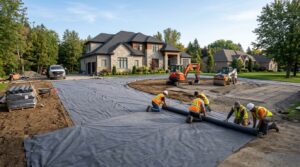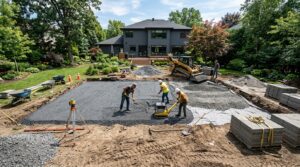
You are standing in the paver aisle, cart loaded with base material, and you spot rolls of black landscape fabric on the endcap. The label says “weed barrier.” Seems like cheap insurance. But after more than twenty years installing driveways, patios, and pool decks across Sarasota, Venice, and Bradenton, we can tell you: landscape fabric under pavers is one of the most misunderstood products in hardscaping. It solves a problem most Florida homeowners do not have, and it can create problems they never expected.
That does not mean fabric is always wrong. It means the answer depends on your soil, your drainage, and the paver system being installed. Here is what we have learned on the job.
Jump to:
What Landscape Fabric Actually Does (and What It Does Not)
Most homeowners think landscape fabric prevents weeds. It does not. Not under pavers, anyway.
The weeds you see growing between paver joints come from seeds blown onto the surface by wind, tracked in by foot traffic, or dropped by birds. Those seeds germinate in the joint sand above the pavers. A sheet of fabric buried six or eight inches below has no influence on them. Unilock’s maintenance guidance confirms this: keeping paver joints properly filled is the real preventive measure, not a buried barrier.
What fabric can do is separate layers. In engineering terms, CMHA identifies four geotextile functions: separation, reinforcement, filtration, and drainage. The one that matters for paver bases is separation. It keeps fine soil particles from migrating up into your crushed rock base, which would weaken it over time. That is a legitimate structural concern, but only when your subgrade soil creates the problem.
Where Fabric Belongs in a Paver Cross Section
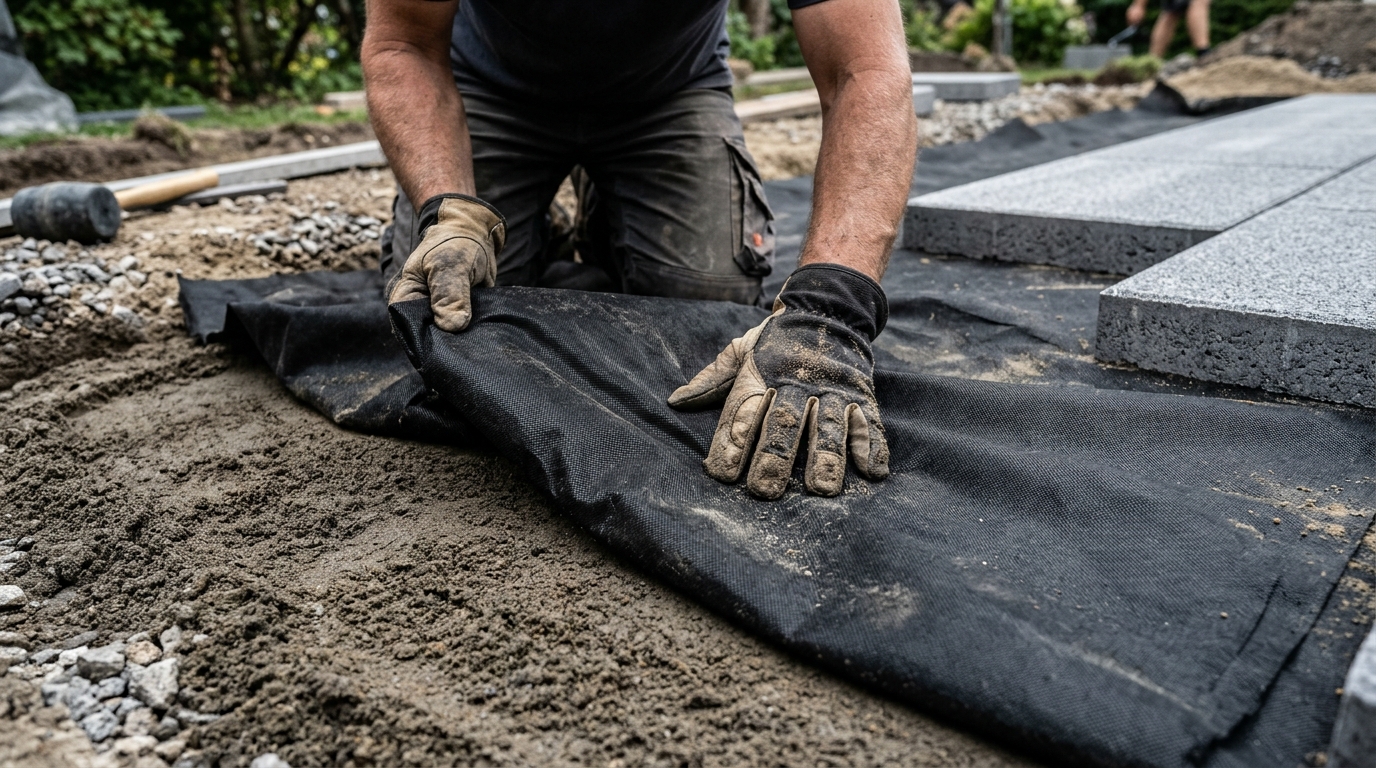
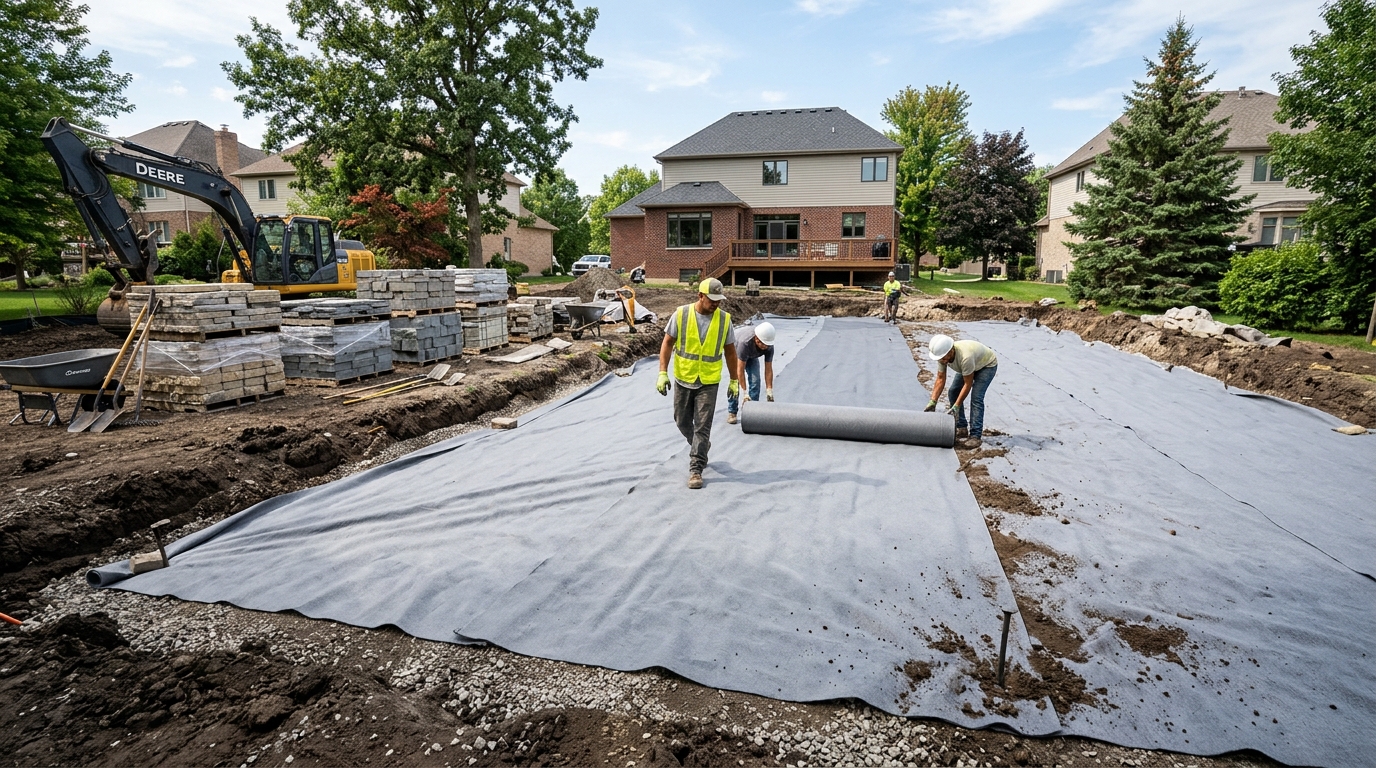
If fabric is specified, it does not go directly under the pavers. It goes at the bottom of the excavation, between the native soil and the compacted aggregate base.
A standard sand-set paver installation stacks up like this from bottom to top:
- Prepared and compacted native soil (subgrade)
- Geotextile fabric, if site conditions require it
- Compacted crushed rock base (minimum 4 inches for patios, 6 inches for residential driveways)
- 1-inch bedding sand layer
- Pavers with polymeric sand in the joints
Belgard’s installation guide places nonwoven filtration fabric across the bottom of the aggregate base and turns it up the sides. Notice: the fabric wraps the gravel, not the pavers. Bedding sand should never exceed 1.5 inches regardless of whether fabric is present. Fabric is not a substitute for proper base depth or compaction.
We see homeowners lay fabric on top of the sand, directly under the paving units. That creates a slip plane. Pavers shift. Joints open. Water pools on the fabric instead of draining through. If you are going to use fabric at all, it belongs at the bottom of the system, not the top.
Why Sarasota Soil Rarely Needs Landscape Fabric
Here is where Florida changes the conversation.
Most of the guidance recommending fabric comes from northern states where clay soils and freeze-thaw cycles are real threats. CMHA specifically identifies saturated conditions, clay, moist silty subgrades, and freeze-thaw exposure as circumstances where geotextile may be appropriate. Sarasota has none of those conditions in a typical residential yard.
Our native soil is predominantly fine sand. It drains fast. It does not heave when temperatures drop because our temperatures do not drop below freezing in any meaningful way. Sandy subgrade compacts well with a plate compactor and does not pump fines into aggregate the way wet clay does. That is why, on the majority of our patio and driveway installations across Sarasota and Venice, we skip the fabric entirely. The base performs better without it.
There are exceptions. If we excavate and hit a pocket of organic muck near a drainage swale, or if a property sits on reclaimed fill with mixed soil types, we will specify a nonwoven geotextile for that section. But those are site-specific decisions. We make them with a shovel in the ground, not from a roll in the store.
When Fabric Causes More Problems Than It Solves
In our climate, adding fabric where it is not needed introduces two risks.
Drainage restriction. Sarasota gets over 50 inches of rain a year, with most of it concentrated in afternoon storms from June through September. Water needs to move through the paver system quickly: down through the joints, through the bedding sand, through the base, and into the subgrade. A woven slit-film landscape fabric (the type sold in most garden centers) restricts that flow significantly. CMHA notes that woven slit-film materials have relatively restricted water movement compared to needle-punched nonwovens. The cheap roll in the garden aisle is almost always a woven product. Under a patio in July, that means water sits longer than it should, saturating bedding sand and softening the base.
False security that replaces real preparation. We have torn out patios where the previous installer laid fabric directly on uncompacted fill, spread a thin layer of gravel on top, and set pavers. The homeowner was told the fabric would “hold everything together.” Within two years, the patio had settled unevenly. Fabric cannot compensate for skipping compaction. CMHA specifies at least 98% of standard Proctor density for pedestrian and residential driveway bases. That number comes from a plate compactor and proper lifts of aggregate, not from a textile.
What Actually Prevents Weeds in Paver Joints
Since the weeds come from above, the solution lives above too.
Polymeric sand is the first line of defense. It hardens in the joints after activation, making it difficult for windblown seeds to find a foothold. But it is not permanent. Rain, foot traffic, and pressure washing break it down over time. CMHA warns against simply topping up existing joints with new polymeric sand; the old material needs to be removed and the joint cleaned before reapplication.
A quality paver sealer also helps lock joint sand in place and makes it harder for organic matter to accumulate in the surface texture where seeds sprout. We typically recommend resealing every two to three years in Sarasota, depending on sun exposure and traffic.
Regular paver cleaning removes organic debris before it decomposes into a thin soil layer on the surface. That decomposed layer is what seeds actually root into. A leaf blower every week and a proper cleaning once a year do more for weed prevention than any buried fabric ever will.
Geotextile vs. Landscape Fabric: They Are Not the Same Product
This is where most of the internet confusion starts. People use “landscape fabric” and “geotextile” interchangeably. They are different materials built for different jobs.
| Material | Construction | Primary Function | Typical Use Under Pavers |
|---|---|---|---|
| Landscape fabric (woven slit-film) | Flat polypropylene tapes woven together | Weed suppression in garden beds | Poor choice: restricts drainage, insufficient puncture resistance for aggregate compaction |
| Nonwoven geotextile | Needle-punched polypropylene fibers | Separation and filtration while allowing water flow | Appropriate when site conditions require separation of subgrade from base |
| Woven geotextile (monofilament or high-strength) | Engineered woven fabric with published specs | Stabilization and separation under load | Specified for heavy-duty applications like commercial driveways |
If a project does call for fabric, we use a needle-punched nonwoven geotextile with published hydraulic properties, not a garden-center weed barrier. The relevant specifications include grab strength (ASTM D4632), puncture resistance (ASTM D6241), permittivity (ASTM D4491), and apparent opening size (ASTM D4751). Weight alone tells you almost nothing useful. A 4.0 oz/sq yd nonwoven and a 4.4 oz/sq yd nonwoven can have very different flow rates and filtration characteristics.
Permeable Pavers Are a Different Conversation
Permeable paver systems are engineered specifically to manage stormwater. They use open-graded aggregate (no fines) in both the base and the bedding layer, and the joints are filled with small stone chips instead of sand. The entire assembly is designed to capture rain and either infiltrate it into the ground or route it to a drain.
In these systems, geotextile serves a specific role: it lines the sides of the excavation to prevent surrounding soil from migrating into the clean stone reservoir. Minnesota’s stormwater manual describes the horizontal bottom fabric as optional, while recommending side separation. The distinction matters because wrapping the bottom of a permeable system in fabric can defeat the infiltration the system was designed to provide.
We install permeable pavers in Sarasota for homeowners managing lot drainage or meeting stormwater requirements. Those projects get a proper engineering cross section. They are not a standard patio with fabric added.
What Matters More Than Fabric
After twenty-plus years of paver installation in this climate, here is what we have seen determine whether a hardscape lasts or fails:
Base depth and material. We use a minimum of 6 inches of compacted crushed rock (limerock or recycled concrete) for driveways and 4 inches for pedestrian applications. On softer subgrade, we go deeper. Proper base preparation is the foundation. Everything rides on it.
Compaction in lifts. We compact in 2-inch lifts with a plate compactor, checking for firmness at each layer. A thick loose pour compacted once at the top leaves voids underneath that settle later.
Drainage slope. Every paver surface we install has at least a 1% slope away from the structure (a quarter inch per foot, minimum). In areas with heavier runoff, we go to 2%. Puddling water is the fastest way to undermine bedding sand and grow algae.
Edge restraint. Without a solid edge, pavers creep outward. We spike concrete or aluminum edging to hold the perimeter. A missing or loose edge restraint is one of the most common problems we see when evaluating existing work, and it has nothing to do with fabric.
Joint sand maintenance. Polymeric sand locks pavers in place, resists erosion, and discourages weeds and insects. But it requires correct installation (clean, dry joints filled to the right depth) and periodic replenishment. A well-maintained joint does what homeowners wish fabric would do.
These five factors determine 95% of long-term performance. Fabric is, at most, a supporting detail for unusual soil conditions.
A Practical Decision Guide for Sarasota Homeowners
Before you buy a roll, answer these questions:
| Condition | Fabric Recommendation | Why |
|---|---|---|
| Sandy, well-drained subgrade (most of Sarasota) | Skip it | Sand does not pump fines into base aggregate. Fabric adds unnecessary cost and a potential drainage restriction. |
| Clay pocket or mixed fill discovered during excavation | Use nonwoven geotextile at the subgrade | Prevents clay migration into crushed rock. Choose a product with published permittivity and puncture specs. |
| High water table or seasonally wet area | Use nonwoven geotextile and address drainage first | Fabric alone will not solve water problems. The site may need a French drain, adjusted grading, or a permeable system. |
| Permeable paver installation | Geotextile on sides of excavation; bottom per engineer’s design | Prevents soil intrusion into the stone reservoir while maintaining downward infiltration. |
| Driveway with heavy vehicle loads | Engineer evaluates; may specify woven geotextile for stabilization | Heavier loading demands a thicker base and may benefit from reinforcement, which differs from simple separation. |
If you are unsure about your soil conditions, that is exactly what a site visit is for. We can dig a test hole in ten minutes and show you what your subgrade actually looks like. A free estimate tells you exactly what your project needs, including whether fabric belongs in the plan or not.
The Environmental Angle Worth Knowing
One topic the paver industry has not widely addressed: what happens to polypropylene fabric in the ground over decades? A scientific review published in November 2025 discusses degradation pathways and microplastic concerns involving polypropylene geotextiles in soil systems. The review identifies gaps in knowledge about how these materials break down and what particles migrate through soil.
This does not mean fabric is toxic under your patio. Burial in soil reduces UV exposure (the primary degradation accelerator), and residential pavers exert far less mechanical stress than highway applications. But it is a reason to use fabric only where its engineering function justifies the material, rather than laying it everywhere “just in case.” If the subgrade does not need separation, you are burying plastic for no structural benefit.
Perguntas frequentes
Should I put landscape fabric directly under my pavers?
No. If fabric is needed, it belongs between the native soil and the compacted crushed rock base, not between the bedding sand and the pavers. Placing it directly under paving units creates a slip plane, traps water against the bedding layer, and does not prevent weeds growing in the joints above.
Does landscape fabric under pavers stop weeds?
Not the weeds you actually see. Joint weeds grow from windblown seeds landing on the paver surface and germinating in the joint sand. A fabric buried under several inches of base material has no effect on that. Properly filled joints, polymeric sand, sealer, and regular cleaning are what control surface weeds.
What is the difference between landscape fabric and geotextile?
Landscape fabric is typically a lightweight woven slit-film product designed for garden-bed weed suppression. Geotextile is an engineered fabric with published strength, filtration, and hydraulic specifications designed for soil separation and drainage. Under pavers, only a geotextile with appropriate specs should be used when conditions require it.
Do I need fabric under pavers in Florida sand?
In most cases, no. Florida’s sandy subgrade drains well and does not migrate into aggregate the way clay does. We skip fabric on the vast majority of our Sarasota-area installations. Exceptions include pockets of organic muck, mixed fill, or sites with unusually high water tables.
How much overlap should geotextile have under a paver base?
CMHA recommends at least 12 inches of overlap on the downslope side for conventional installations. On very weak subgrades, overlaps increase or seams may need to be sewn. Panel-based systems like Brock PaverBase specify a different overlap (4 to 6 inches) because they follow a distinct installation method. Always match the overlap to the specific system.
Can fabric fix a sinking paver patio?
No. Sinking pavers indicate a base failure: insufficient compaction, inadequate base depth, or poor drainage. Fabric cannot add structural support after the fact. The fix is lifting the pavers, correcting the base, and reinstalling. Our crew can walk your patio and point out what a photo cannot show.