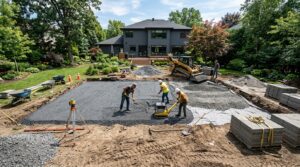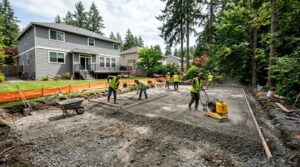
Every fabric supplier will tell you geotextile is essential under pavers. After more than twenty years installing driveways, patios, and pool decks across Sarasota, we can tell you the real answer: it depends on your soil. Geotextile fabric for pavers solves a specific problem at the soil-aggregate boundary, and whether that problem exists on your property determines whether the fabric earns its place in the base assembly.
Get this decision wrong in either direction and you pay for it. Skip fabric over saturated clay and your pavers settle within three rainy seasons. Add it to a clean sandy subgrade where nothing would have migrated anyway and you’ve spent money that changed nothing. This guide walks through what the fabric actually does, which type fits which project, and how we decide on every site we evaluate in the Sarasota area.
Jump to:
What Geotextile Actually Does Under a Paver Base
A geotextile is a permeable synthetic textile placed between soil layers. Under pavers, it can perform up to four distinct functions: separation, filtration, drainage, and reinforcement. Most residential paver projects only need one or two of those, and the product you choose should match the function you’re after.
Separation is the most common reason we install it. Over time, fine subgrade particles migrate upward into your crushed rock base, especially when water moves through the system. As fines contaminate the aggregate, the base loses its load-bearing capacity. Pavers settle unevenly. A geotextile at the soil-aggregate interface keeps those layers distinct so compacted limerock stays clean and structural.
Filtration lets water pass through while retaining fine soil particles. This matters where your water table rises seasonally, something we deal with in low-lying areas near Sarasota Bay and the intercoastal waterway.
Reinforcement and lateral drainage require different products entirely. A standard separation fabric won’t reinforce weak soil the way a geogrid does, and it won’t channel water sideways the way a drainage composite will. These are separate product categories, not interchangeable labels.
One thing geotextile is not: a weed barrier. Weeds in paver joints almost always grow from seeds blown onto the surface, not from roots pushing up through six inches of compacted base. If someone tells you fabric keeps your patio weed-free, they’re solving a problem that starts at the top, not the bottom. Proper paver cleaning and joint sand maintenance do more for weed control than anything buried under your base.
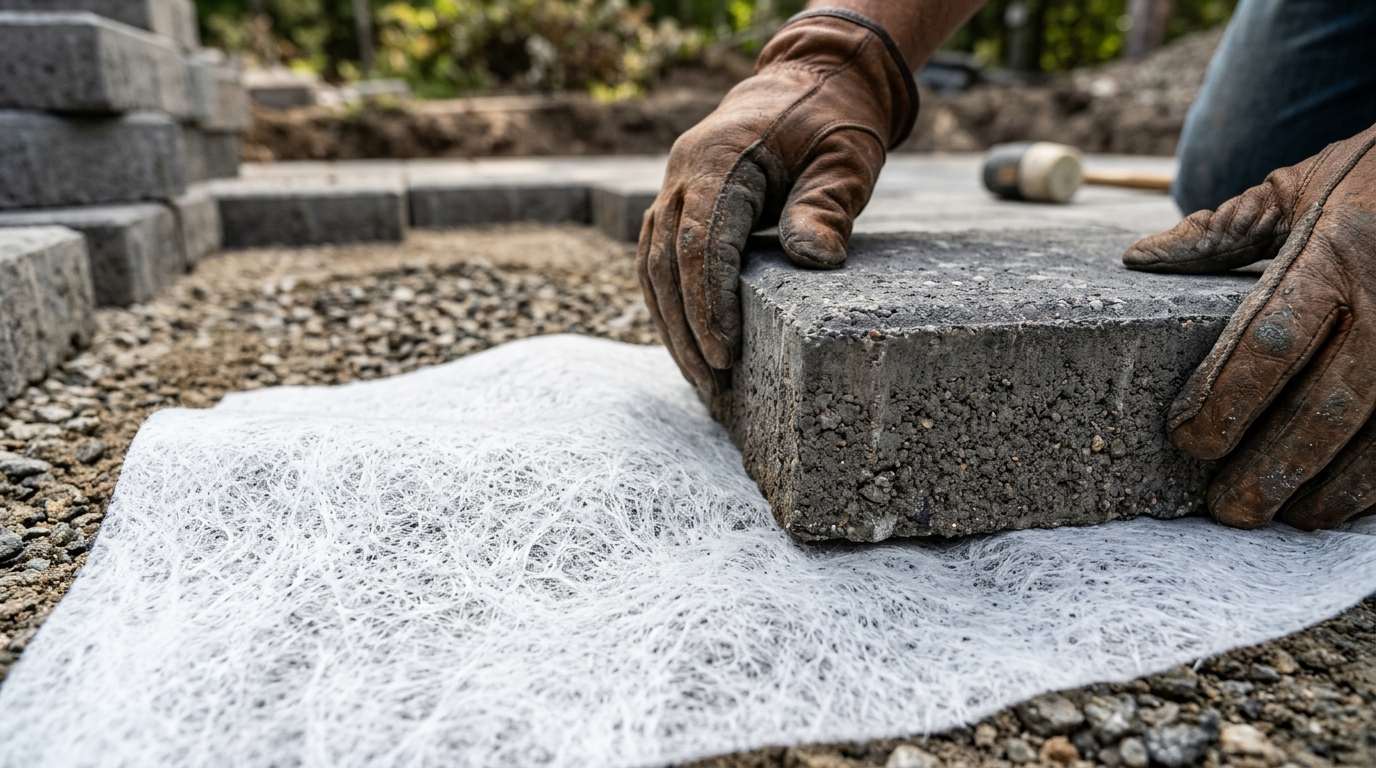
Woven vs Nonwoven: Picking the Right Type
These are two fundamentally different products. Choosing between them based on price or availability is like choosing between concrete pavers and travertine based solely on color: you’ll miss what actually matters.
Woven geotextile is made from interlaced polypropylene strips. It handles tensile loads well, making it effective for stabilization over soft or marginal soils. The trade-off: many woven products have relatively low cross-plane water flow.
Nonwoven geotextile is needle-punched from random fibers. It moves water through its cross-section more freely, making it the better filter. The trade-off: lower tensile strength in many formulations.
Here is what those differences look like in published specifications:
| Property | Woven example (MIRAFI 500X) | Nonwoven example (Gator GF4.4) |
|---|---|---|
| Construction | Interlaced polypropylene | Needle-punched polypropylene |
| Grab tensile strength (ASTM D4632) | 200 lb | 120 lbf |
| Permittivity (ASTM D4491) | 0.05 sec⁻¹ | 1.5 sec⁻¹ |
| Primary role | Separation, stabilization | Filtration, separation |
| Typical paver application | Driveways on marginal soil, high-load areas | Patios, walkways, standard residential separation |
Look at the permittivity line. The nonwoven product moves water through its thickness thirty times faster. Now look at tensile strength: the woven product is nearly twice as strong. Neither number makes one product “better.” They make each product right for a different job.
For most residential paver patios and walkways on reasonably stable soil, a nonwoven separation fabric in the 4 to 6 oz range handles the job. For driveways over saturated or clay-heavy subgrade, or commercial areas expecting heavy loads, a woven product or even a geogrid may be the better call.
When Fabric Belongs in Your Base (and When It Does Not)
The Concrete and Masonry Association of Canada and the U.S. (CMHA), which publishes the most widely referenced interlocking pavement tech notes, identifies specific soil conditions where geotextile is useful: clay, moist silt, seasonal saturation, and freeze-thaw exposure. Outside those conditions, fabric is discretionary.
In Sarasota, freeze-thaw is irrelevant. That eliminates one of the four triggers entirely. Our native soil is mostly Myakka fine sand, Florida’s official state soil, and it drains well. Sand particles are too coarse to pump into properly compacted limerock the way clay does. On a typical residential lot in Sarasota, Venice, or Osprey with clean sandy subgrade, we compact the soil, verify stability, and build the base directly on it.
Where we install fabric on our projects:
- Near the bay or intercoastal waterway, where fill soil often contains clay, silt, or organic material mixed in by prior grading
- Yards that hold visible standing water after an afternoon rain, signaling poor drainage or a high water table
- Sites where excavation exposes dark, organic muck below the topsoil layer
- Retaining wall projects where backfill needs a drainage interface to prevent hydrostatic pressure
- Any area where imported fill of unknown composition sits beneath the topsoil
Where we typically skip it:
- Clean, well-drained sandy subgrade (the majority of residential lots in our service area)
- Pool decks on compacted fill that’s already been graded and stabilized during the pool construction
- Walkway and stepping stone projects with minimal load and a solid 4-inch compacted base
The principle is simple: fabric solves a soil-interface problem. If that problem doesn’t exist on your property, the budget is better spent on tighter compaction or an extra inch of base depth, both of which directly improve long-term performance in Florida’s rainy season.
Where Fabric Goes in the Base Assembly
When fabric is warranted, placement matters more than the product brand. Here is the correct layering for a conventional sand-set paver installation, following the principles outlined in our guide on preparing base for pavers:
- Excavated and graded subgrade, compacted and sloped at a minimum 1% away from structures for drainage
- Geotextile (if soil conditions require it)
- Compacted crushed rock base: minimum 4 inches compacted for pedestrian areas, 6 inches for residential driveways
- 1-inch screeded bedding sand (uncompacted nominal depth)
- Pavers in your chosen laying pattern
- Polymeric sand swept into joints
- Edge restraint secured with spikes
The fabric sits between native soil and aggregate. Not between aggregate and bedding sand. Not on top of the base. At the soil-aggregate interface, where particle migration would otherwise contaminate your structural layer.
Three installation details that most online guides skip:
Overlap. CMHA specifies at least 12 inches of overlap on downslope seams. On our jobs we hold that 12-inch minimum on every seam, and bump it to 18 inches if the soil is visibly wet during installation. A 6-inch overlap (which we see on DIY projects regularly) separates under compaction loads and defeats the purpose of the fabric.
Sidewalls. Turn the fabric up the excavation walls. If you cut it flush at the bottom, soil migrates laterally from the side of your dig into the base. We run it up to within about 2 inches of finished paver grade and tuck it behind the edge restraint.
Wrinkles. A wrinkled fabric creates voids in the base. Voids collect water. Water under hydrostatic pressure pushes fines through any gap it finds. Pull the fabric taut before placing aggregate, and backfill from the center outward so the material stays flat under load.
Permeable Pavers Follow Different Rules
If you’re considering permeable interlocking concrete pavement (PICP) for a driveway or patio, the conventional fabric logic above doesn’t apply directly. Permeable systems use open-graded aggregate storage layers, not dense-graded crushed rock. They use washed stone chip in the joints, not polymeric sand. The entire assembly is designed to capture, store, and infiltrate stormwater.
Minnesota’s stormwater manual recommends geotextile against vertical soil faces where the excavation walls expose native earth without concrete curbs or liners. But horizontal bottom fabric, the layer between the aggregate reservoir and native soil, is left to the designer’s discretion.
The reason for that caution: horizontal fabric in a drainage system can become a clogging surface over time. FHWA’s permeable pavement tech brief specifically requires evaluating clogging potential when selecting horizontal geotextile in these applications.
That said, fabric doesn’t always clog at the bottom. A multi-year evaluation of permeable pavement in Vaughan, Ontario found that bottom geotextile did not inhibit infiltration into native soil, even as the pavement’s surface joints steadily lost permeability from accumulated sediment. The clogging happened at the top, not the bottom.
The takeaway for permeable pavers: the system design dictates fabric placement. PICP does not use sand bedding or sand jointing materials. If an installer describes a permeable project using the same details as a conventional patio, including polymeric sand and dense-graded base, that’s a red flag worth asking about before any work begins.
What Happens When You Get It Wrong
We’ve torn out and rebuilt enough failed hardscapes to describe two patterns that repeat every year.
Skipped fabric over problem soil. A homeowner (or contractor cutting corners) installs pavers over clay-heavy fill without any separation layer. Sarasota’s rainy season, June through September, drives water through the base repeatedly. Fine clay particles pump upward into the crushed rock. By year two, certain pavers sit a quarter inch lower than their neighbors. By year four, the dips are visible from ten feet away. The repair isn’t re-leveling the pavers: the base aggregate is contaminated. You strip the pavers, excavate the ruined base, install fabric, re-compact new aggregate, re-screed, and re-lay everything. On a 400-square-foot patio, that costs roughly three to four times what the fabric would have cost in the original installation.
Fabric in the wrong layer. On DIY projects, we occasionally see thick geotextile placed directly under the bedding sand (above the aggregate base) because someone assumed more layers meant more protection. That creates a slip plane. Bedding sand shifts on the smooth fabric surface, and pavers walk apart within a few months. The fix requires pulling up every paver, removing the misplaced fabric, and re-laying from the bedding course up.
Both failures share the same root cause: installing a product without understanding why it goes where it goes. Right product, right layer, right soil conditions. That’s the entire principle.
Frequently Asked Questions
Does geotextile fabric go under every paver patio?
No. CMHA identifies clay, moist silt, seasonal saturation, and freeze-thaw as conditions where fabric adds value. On clean, well-drained sandy soil like most lots in the Sarasota area, the compacted subgrade and a properly built crushed rock base handle the job without additional separation.
Can I use landscape fabric from the garden center instead of geotextile?
Landscape weed barrier is not engineered for the loads and drainage a paver base demands. It often lacks published tensile strength, permittivity, and apparent opening size data. For a structural base assembly, specify a product with ASTM-tested properties that match your soil and drainage conditions.
Will geotextile stop weeds from growing between my pavers?
Not meaningfully. Weeds in paver joints almost always start from airborne seeds settling into joint material at the surface. The fabric sits six or more inches below and has no effect on surface weed growth. Properly maintained polymeric sand and periodic cleaning are the effective weed controls.
How much overlap do seams need?
CMHA specifies a minimum 12-inch overlap on the downslope side. In wet conditions or on silty soil, increasing that to 18 inches provides better insurance against separation during base compaction. Pin the overlap with landscape staples to keep it from shifting while you place aggregate.
Can I use polymeric sand with permeable pavers?
No. Permeable interlocking pavement uses washed, open-graded stone chip in the joints to allow rapid water infiltration. Polymeric sand would seal the joints and eliminate the system’s entire stormwater function. These are two completely different paver systems with different joint, bedding, and base materials.
Does the fabric ever need to be replaced?
Polypropylene geotextile buried below aggregate and shielded from UV light has an expected service life that exceeds the pavement above it. Under normal residential conditions, you will rebuild your paver surface long before the fabric degrades. The only scenario requiring replacement is if the base must be excavated for other reasons, such as utility work or a full rebuild due to base failure.
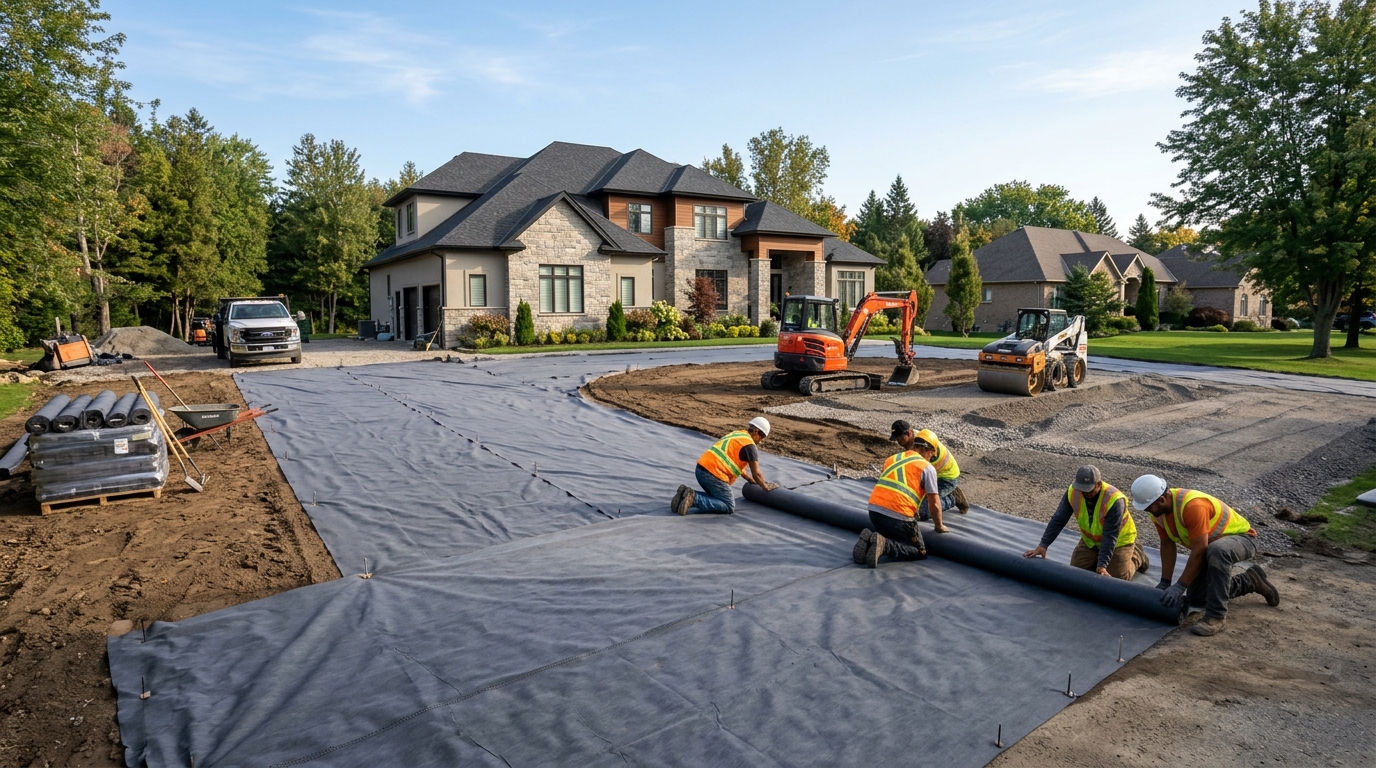
Your Base Is the Whole Story
Geotextile fabric is one component in a system. It matters when it matters, and it’s unnecessary when it’s not. What always matters is excavation depth, aggregate quality, compaction, drainage slope, and proper joint sand. Those fundamentals determine whether your pavers stay flat through a decade of Sarasota summers.
If you’re planning a driveway, patio, or pool deck and you’re not sure what your soil actually needs, our crew can walk your property and check. Soil tells you more than a product label ever will. Reach out for a free estimate before the rainy season tests your base.