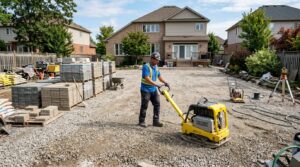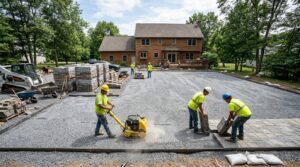
You’re planning a driveway, patio, or pool deck. You’ve spent time comparing paver colors, debating travertine versus concrete, maybe even picking a laying pattern. If you’re considering elevation changes, review our guide on how to build a raised paver patio for structural requirements. But the layer you can’t see after the project is finished is the layer that determines whether those pavers still sit flat and drain properly five years from now. That layer is the paver base.
We’ve been installing hardscape in Sarasota since 2000 with our own in-house crew. The pattern is consistent: when a paver surface fails, the base is almost always the cause. Not the paver. Not the joint sand. Not the sealer. The crushed rock (or lack of it) underneath. This guide covers what a paver base is, what materials work, how deep it needs to be, and where the most expensive mistakes hide.
Jump to:
What a Paver Base Actually Does
A paver base is the layer of compacted aggregate between your native soil and the bedding sand your pavers rest on. Its job is structural. It distributes weight across a wider area, resists lateral movement, and channels water so the surface above stays level through Florida’s rain and heat cycles.
Think of it this way. Your native soil (the subgrade) is what’s already in the ground. In Sarasota, that’s usually sandy, sometimes with a clay lens or shell layer a few feet down. The paver base sits on top of that soil after excavation, and it’s typically made of crushed rock (often limerock or crushed shell in our area). Above the base, a thin layer of bedding sand levels the surface. Then the pavers go on top of that.
Without a properly compacted base, pavers have nothing stable to rest on. Sand alone compresses. Native soil shifts when it saturates. CMHA’s construction guidelines describe the base as the structural layer that distributes loads to the subgrade, and that description matches what we see in the field: skip or shortcut the base, and the surface tells you about it within a season or two.
Every Layer Has a Job
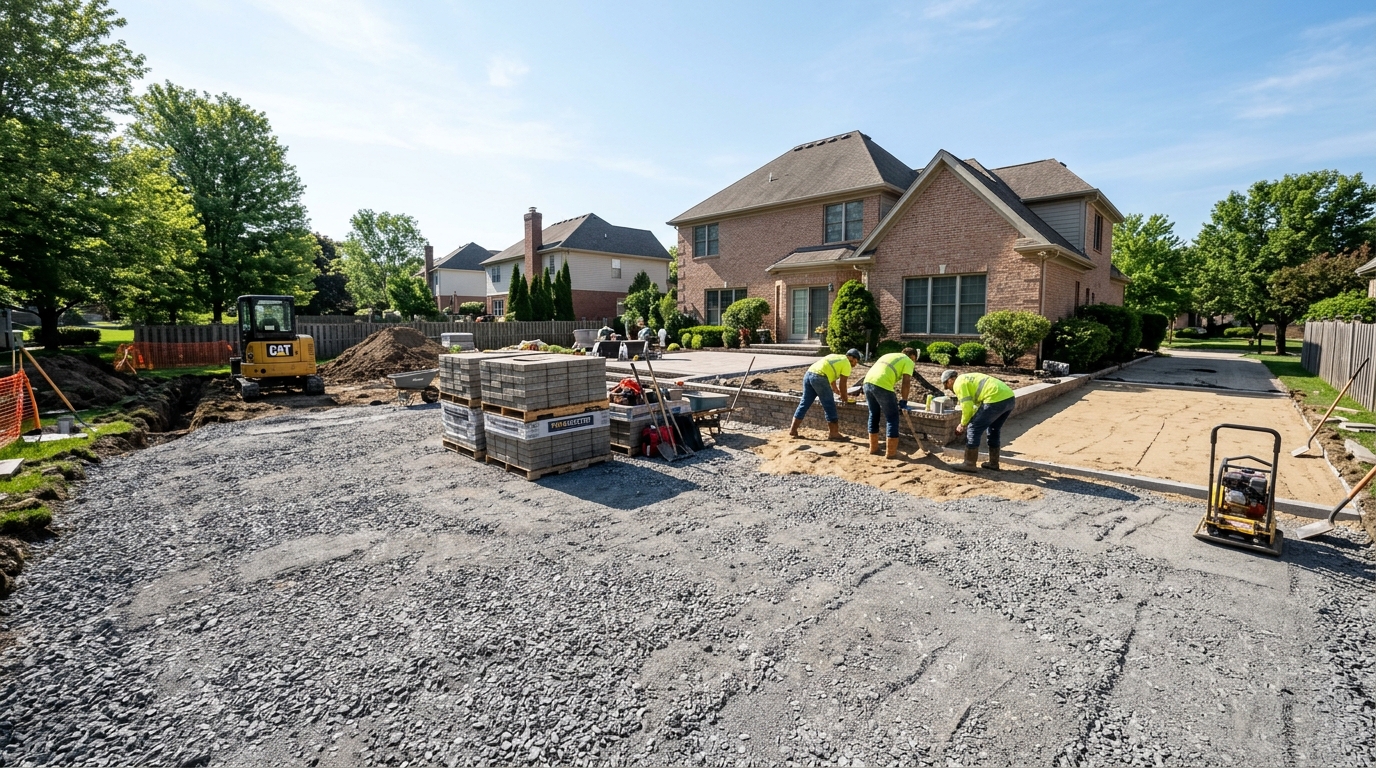
A paver installation is not one thing. It’s a system of layers, and each one does something the others can’t. Mixing them up or leaving one out is where projects fail.
| Layer | Material | Purpose | Typical Thickness |
|---|---|---|---|
| Subgrade | Native soil, compacted | Final support for everything above | Existing ground |
| Base | Crushed rock / dense-graded aggregate | Structural support, load distribution, drainage | 4 to 6+ inches compacted |
| Bedding | Concrete sand (ASTM C33) | Levels the surface for paver placement | 1 inch uncompacted, screeded |
| Pavers | Concrete, brick, travertine, porcelain | Finished walking or driving surface | 2 3/8 in. to 3 1/8 in. |
| Joint fill | Polymeric sand or jointing sand | Locks pavers together, resists insects and weeds | Fills joint width |
| Edge restraint | Plastic, aluminum, or concrete | Prevents lateral paver spread | Installed at perimeter |
The most common confusion we hear from homeowners: “Isn’t the sand the base?” No. Bedding sand is a leveling layer, not a structural one. CMHA explicitly rejects masonry sand, limestone screenings, and stone dust as bedding material, and none of those belong in the structural base either. When someone says they “put sand down and laid the pavers,” what they usually mean is they skipped the base entirely.
Edge restraints matter too. Without them, the pavers at the perimeter slowly spread outward, paver joints open, and the whole field loosens over time. We install spiked plastic or aluminum edge restraints on every project. On driveways, where turning tires push hard against the border, restraint quality is non-negotiable.
Base Materials: Crushed Rock, Open-Graded Stone, and Panels
Not all paver bases use the same material, and the choice depends on what the project needs to do with weight, water, and soil conditions.
Dense-graded aggregate: the standard
This is what most residential patios, driveways, walkways, and pool decks in Florida are built on. Dense-graded aggregate (crushed limerock or crushed shell in our area) contains a range of particle sizes, from fines to roughly 3/4-inch stone. When compacted, those particles interlock and form a stable, load-bearing platform.
Dense-graded base is the workhorse. It handles foot traffic, vehicle loads, patio furniture, fire pit weight. It compacts well in lifts with a plate compactor, and it’s available in bulk from local quarries at a fraction of the cost of bagged material.
That cost difference matters. A single 0.5-cubic-foot bag of paver base retails for around $7. A 100-square-foot patio with 4 inches of base needs roughly 67 bags: over $460 before delivery or compaction. A bulk load of the same material from a quarry costs a fraction of that. Bags make sense for a small stepping-stone path. For anything larger, order bulk.
Open-graded (clean) stone
Open-graded aggregate is uniform-sized crushed stone with no fines. Water passes through it freely, which makes it the foundation for permeable paver systems designed to manage stormwater on-site. ASTM No. 57 stone (roughly 1-inch diameter) is a common base layer for these systems, with No. 8 or No. 9 stone used as bedding.
Open-graded stone is not a direct substitute for dense-graded in a standard installation. CMHA limits its guidance for standard pavers on open-graded bases to residential pedestrian areas only, excluding driveways and commercial applications. Without fines to lock particles together, the base relies more on confinement, and it behaves differently under repeated vehicle loads.
If your project is a patio and you want water to drain through the surface, open-graded stone with permeable pavers is a strong system. If your project is a driveway, dense-graded aggregate remains the proven choice.
Synthetic panels
Products like Brock PaverBase and Gator Base are lightweight panels (polypropylene or expanded polypropylene) that sit on a prepared, leveled surface and replace some or all of the traditional aggregate layer. They reduce excavation and material hauling, which matters in tight backyards or projects with limited equipment access.
The limitation is load rating. Brock states that PaverBase is not engineered for driveways or areas where vehicles are present. Gator Base’s technical data sheet specifies pedestrian use only and caps warranty remedies at the product purchase price. A panel that saves excavation labor does not transfer driveway responsibility to the manufacturer.
We’ve used panels in situations where hauling bulk aggregate through a screened lanai or narrow side yard would have doubled the labor. They can work for a patio or walkway on stable, well-drained soil. For driveways, heavy-traffic pool decks, or any project on soft ground, we use crushed rock.
How Deep Your Paver Base Needs to Be
Base depth depends on two things: what’s driving on it and what’s underneath it.
| Application | Minimum Compacted Base Depth | Condition |
|---|---|---|
| Walkways and patios | 4 inches | Well-drained soil |
| Residential driveways | 6 inches | Well-drained soil |
| Residential streets | 8 to 10 inches | Engineered per traffic loads |
These are CMHA’s published minimums for well-drained soil. In Sarasota, most native soil is sandy and drains reasonably well, so 4 inches for a patio and 6 inches for a driveway is typically our starting point. But “well-drained” is a condition you verify on-site, not an assumption you carry from one property to the next. If you hit a clay lens 8 inches down (it happens in parts of Bradenton and Osprey), or if the site holds standing water after afternoon storms, those minimums go up.
Total excavation depth is more than just the base. You also need room for bedding sand (1 inch) and the paver itself (2 3/8 inches for a standard paver, 3 1/8 inches for a driveway-rated unit). A patio with 4 inches of base requires 7 to 8 inches of excavation. A driveway with 6 inches of base requires 9 to 10 inches.
We see this miscalculation regularly: a homeowner digs 4 inches total, fills it with sand, and lays pavers flush with the lawn. The sand compresses, the pavers sink, and water pools on the surface within one rainy season. Four inches is for the crushed rock base alone, compacted, before the bedding and pavers stack on top.
Compaction: The Step Most Projects Get Wrong
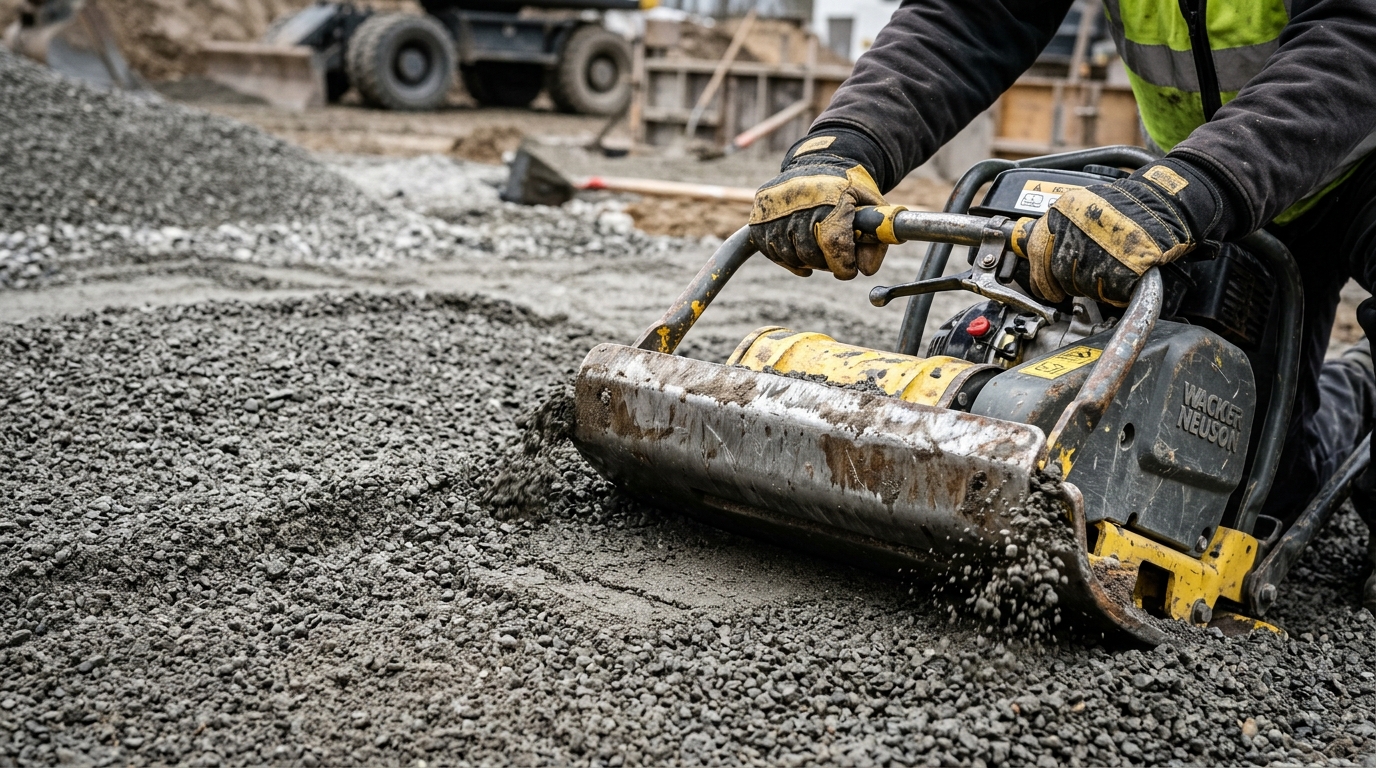
You can have the right material at the right depth and still end up with a failing base if it isn’t compacted properly. Compaction is what transforms loose rock into a structural layer.
CMHA’s construction guidance calls for at least 98% Standard Proctor density on pedestrian areas and residential driveways. In practical terms, knowing how to compact paver base correctly means four things.
First, compact in lifts. Each lift should be 4 to 6 inches of loose material, run through a full compaction pass before the next lift goes down. Dumping the entire depth of rock at once and making a single pass with the compactor produces a firm surface over a loose core.
Second, use the right equipment. A reversible plate compactor with at least 5,000 pounds of centrifugal force is the standard for residential paver bases. Smaller compactors work for tight areas, but lifts need to be thinner to compensate.
Third, wet the material. Aggregate compacts better near its optimal moisture content. In Sarasota’s heat, dry limerock doesn’t lock together as effectively. We wet each lift lightly before running the compactor.
Fourth, compact the subgrade before any base material goes down. Loose, disturbed soil under a perfectly compacted base just means the whole assembly settles together. If the native soil is soft, address it first.
A plate compactor rents for roughly $80 to $100 a day. The cost of tearing out and rebuilding a sunken patio runs into thousands. That ratio tells you everything about whether compaction is optional.
For timeline planning and labor estimates, see how long to install paver patio.
Drainage and Slope in Florida’s Rain
Sarasota averages roughly 55 inches of rain a year, with the bulk concentrated in heavy summer downpours. A paver base that doesn’t move water away from the surface and away from structures will eventually fail, no matter how well it was compacted.
CMHA recommends a minimum 1.5% slope on the finished paver surface. That equals about 3/16 of an inch per foot. On a 10-foot-wide patio, the total fall from one edge to the other is just under 2 inches. This slope directs water away from the house, away from the pool, and toward a permeable area or drainage inlet.
The slope is built into the base, not corrected with extra bedding sand. If the base is flat and you try to create slope by varying sand thickness, you end up with 2 inches of sand on one end and 1/2 inch on the other. Thick sand compresses more, and the pavers on that end sink first. Screed to a uniform 1-inch sand layer over a properly graded base.
For pool decks, drainage demands are even higher. Splash-out water is constant, and a pool deck that slopes toward the pool or sits flat develops algae in the joints within weeks during summer. We grade pool deck bases away from the coping edge and toward perimeter drains or adjacent lawn.
Florida’s sandy soil is an advantage here. Unlike clay-heavy regions where water sits on the subgrade for days, our sand drains relatively quickly through the profile. But that benefit disappears if downspouts dump roof runoff directly onto the paver surface, or if a landscape bed creates a dam that traps water against the pavers. We always check where roof drainage goes before finalizing a base plan.
How to Calculate Base Material
The formula:
Length (ft) × Width (ft) × Depth (ft) ÷ 27 = cubic yards
Quarries and delivery trucks sell by the cubic yard. Here are two common Sarasota projects as examples.
A 12 × 20-foot patio with 4 inches of compacted base:
- 12 × 20 = 240 sq ft
- 4 inches = 0.33 ft
- 240 × 0.33 = 79.2 cubic feet
- 79.2 ÷ 27 = 2.93 cubic yards
- Add 10 to 15% for compaction loss and waste: order roughly 3.4 cubic yards
A 12 × 40-foot driveway with 6 inches of compacted base:
- 12 × 40 = 480 sq ft
- 6 inches = 0.5 ft
- 480 × 0.5 = 240 cubic feet
- 240 ÷ 27 = 8.89 cubic yards
- With 10% overage: order roughly 9.8 cubic yards
On pricing: USGS estimates the average unit value of crushed stone at $18.50 per metric ton, but that’s the national quarry-gate average across all uses. Your delivered price depends on quarry, material grade, distance, and load size. In the Sarasota area, we typically see limerock base delivered in the $30 to $50 per cubic yard range, though prices fluctuate with fuel and demand.
Always get a delivered price, not just a quarry price. And budget for excavation and disposal of the soil you’re removing. Hauling out dirt is often the most labor-intensive part of the project, and the part DIYers consistently underestimate.
What Makes a Paver Base Fail
After 26 years of installations and repairs across Sarasota, Venice, Nokomis, Bradenton, and Osprey, we’ve watched the same failures repeat. They cluster into a few categories.
No base at all, or not enough of it
The most common failure. Someone lays pavers on 2 inches of sand over native soil. It looks great for a few months. Then the first heavy rain season arrives, the sand washes and compresses, and the pavers develop low spots that hold water. By year two, individual pavers have shifted enough that joints open and polymeric sand washes out.
Skipped compaction
The aggregate is there, but it was dumped and raked level without a plate compactor. Loose rock settles unevenly under load and rain over the first year. The surface develops waves and dips. We’ve pulled up patios where a “6-inch base” had compressed to 3 inches in foot-traffic paths and sat at 5 inches between them.
Wrong material in the wrong layer
CMHA documents a case where a bus pavement failed within hours of opening because the bedding contained excessive fines. Those fine particles migrated through drainage openings, the saturated bedding liquefied, and the surface rutted immediately. That’s an extreme example, but the residential version is common: stone dust used as bedding (it holds water and turns to mush), or fill dirt mixed into the base to save on aggregate cost.
The rule: base aggregate should be clean, angular, crushed rock. Bedding should be ASTM C33 concrete sand. Paver joints get polymeric sand or a specified jointing material. Don’t substitute between layers.
Flat surface with no drainage slope
A flat base produces a flat surface that holds water. Standing water accelerates joint erosion, promotes mold and algae in Florida’s humidity, and can soften the subgrade beneath the base if it persists. In the worst cases, pooled water migrates under the base and undermines it from below.
Unstable subgrade
If the native soil is soft, recently backfilled, or saturated, a well-built base on top of it settles with it. We’ve seen patios where the base was compacted properly but installed over a utility trench that was never re-compacted after backfill. A visible groove appeared in the paver surface within six months, following the trench line exactly.
What Happens After Year Five
A properly built base on stable soil doesn’t need routine attention. The crushed aggregate itself doesn’t degrade. What changes over time is the soil beneath it, the drainage around it, and the condition of the joints and bedding above it.
When settling does occur, the repair depends on the cause. A localized low spot (one to three pavers) usually means pulling those pavers, adding bedding sand, re-leveling, and reinstalling. If the same spot keeps sinking, the base or subgrade below it needs investigation, not another sand top-up. Widespread settling or tilting typically points to a base that was under-compacted originally, and the honest fix is removing the pavers in the affected area, adding and re-compacting base material, re-screeding, and reinstalling.
Sometimes the pavers themselves are fine, but the site around them has changed. A new garden bed, a regraded lawn, or a redirected gutter can send water toward the paver surface where it never went before. Fix the drainage first, then address any base damage.
Permeable paver systems need more active maintenance. The open-graded stone reservoir that stores and infiltrates water gradually accumulates sediment in the joints and surface voids. CMHA recommends cleaning permeable paver surfaces one to two times per year, adjusted to site conditions. EPA monitoring at a New Jersey research parking lot found that clogging develops unevenly, concentrating where runoff and sediment collect most heavily. Testing and cleaning should target those vulnerable spots rather than rely on a whole-site average.
The broader point: a paver base is durable when built right, but the site around it evolves. Trees send out roots. Soil settles after nearby construction. Water patterns shift when neighbors regrade or municipalities update storm systems. Knowing what your base looks like and how it was built gives you, or your contractor, a starting point when something eventually needs attention.
Frequently Asked Questions
Can I use regular sand as a paver base?
No. Sand compresses under load and washes out with water. It serves as a bedding layer (1 inch of ASTM C33 concrete sand, screeded level), but it lacks the structural capacity of crushed aggregate. The base layer needs angular, compactable crushed rock that interlocks under compaction to distribute weight and resist shifting.
Is paver base the same as gravel?
They overlap but aren’t identical. Paver base typically refers to dense-graded crushed aggregate containing a range of particle sizes from fines to 3/4-inch stone. “Gravel” can mean anything from round river rock to crushed stone. For a paver base, you need crushed, angular particles that interlock when compacted. Round river gravel rolls under load and never forms a stable platform.
How thick should a paver base be for a driveway?
CMHA’s minimum is 6 inches of compacted dense-graded aggregate over well-drained soil. In Sarasota’s sandy ground, 6 inches is our standard starting point for residential driveways. Softer soil, high water tables, or heavier vehicles may require more. Total excavation runs 9 to 10 inches to accommodate bedding sand and paver thickness on top of the base.
Do I need to compact the soil before adding the base?
Yes. The subgrade must be compacted and firm before any aggregate goes on top. Loose, recently disturbed, or saturated soil under a compacted base allows the entire assembly to settle unevenly. Address the subgrade first, then build the base in compacted lifts.
How long does a paver base last?
A properly compacted crushed rock base on stable, well-drained soil can last decades. The aggregate doesn’t wear out. What changes over time is the soil beneath it, the drainage around it, and the joints and bedding above. Routine paver cleaning, periodic joint sand replenishment, and keeping drainage paths clear extend the life of the entire system.
Should I use landscape fabric under the base?
A separation geotextile (not standard weed barrier) helps when clay, silt, or saturated soil could migrate into the crushed rock and weaken it. In Sarasota’s predominantly sandy soil, it’s not always necessary. In areas with high water tables or clay pockets (parts of Venice and Osprey), fabric between the subgrade and base prevents contamination over time. Use the material specified for separation, not generic garden fabric.
The base is the least visible part of a paver project and the most consequential. If you’re planning a patio, driveway, or pool deck in the Sarasota area, a free estimate lets our crew walk your property, check the soil and drainage, and tell you exactly what the base needs before any material gets ordered. Reach out before the rainy season tests what’s underneath.