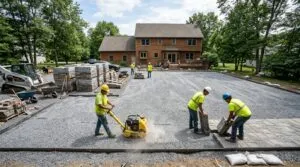
You have a date in mind. A birthday party, a holiday weekend, the end of the dry season before June storms roll through Sarasota. And now you need to know: if we start this paver patio project, when can we actually use it?
The honest answer is that how long it takes to install a paver patio depends on three separate clocks, and most estimates only account for one. A standard 200 to 400 square foot patio typically takes 3 to 5 working days of active construction. But the calendar time from your first phone call to the moment you set a table on finished pavers can stretch to 2 to 6 weeks, depending on scheduling, materials, and weather.
We have been installing patio pavers across Sarasota, Venice, Bradenton, and Osprey since 2000. Here is what actually controls your timeline, and where the surprises hide.
Jump to:
Three Clocks Run at the Same Time
When a homeowner asks “how long does it take,” they usually mean one of three things:
- Preconstruction time: from your first call through design decisions, material orders, permits (if needed), and scheduling. This can take 1 to 3 weeks, especially during Sarasota’s busy fall and winter season.
- Active construction time: the days our crew is physically on your property with equipment running. For a typical patio, 3 to 5 days. Larger or more complex hardscapes push into 1 to 3 weeks.
- Cure and release time: the hours or days after the crew leaves before you should place furniture, host guests, or walk freely on the surface. This depends on the sealer and polymeric sand used.
Industry estimates consistently show 1 to 2 on-site installation days but 2 to 6 weeks of total project time when you include the full cycle. That gap catches people off guard. If you need a patio ready by Thanksgiving, you are not calling in November. You are calling in October, maybe September.
What Controls Active Construction Days
A patio is not a single task. It is a sequence of dependent tasks, each one waiting for the last to finish correctly. Skip or rush one, and the next one fails. Here is how those tasks break down in our Sarasota installations:
Excavation: 4 to 8 hours for a standard patio
We excavate to a minimum of 8 inches below finished grade for a residential patio on Sarasota’s sandy soil. Belgard’s standard guide specifies at least 8 inches, going to 10 or 12 inches in freeze-thaw regions or where additional base is needed. Florida does not freeze, but our sandy subgrade still needs proper depth for stability and drainage.
What slows excavation: tree roots, old concrete or irrigation lines beneath the surface, limited equipment access through a side yard gate, and hauling spoil out. If a bobcat can reach your backyard, excavation goes faster. If we are wheelbarrowing material through a 36-inch gate, add time.
Base preparation: the biggest time investment
This is where most of the work lives, and it is the part you never see in the finished patio. We place 4 to 6 inches of crushed rock base in lifts, compacting each lift with a plate compactor. Belgard specifies 2 to 4 inch lifts of dense-graded aggregate, each compacted before the next goes down.
In Sarasota, our sandy subgrade actually works in our favor here. Sand compacts more predictably than clay, and it drains well. A crew working clay soil in Georgia or the Carolinas will spend more time waiting for conditions and running extra compaction passes. On our local sand, we typically finish base preparation for a 300 square foot patio in a full working day.
The finished base must slope at least 2% away from any structure. That is a quarter inch per foot. We check this with a level on a long straightedge. If the slope is wrong, water pools against your house, and five years from now you are dealing with the kind of settlement problem This Old House documented in a Chicago repair case, where accumulated water eventually overflowed into the homeowners’ basement stairwell.
Bedding and paver laying: the visible progress
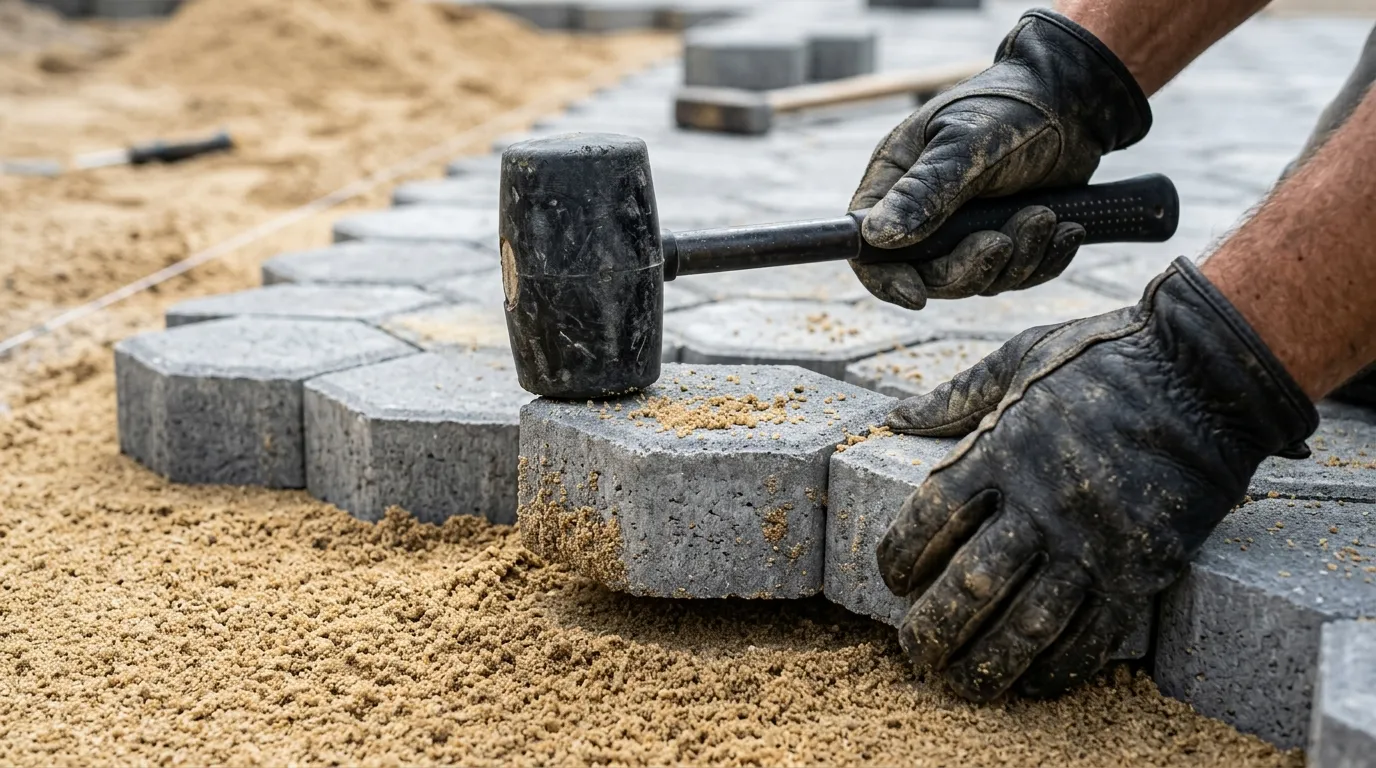
After the base passes inspection (ours, not necessarily the city’s), we screed a 1-inch layer of bedding sand and begin setting pavers. This is the stage that looks fast from the kitchen window. A four-person crew can lay a 300 square foot patio in herringbone or running bond surprisingly quickly, often in half a day.
What slows it down: cuts. Every edge, curve, and angle where a whole paver does not fit requires a wet-saw cut. A simple rectangular patio with a soldier course border might need 30 cuts. A curved patio wrapping around a pool deck might need 150. Young House Love’s DIY project documented how their borrowed wet saw could not cut through 2.5-inch pavers in one pass, turning each piece into a multi-step operation. Professional saws eliminate that problem, but the cuts still take time.
Finishing: edge restraint, compaction, polymeric sand, sealer
We install aluminum or plastic edge restraint, make a final pass with the plate compactor over the entire surface, sweep polymeric sand into every joint, activate it with a controlled mist, and (if sealing the same visit) apply sealer after the sand cures.
Polymeric sand is weather-sensitive. Gator Maxx G2 requires dry conditions, temperatures above 32°F, and provides a 15-minute rain-safe window on traditional installations. In Sarasota’s summer, afternoon thunderstorms are a daily possibility from June through September. We watch the forecast carefully and sometimes finish the sand activation early in the morning to stay ahead of 3:00 p.m. storms.
Timeline by Patio Size and Complexity
Size matters, but it is not the only variable. A 400 square foot rectangle on flat ground with good access installs faster than a 250 square foot curved patio with a retaining wall and a fire pit. Here is what we see in the field:
| Project scope | Typical active construction time | What drives the estimate |
|---|---|---|
| Simple patio, under 400 sq. ft., flat site, good access | 3 to 5 days | Standard excavation, base, lay, finish sequence |
| Mid-size patio (400 to 600 sq. ft.) or patio plus one feature | 1 to 2 weeks | Added scope from a fire pit, seat wall, or retaining wall |
| Large patio (600+ sq. ft.) with multiple features or significant grading | 2 to 3 weeks or longer | Walls, steps, lighting conduit, drainage, outdoor kitchen prep |
Kalagan Outdoor Design publishes similar ranges, noting that standalone patios under 400 square feet take 3 to 6 working days while multi-feature projects can extend to 2 to 3 weeks or longer.
The jump between a simple patio and a patio-plus-fire-pit is not just more pavers. It is a second excavation, a separate base, block construction, possibly a gas line, and coordination between those elements. Each added feature is its own mini-project nested inside the larger one.
Sarasota-Specific Factors That Shift the Schedule
National timeline guides are useful starting points, but they miss details that matter here in Southwest Florida.
Sandy soil: usually an advantage
Sarasota sits on well-drained sandy soil. Compared to the clay subgrades common in the Southeast, our sand compacts reliably, rarely holds standing water after a rain delay, and does not expand and contract with moisture the way clay does. This means we lose fewer days to soggy ground than contractors working in Georgia red clay or Louisiana gumbo.
The rainy season: June through September
Summer afternoon thunderstorms are predictable in their unpredictability. We know storms will come. We do not always know which afternoon. This affects polymeric sand application more than excavation or base work. A sudden downpour can wash uncured polymeric sand out of joints, requiring us to re-sweep and re-activate. We schedule sand and sealer work for morning hours during the wet months.
If your project falls between October and May, weather delays are rare. That dry season window is one reason fall and winter are our busiest months.
Heat and crew endurance
July in Sarasota means a heat index above 100°F by midday. Our crews start at first light and work through the cooler morning hours, but afternoon productivity drops. A project that takes 4 days in November might take 5 in July, not because the work is different, but because safe working pace changes with the heat.
Material selection
The paver you choose affects installation speed in ways that are not obvious. Travertine pavers are softer and cut faster than concrete pavers. Porcelain pavers are dense and require diamond blades and slower feed rates. Larger format pavers cover ground faster but weigh more per unit, which changes handling rhythm. Brick pavers in a herringbone pattern require more cuts at the edges than a simple stacked bond.
None of these differences add days by themselves. But stacked together on a large project, material choice can shift the schedule by half a day to a full day.
DIY vs. Professional: An Honest Time Comparison
If you are considering doing it yourself, the single most useful data point is this: a documented DIY paver patio of 300 square feet took approximately 30 hours including planning, construction, and cleanup. That was a completed, successful project by motivated homeowners with basic tools.
Thirty hours spread across weekends is three to four weekends, assuming 8 to 10 productive hours each weekend day. And that assumes no rain delays, no tool breakdowns, and no discovery of irrigation lines or roots mid-excavation.
A professional crew with a skid steer, commercial plate compactor, and a proper wet saw finishes that same scope in 3 to 5 days. The difference is not skill alone. It is equipment, crew size, and the fact that four people working in coordinated sequence cover ground faster than one or two people trading off tasks.
Where DIY time really expands:
- Excavation without a machine. Hand-digging 300 square feet to 8 inches deep means moving roughly 7.5 cubic yards of material. With a shovel. That is a full day for a strong, experienced laborer. For a homeowner, it could be two days.
- Material delivery and staging. A 300 square foot patio needs roughly 2 to 3 tons of crushed rock base, plus sand, plus pavers. Moving that from a driveway pile to the backyard by wheelbarrow is a workout most people underestimate.
- Cutting. Renting a wet saw costs money and time. Returning it costs more time. And if the saw cannot handle your paver thickness in one pass, every cut doubles in duration.
We are not discouraging DIY. We are saying: plan for the real hours, not the highlight reel.
What Happens After the Crew Leaves
The crew packs up. Your patio looks finished. But “finished” and “ready for a party” are not the same moment.
Polymeric sand needs time to fully harden. Light foot traffic is generally fine after 24 hours. Placing heavy furniture, dragging chairs across the surface, or hosting 30 guests should wait 48 to 72 hours, depending on the product and conditions. If we applied sealer the same day, add another 24 hours before the surface is ready for normal use.
One detail worth noting: overlay installations have a longer rain-safe requirement of 24 hours compared to 15 minutes for traditional base installations. If your patio is being built over an existing concrete slab, the finishing timeline is different.
Full cure for polymeric sand takes about 7 days. During that first week, avoid power-washing the surface or flooding the joints with a garden hose.
How to Keep Your Project on Schedule
After 25 years of installations, we know where delays come from. Most of them are preventable.
Finalize your design before the crew arrives. Changing the layout mid-project is the single biggest schedule killer. Moving a fire pit location 6 feet to the left after excavation has started means re-digging, re-grading, and sometimes re-ordering materials.
Confirm material availability early. Most paver styles and colors are stocked locally. Specialty items, custom colors, or large quantities of premium brands may need a lead time of 1 to 2 weeks. We check stock before quoting a start date, but surprises happen when manufacturers run short on a particular mold.
Clear the work area. Potted plants, furniture, grills, garden hoses, and lawn ornaments in the work zone cost the crew 30 minutes to an hour at the start. That is not dramatic, but it adds up across a multi-day project.
Know what is underground. Irrigation lines, landscape lighting wire, cable TV runs, and gas lines can all cross a patio footprint. In Florida, calling 811 before digging is required by law. Locators need at least two full business days to respond. Schedule that call the week before your project starts, not the morning of.
Talk to your installer about access. Can a skid steer reach the backyard? Is there a gate wide enough? Will material need to be staged on the driveway, and for how long? These logistics do not add construction days, but they affect how efficiently each day runs.
When to Start Planning for a Specific Deadline
Working backward from a target date:
- Allow 1 to 2 weeks for consultation, design, and material confirmation.
- Allow 3 to 7 days of active construction for a standard patio (longer for complex projects).
- Allow 2 to 3 days for cure and release before heavy use.
- Add a weather buffer of 2 to 3 days if your project falls during rainy season (June through September in Sarasota).
For a simple patio, that means reaching out about 4 to 5 weeks before your deadline. For a patio with a fire pit, seat wall, or coping work, give it 6 to 8 weeks. During our peak season (October through April), add another week for scheduling availability.
A free estimate gives you exact dates for your specific project. We can walk the site, measure, check access, and tell you what a photo cannot show.
Perguntas frequentes
How long does a 400 sq. ft. paver patio take to install?
A professional crew typically completes a standard 400 square foot patio in 3 to 5 working days. This includes excavation, base preparation, paver laying, and finishing. Add 1 to 3 weeks of preconstruction time for design, material ordering, and scheduling, plus 2 to 3 days of cure time before heavy use.
Can I install a paver patio myself in one weekend?
Unlikely for anything over 100 square feet. A documented DIY project of 300 square feet took approximately 30 hours including planning and cleanup. Spread across weekends with realistic energy levels, expect 3 to 4 weekends for a mid-size patio. Hand-excavating and moving base material without equipment takes significantly longer than most online guides suggest.
How soon can I walk on my new paver patio?
Light foot traffic is usually safe 24 hours after polymeric sand activation. Heavy furniture placement, dragging chairs, and hosting large groups should wait 48 to 72 hours. Full polymeric sand cure takes about 7 days. Avoid power-washing the joints during that first week.
Does rain delay paver installation in Florida?
Rain affects different stages differently. Excavation and base work can resume once standing water drains (usually quickly on Sarasota’s sandy soil). Polymeric sand is the weather-sensitive step: it requires dry conditions and a minimum dry window after activation. During Sarasota’s summer, we schedule sand work for mornings to stay ahead of afternoon storms.
What adds the most time to a paver patio project?
Features beyond the patio surface itself: retaining walls, fire pits, seat walls, steps, and outdoor kitchen foundations each add their own excavation, base, and construction sequence. A simple patio might take 3 to 5 days. Adding a fire pit and seat wall can push that to 10 to 14 days of active work.
Does the type of paver affect installation time?
Porcelain pavers cut slower than travertine or concrete pavers. Complex laying patterns like herringbone require more edge cuts than running bond. Larger format pavers cover area faster but are heavier to handle. These differences rarely add more than half a day on a standard patio, but they compound on larger projects.