When pavers settle, shift, or collect puddles after every summer rain, the surface material is rarely the problem. The crushed rock base underneath is. Wrong aggregate, insufficient depth, or skipped compaction will undo even the most expensive paver surface within a few seasons.
We’ve been installing paver driveways, patios, and pool decks across Sarasota since 2000. The base is where we spend most of our planning time, because everything visible depends on what’s hidden below grade. Here’s what building hardscape in Florida’s sandy soil and heavy rain has taught us about getting a crushed rock base right.
Jump to:
What the Crushed Rock Base Actually Does
Pavers don’t rest on dirt. They rest on a system of layers, and the crushed rock base is the structural core. It does three things at once: distributes weight across a wider area than any individual paver covers, provides stable support that resists shifting under load, and channels water downward so the subgrade beneath doesn’t soften and fail.
In Sarasota, our subgrade is almost always sand. Myakka fine sand, specifically, the state soil of Florida. That’s an advantage for drainage (clay soils up north trap water and create freeze-thaw problems we don’t deal with). But sand by itself doesn’t lock together. It migrates. Preparing the base for pavers with properly graded and compacted crushed rock provides the interlocking structure that sandy soil can’t.
Without it, your patio pavers will look perfect for about one rainy season. Then you’ll start seeing low spots, gaps opening in your paver joints, and that familiar wobble underfoot.
Not All Crushed Rock Works the Same Way
This is where most DIY projects and even some contractor bids go wrong. “Gravel” is not a specification. It’s a category, and it includes materials that will ruin a paver installation.
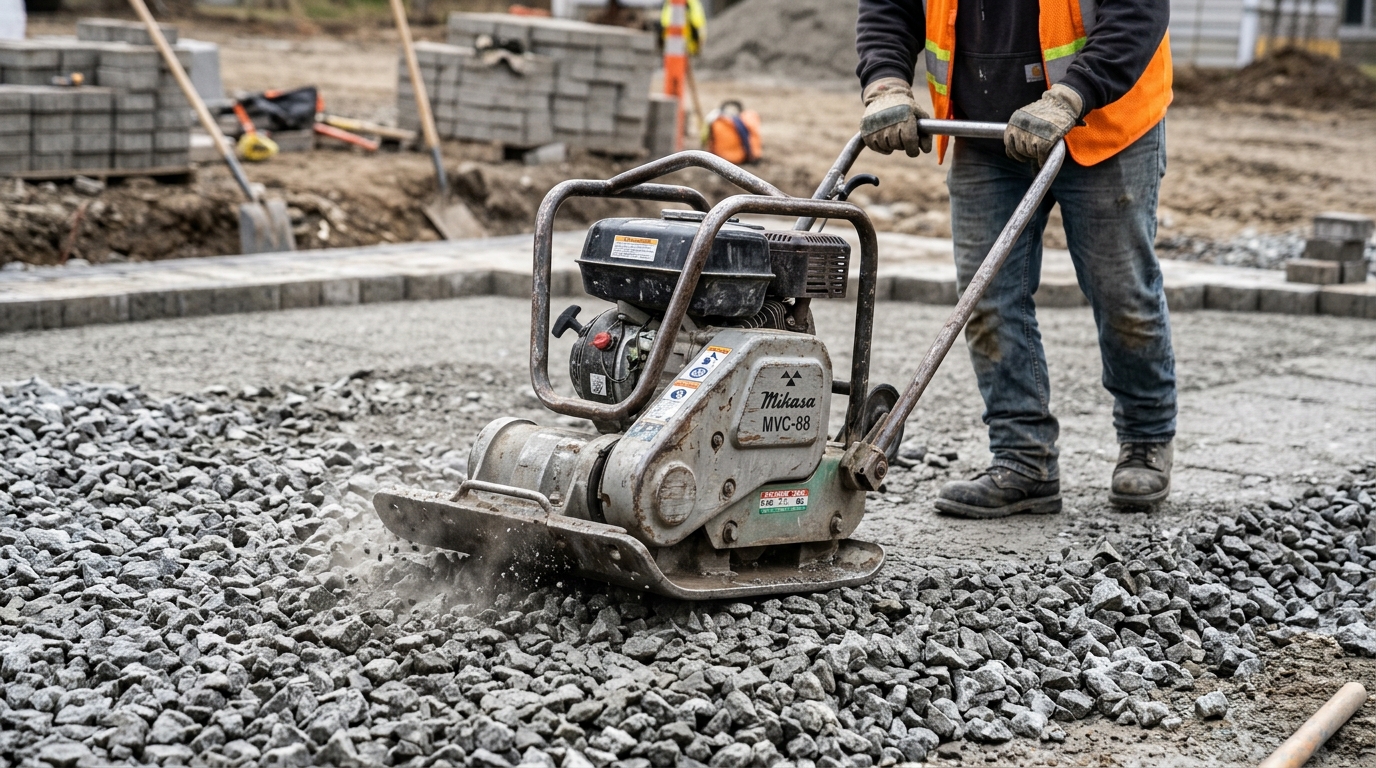
What you need is crushed, angular aggregate with a controlled blend of sizes, from coarse pieces down to fine particles. The angular edges lock together under compaction, forming a dense, stable mass. The Concrete Masonry and Hardscapes Association specifies crushed, angular material for unbound dense-graded paver bases, and that spec exists for a reason.
What you don’t need: round pea gravel, river rock, or decorative stone. These particles roll against each other instead of locking. No amount of compaction will make them stable.
Common product labels you’ll encounter at suppliers:
- Crusher run (also called “crush and run” or “road base”): a blend of crushed stone and fines, typically 1.5 inches down to dust. This is the most common dense-graded base material for paver installations in our area.
- #57 stone: clean, angular, roughly 3/4-inch to 1-inch pieces with no fines. Used in open-graded base systems and as a drainage layer beneath permeable pavers.
- “Paver base” bags: pre-blended aggregate sold in 0.5-cubic-foot bags at home-improvement stores. Same basic material as crusher run, in much smaller and more expensive quantities.
The label on the bag or the supplier’s product name doesn’t guarantee it meets your project’s requirements. Aggregate specifications and availability vary by quarry and region. When ordering in bulk, ask for the gradation and confirm it’s crushed (not naturally rounded) stone.
How Deep the Base Needs to Be
Base depth isn’t a one-size-fits-all number. It depends on what the pavers will carry and what’s underneath them.
CMHA’s construction guidelines set these minimums for compacted base on well-drained soils:
| Application | Minimum compacted base depth |
|---|---|
| Walkways and patios (pedestrian traffic only) | 4 inches |
| Residential driveways | 6 inches |
| Residential streets and heavy-vehicle areas | 8 to 10 inches |
For most of the driveway paver work we do in Sarasota, Bradenton, and Venice, 6 inches of compacted crusher run is our standard. For walkways on stable, well-drained sand, 4 inches can work. But “well-drained” is doing real work in that sentence. If your yard sits low, holds water after storms, or borders a retention pond, 4 inches isn’t enough regardless of what the pavers will carry.
Florida’s sandy soils usually drain well, which means we rarely need the extra depth that installers in clay-heavy or frost-prone regions add. No frost heave is the one structural advantage our climate gives us. But we do deal with June through September: months of near-daily downpours that test drainage slope and base integrity over and over.
Compaction happens in layers, not all at once
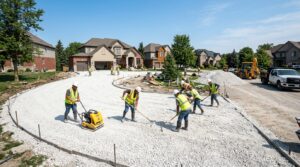
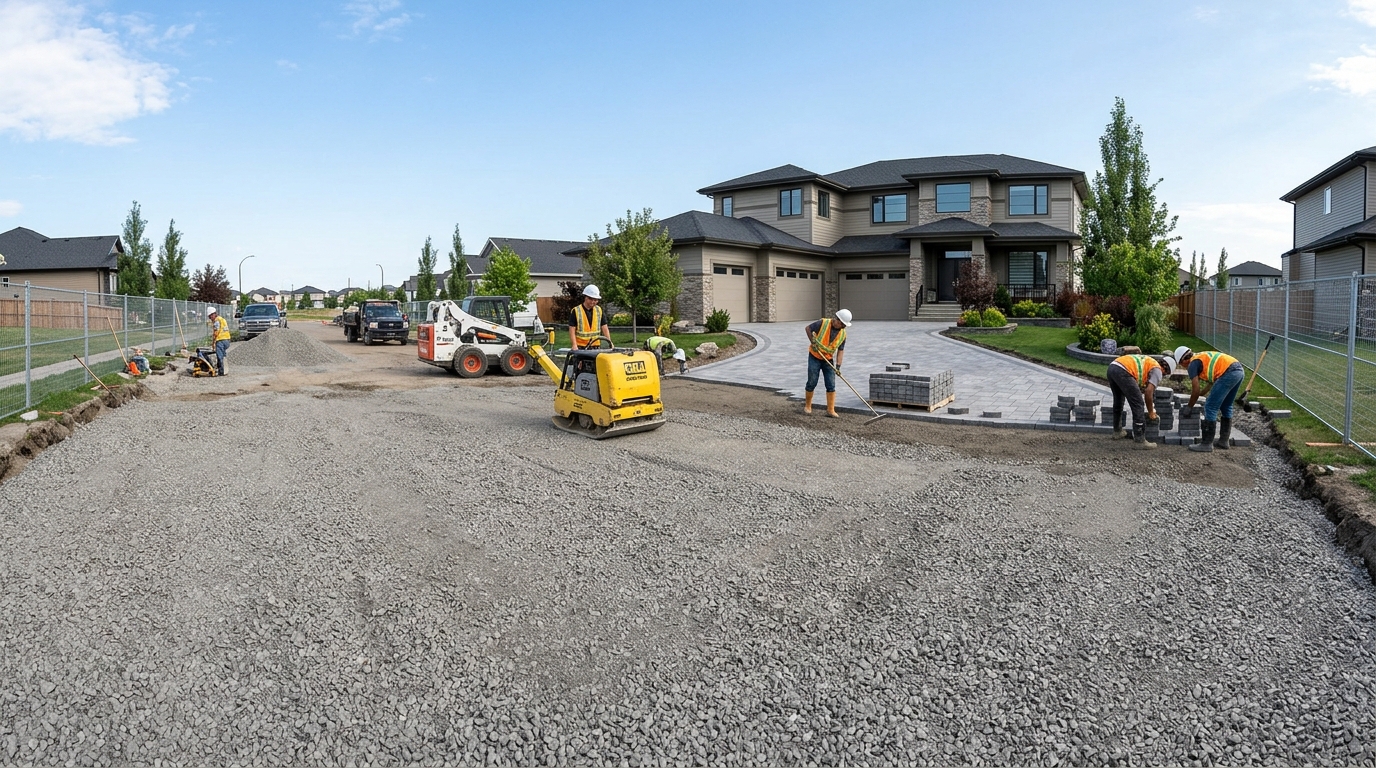
You can’t dump 6 inches of crusher run in the excavation and compact it once from the top. The bottom half won’t densify. We compact in lifts of 2 to 3 inches using a reversible plate compactor, wetting the material lightly to help the fines fill voids. CMHA calls for a minimum 98% standard Proctor density for pedestrian and residential-driveway bases. That number means the aggregate is nearly as dense as laboratory testing can make it.
Skip this step and the base will continue to settle under use. We’ve pulled up patios that were less than two years old where the base was never compacted in proper lifts. The pavers looked fine from above, but the moment you stepped on them, you could feel the give.
The Bedding Layer Is Not Extra Base
Above the compacted crushed rock, you place a bedding layer: a thin, uniform surface that the pavers sit directly on. This layer serves a different purpose than the base, and it requires a different material.
For conventional paver installations, the bedding should be ASTM C33 concrete sand, screeded to a nominal 1 inch before you set the pavers. After the pavers are placed and compacted with a plate compactor, that layer settles to about 3/4 inch.
What doesn’t belong in the bedding layer: stone dust, limestone screenings, or leftover crusher run. CMHA explicitly rejects these materials for bedding because they contain excess fines that hold moisture, break down under wetting cycles, and can pump up through paver joints under vehicle loads. The result is rutting and uneven settling in exactly the spots that see the most traffic.
This distinction trips up a lot of homeowners (and, honestly, some installers). Dense-graded base benefits from a controlled amount of fines, typically 5% to 12% passing the #200 sieve, because those fines help fill voids and stabilize the mass. But the bedding layer needs no more than 1% passing that same sieve. Two layers, two different jobs, two different material requirements.
One more thing worth knowing: bedding sand is not a way to level out an uneven base. If the compacted base has dips and humps, fix the base. Thick spots of bedding sand will compress unevenly over time, and every imperfection will telegraph up through the finished surface.
How Much Crushed Rock to Order
The math is straightforward geometry:
Volume (cubic yards) = Area (sq ft) × Depth (ft) ÷ 27
For a 300-square-foot patio with a 6-inch compacted base:
300 × 0.5 ÷ 27 = 5.56 cubic yards
Add 10% to 15% for compaction loss and waste. That brings the order to about 6.1 to 6.4 yards. For the 1-inch bedding layer on the same patio, figure roughly 0.93 cubic yards of C33 sand.
Bags vs. bulk: the cost gap is dramatic
At home-improvement stores, paver base typically comes in 0.5-cubic-foot bags. For that same 300-square-foot patio at 6-inch depth, you’d need approximately 300 bags. At $5 to $6 per bag, that’s $1,500 to $1,800 in aggregate alone.
Bulk crusher run from a local quarry or landscape-supply yard runs roughly $40 to $75 per cubic yard in most Florida markets (prices vary by supplier, distance, and minimum-delivery requirements). At the midpoint of that range, 6.4 yards comes to roughly $370–$480 before delivery. Call your nearest landscape-supply yard for a current quote and ask about minimum-delivery quantities.
The math is clear: bags cost roughly three to four times more per cubic yard than bulk. Bags make sense for very small projects, maybe a short walkway or a set of stepping stones. For anything over 50 square feet, bulk delivery saves hundreds of dollars and hours of hauling 50-pound bags from your truck to the site.
Dense-Graded vs. Open-Graded: Two Systems, Different Rules
Most paver installations in our area use the conventional dense-graded system: crusher run compacted in lifts, topped with C33 sand bedding. It’s proven, well-documented, and works reliably on Sarasota’s sandy subgrade.
There’s also an open-graded approach. Unilock recommends a system using #57 stone as the base with #8 crushed stone as bedding, requiring at least 6 inches of base depth. Because #57 stone has no fines, water drains freely through the entire assembly. There’s no trapped moisture, no bedding-sand migration, and the base can be placed in wetter conditions without the moisture sensitivity that dense-graded aggregate has.
Open-graded systems are particularly relevant if you’re considering permeable pavers, which are designed to let stormwater filter through the surface and into a stone reservoir below. Those assemblies use clean aggregate (often #57 over a #2 subbase) as both structural support and water storage. In a climate like ours, where stormwater management is a growing concern for both municipalities and homeowners, this approach addresses drainage and pavement support in a single system.
The critical rule: don’t mix systems. Don’t put #57 stone on the bottom and crusher run on top, or use C33 sand bedding with an open-graded base. Each system is engineered as a complete assembly. Swapping layers from different recipes creates unpredictable drainage and structural behavior that neither system was designed to handle.
Base Mistakes We Fix in Sarasota
After more than two decades of hardscape work across Sarasota, Venice, Bradenton, Nokomis, and Osprey, we’ve developed a clear picture of what goes wrong when a base is built incorrectly. These aren’t theoretical failures. They’re the problems we see when we tear out and replace someone else’s work.
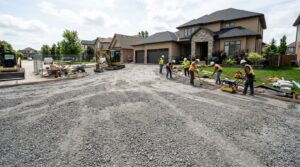
The most common is building on unconsolidated fill. New construction homes in our area often have recently placed fill soil around the foundation. That fill hasn’t settled under its own weight yet. Building a paver base directly on it means the entire assembly sinks over months, sometimes unevenly. We proof-roll the subgrade with our plate compactor before any base aggregate goes down. Soft spots get addressed first.
Missing drainage slope is almost as common. CMHA recommends at least 1.5% slope away from structures. On a 10-foot pool deck, that’s less than 2 inches of fall, barely visible to the eye but enough to keep water moving. Without it, rain pools on the surface, saturates the paver joints, and seeps into the bedding. Over time, the wet bedding migrates and you get dips exactly where the water collects. The problem reinforces itself.
Then there’s missing edge restraint. Paver edging isn’t decorative trim. It’s structural. Without it, the pavers on the perimeter spread outward under foot and vehicle traffic, joints open, and polymeric sand washes out. We use spiked edge restraints secured into the compacted base with 10-inch spikes. CMHA calls for at least 1 inch of vertical contact with the paver’s side face to hold everything locked.
We also see wrong materials more often than you’d think. Installations where the “base” turned out to be unwashed shell, beach sand, or topsoil with a skim of gravel on top. None of these have the angular, interlocking structure that a crushed rock base requires. They shift, compress, and wash away.
And finally, insufficient compaction. Sometimes the right material is there, at the right depth, but nobody ran a plate compactor over it in proper lifts. We can usually tell by feel: the pavers have a slight bounce, a softness that signals voids in the base below. At that point, the only real fix is to pull the pavers, remove the base, and start over.
Frequently Asked Questions
Can I use pea gravel or river rock as a paver base?
No. Rounded stones roll against each other instead of locking under compaction. A paver base needs crushed, angular aggregate where irregular edges interlock to form a stable mass. Pea gravel works for decorative fill between stepping stones. It won’t support a paved surface that carries any foot or vehicle traffic.
How thick should a paver base be for a driveway?
Six inches of compacted crushed rock is the minimum for residential driveways on well-drained soil. In Sarasota’s sandy soils, this depth handles standard passenger vehicles. If heavy trucks (concrete trucks, moving trucks, waste haulers) will regularly use the driveway, increase to 8 or 10 inches, compacted in 2- to 3-inch lifts.
Is stone dust acceptable as bedding under pavers?
Not for a conventional installation. Stone dust and limestone screenings contain excess fines that trap moisture and break down under wetting cycles, leading to rutting and pumping. CMHA recommends ASTM C33 concrete sand for bedding, screeded to 1 inch before paver placement. Base and bedding serve different roles and require different materials.
Do I need a plate compactor, or can I tamp by hand?
A plate compactor is not optional for any project larger than a few square feet. Hand tamping cannot achieve 98% standard Proctor density. Reversible plate compactors rated at 7,000 pounds-force or more are standard for paver base work. You can rent one, but the process still requires even lifts, controlled moisture, and overlapping passes.
Should I put landscape fabric under the crushed rock base?
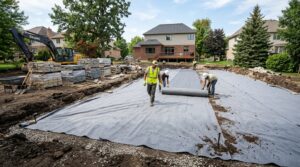
Only in specific conditions. Geotextile fabric is useful over clay, moist silt, seasonally saturated soil, or areas near a high water table. On Sarasota’s well-drained sand, it isn’t always necessary. We use it when the subgrade shows silt content or when building near coastal areas where the water table sits close to the surface. It separates base aggregate from the soil below, preventing fines from migrating upward.
How do I calculate how much crushed rock I need?
Multiply the area in square feet by the compacted depth in feet, then divide by 27. Example: a 200-square-foot area at 6 inches of depth equals 200 × 0.5 ÷ 27, or 3.7 cubic yards. Add 10% to 15% for compaction and waste. If ordering by the ton, ask your supplier for the material’s bulk density to convert yards to tons.
If you’re planning a paver project in Sarasota, Venice, Bradenton, Nokomis, or Osprey, a free estimate lets us look at your soil, your drainage, and your layout before any material gets ordered. Our crew can walk your site and point out what photos can’t show, from subgrade conditions to slope direction. Reach out before the rainy season tests whatever’s under your pavers right now.