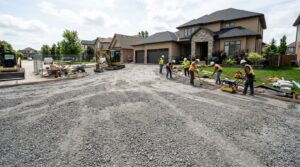
You are comparing paver colors, textures, maybe a herringbone for the driveway or a stacked bond around the pool. That is the part of the project you will see every day. But the paver layers underneath, the ones buried before the first stone goes down, determine whether your hardscape stays flat and drains properly for two decades or starts sinking after a couple of Sarasota rainy seasons.
We have been installing driveways, patios, and pool decks across Sarasota, Venice, Bradenton, and Osprey since 2000, and the pattern on repair calls is consistent: the pavers themselves are fine. The layers below them are not. Understanding what goes under your pavers puts you in a better position to evaluate any installer’s proposal, or to spot shortcuts before they become your problem.
Jump to:
The Five Paver Layers, Bottom to Top
Every ground-level paver installation stacks five functional layers. Each one has a specific job, a target thickness, and a predictable failure mode when someone gets it wrong.
| Layer (bottom to top) | Material | Typical thickness | What it does |
|---|---|---|---|
| 1. Subgrade | Native soil, mechanically compacted | Existing ground | Carries the weight of everything above it |
| 2. Geotextile fabric | Non-woven separation fabric | Single layer | Prevents soil from migrating into the aggregate |
| 3. Crushed rock base | Dense-graded aggregate (typically FL limestone) | 4 to 8+ inches | Distributes load and provides structural support |
| 4. Bedding sand | Washed concrete sand | 1 inch after compaction | Levels the surface for paver placement |
| 5. Surface system | Pavers + polymeric sand + edge restraints | Paver thickness (usually 2 3/8 in.) | Interlocks to transfer load across the entire surface |
The subgrade is whatever your property gives you after excavation. In most of Sarasota County, that means sandy soil, which drains better than clay but still needs mechanical compaction. Loose sand shifts under load, and a paver base built on uncompacted sand will follow it down.
Geotextile fabric sits between the subgrade and the crushed rock base. It keeps fine soil particles from working up into the aggregate over time, which would weaken the structural layer. CMHA’s construction guidance identifies geotextile separation as particularly important when the subgrade is fine-grained or stays saturated. In our area, we always use fabric in coastal zones near Nokomis and Casey Key where organic or silty soils show up in the first few inches of excavation.
The crushed rock base is where the real structural work happens. We cover its depth in detail below, because this is the layer where most installation failures begin.
Bedding sand goes over the compacted base as a thin, uniform leveling course. And at the top, the pavers, polymeric sand in the joints, and edge restraints work together as a locked surface. Remove any one of those three components, and the interlocking system breaks down.
Base Depth: The Number That Changes Everything
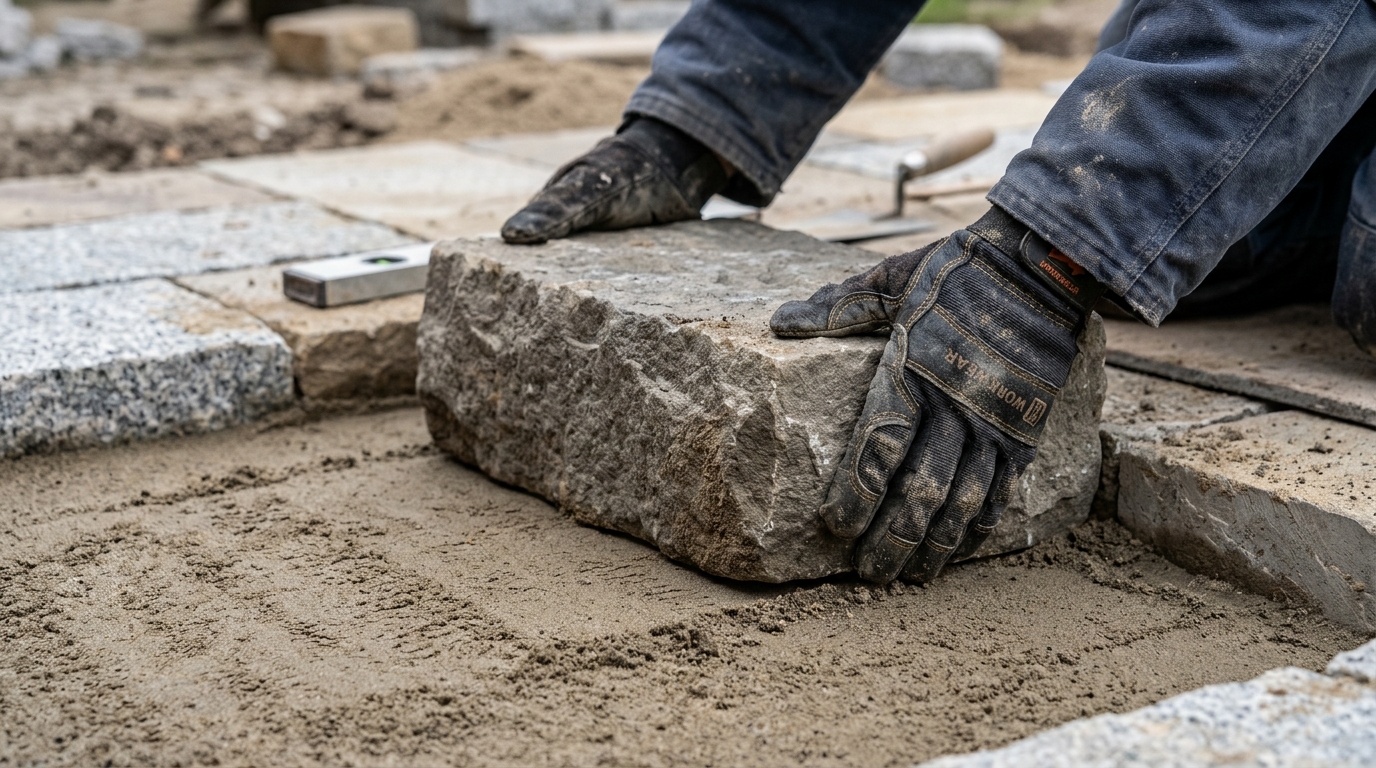
If someone gives you a quote for a paver patio without discussing base depth, ask. It is the single most consequential variable in the entire project.
CMHA publishes favorable-condition minimums for dense-graded aggregate base:
- 4 inches for pedestrian areas (patios, walkways)
- 6 inches for residential driveways
- 8 inches for parking lots and residential streets
“Favorable conditions” means strong, well-drained soil and a climate without deep frost. Sarasota checks both boxes. Our sandy subgrade drains reasonably well, and we do not deal with freeze-thaw cycles that force northern installers to double their base. That means the CMHA minimums are a realistic starting point here, not an optimistic number that needs automatic adjustment upward.
Where we do add depth is on properties with a high water table. Parts of Osprey, the barrier islands, and low-lying lots near Phillippi Creek stay damp most of the year. Soil that sits in moisture loses bearing capacity. On those sites, we typically add 2 to 4 inches of base and sometimes install a French drain or underdrain below the aggregate to give water somewhere to go besides up through the base.
Compaction is the other half of the equation. We compact in lifts of 3 to 4 inches, running a plate compactor over each lift before adding the next. Dumping 6 inches of crushed rock in at once and compacting only the top creates a firm surface over a loose foundation. It looks ready. It is not. Six months later, the bottom half settles, and the pavers follow.
For a driveway handling daily car traffic, we stay at or above 6 inches of compacted base—learn more about proper driveway paver base specifications. For a backyard patio on solid sandy ground, 4 inches works. For pool decks, the base also needs to account for saturated conditions created by the pool shell itself. Every site is different, which is why a soil check and a tape measure matter more than a formula.
Bedding Sand Is Not a Correction Layer
This is the mistake we see most often on jobs we are called to fix. Someone noticed dips in the compacted base but filled them with extra sand instead of more aggregate. Two inches of sand here, three inches there. The base looked level. The pavers went down. Everything looked great for a few months.
Then the thick sand pockets compressed unevenly, and the pavers above them sank. The dip you see in the middle of your patio is not a paver problem. It is a bedding problem created by using bedding material to do the base’s job.
The rule is straightforward: correct base deviations with base rock, not sand. CMHA specifies a uniform 1-inch bedding layer after compaction. That is the entire tolerance. If the base has a low spot deeper than an inch, add crushed rock, compact it, screed fresh bedding sand, and then lay the pavers.
Material matters, too. CMHA’s technical guidance on bedding sand recommends washed concrete sand and limits fines passing the No. 200 sieve to 1%. Even 3% fines can reduce permeability fivefold, trapping water inside the bedding layer. Limestone screenings and stone dust are not suitable substitutes. They break down under moisture and repeated loading, turning your bedding into a soft, water-retaining paste.
In Sarasota, where summer storms can drop 2 inches of rain in an hour, trapped water in the bedding layer is not a hypothetical risk. It is a Tuesday afternoon.
Joint Fill and Edge Restraints Complete the System
Pavers interlock through their joints. Each unit transfers load to its neighbors, but only if the joints are filled and the edges are held. Without both, individual pavers shift, rock, and separate under foot traffic or vehicle weight.
We use polymeric sand in paver joints on nearly every project. Polymeric sand contains a binder that activates with water and firms up, locking the pavers together and resisting washout. It also inhibits weed growth and ant tunneling through the joints. Standard joint sand works in theory, but in our climate it tends to wash out during summer downpours, which means refilling joints every year or two.
A proper joint is filled to within about 3 mm of the paver surface. Not flush, and not halfway down. Overfilling leaves a film of polymeric residue on the paver face that is difficult to remove. Underfilling lets water run through instead of over the surface, accelerating erosion at the base of the joint.
Edge restraints are the piece homeowners rarely think about until pavers start creeping outward. We install spiked plastic or aluminum edging along every border of the paver field, pinned into the base with 10-inch spikes. Without restraints, the outermost row of pavers shifts under load, the joints open, and the spreading works inward. This is especially common on walkways where there is no hard border like a foundation wall or retaining wall on both sides.
If you are considering paver sealer, know that sealing protects the surface and improves joint-sand stability. But it does not replace properly filled joints or solid edge restraints. The system works from the bottom up.
How Sarasota’s Climate Tests Every Layer
Florida’s conditions stress paver layers in ways that differ from projects in New Jersey or Ontario. Here is what actually matters on the ground in our area.
Rain volume and intensity. Sarasota averages over 55 inches of rain per year, most of it falling in intense afternoon storms from June through September. That water has to move. If your base is not graded to drain at a minimum slope of 1/4 inch per foot (roughly 2% away from the house), water pools under the pavers, softens the bedding sand, and eventually degrades the base aggregate.
Sandy subgrade. Our native sand drains well, which is a genuine advantage over the clay soils found in other parts of the country. But sand compacts differently than clay. It requires proper mechanical compaction, not just the weight of the aggregate sitting on top of it, to become a stable platform.
No freeze-thaw, but extreme heat. We do not have frost heave. That eliminates one of the biggest structural threats to paver layers in northern climates. What we do have is sustained heat that bakes polymeric sand, accelerates sealer breakdown, and causes thermal expansion in concrete pavers. These are surface effects, not structural ones, but they influence maintenance schedules. Plan on cleaning and resealing every 2 to 3 years in full-sun areas.
High water table. Properties near the coast, along Phillippi Creek, or in low areas of Osprey can have a water table within a few feet of the surface during the wet season. A base that sits in standing water loses bearing capacity. On these sites, we factor in underdrains and sometimes raise the finished grade to keep the aggregate above the seasonal high water mark.
Permeable Paver Layers Are a Different System
If you have looked at permeable pavers, the first thing to understand is that the layers underneath them are not the same as a conventional installation. You cannot swap a permeable paver onto a standard dense-graded base and expect stormwater performance.
A permeable interlocking concrete pavement (PICP) system replaces dense-graded aggregate with open-graded stone for both the base and bedding layers. The joints are filled with small, clean stone chips instead of sand or polymeric sand. EPA describes the system as combining surface pavement with underground storage and a controlled drainage outlet. Water enters through the joints, passes through the stone bedding, and flows into a reservoir of open-graded aggregate below. From there it either infiltrates the soil or drains through a pipe to a designated discharge point.
| Layer | Conventional system | Permeable PICP system |
|---|---|---|
| Joints | Polymeric sand or joint sand | Clean, angular stone chips (no sand) |
| Bedding | Washed concrete sand, 1 inch | Open-graded stone chips, 2 inches typical |
| Base | Dense-graded aggregate | Open-graded aggregate reservoir |
| Water path | Surface runoff, graded away | Through joints, into reservoir, to soil or pipe |
| Maintenance | Joint refill, sealing, cleaning | Periodic vacuum sweeping to prevent clogging |
Permeable systems make sense in Sarasota for managing runoff on properties where impervious coverage limits apply or where directing stormwater away from a neighbor’s lot is a concern. But they carry a maintenance obligation that conventional pavers do not. A USGS field study in Madison measured a 69% reduction in suspended solids for permeable interlocking pavers, but also documented how sediment capture gradually reduced infiltration capacity. Maintenance partially restored it. The point is clear: permeable paver layers handle water, but they need ongoing attention to keep handling it.
When a Layer Fails, the Surface Tells You Which One
After more than 25 years of repair calls across Sarasota County, we can usually diagnose the failing layer before we pull a single paver. The surface shows specific symptoms depending on what went wrong below.
If you notice broad sinking or dipping across a large area, the base or subgrade is the likely problem. The aggregate was not deep enough, was not compacted in proper lifts, or the native soil beneath it was never properly prepared. This is the most expensive fix because it means pulling pavers, removing sand and aggregate, recompacting or adding material, and rebuilding from the bottom up.
A depression directly under a heavy object (a large planter, a built-in grill, a table that never moves) points to the bedding layer. If the base is solid everywhere else, someone probably used too much sand in that spot. The extra sand compressed under sustained weight. The fix is localized: pull the pavers in that zone, correct the base with aggregate if needed, screed fresh bedding to a uniform 1 inch, and relay.
When pavers shift or spread outward at the edges, the edge restraints are the issue. They were never installed, the spikes pulled out of soft soil, or a landscaper’s edger cut through the plastic. Resetting restraints with longer spikes and backfilling behind them usually solves it without disturbing the rest of the field.
Weeds, ant mounds, or visible sand loss in the joints means the joint fill has failed. The polymeric sand may not have been activated properly during installation (it needs a specific amount of water and curing time), or standard sand was used and washed out over successive storms. Cleaning the joints, removing old material, and refilling with quality polymeric sand restores the interlock.
Water pooling on the surface after rain is a grade or drainage problem. The pavers were not installed with adequate slope, or the base was not graded toward an outlet. Sometimes root growth or soil settlement beneath the base changes the grade years after installation. Correcting this often means releveling sections of the base, not just the pavers on top.
Every surface symptom traces back to a buried layer. The pavers are the messenger.
If you are planning a paver project in Sarasota, Venice, Bradenton, Nokomis, or Osprey, a free estimate lets us walk your site, check soil conditions, and spec the right base depth before anything gets dug up. That conversation costs nothing and can save you from the kind of layer problems that only show up after the pavers are down.
Frequently Asked Questions
What is the correct order of paver layers?
From the bottom up: compacted subgrade, geotextile fabric (where soil conditions call for it), crushed rock base compacted in 3-to-4-inch lifts, 1 inch of washed concrete bedding sand, pavers, polymeric joint sand, and edge restraints. Each layer has a target thickness and a specific material. Skipping the fabric or substituting the wrong sand shifts the cost to a future repair.
How deep should I dig for a paver patio in Florida?
Add paver thickness (typically 2 3/8 inches), 1 inch of bedding sand, and base depth. For a patio on Sarasota’s sandy soil, that comes to about 7.5 inches of total excavation—see our detailed guide on paver base thickness for patio installations. A driveway needs at least 6 inches of base, bringing the total closer to 9.5 inches. Properties with a high water table may require additional base depth and an underdrain.
Can I use stone dust or limestone screenings instead of bedding sand?
We do not recommend it. Stone dust contains excessive fine particles that trap moisture and lose stability when wet. CMHA warns against limestone screenings as bedding material because fines degrade under wetting and repeated loading. Use washed concrete sand with less than 1% passing the No. 200 sieve.
Do I need geotextile fabric under my pavers?
In most Sarasota installations, yes. The fabric prevents fine sand particles from migrating into the crushed rock base, which would reduce its structural integrity over time. It is inexpensive, adds minutes to the install, and prevents a problem that would not surface until years later when the base begins settling unevenly.
Can lightweight panel bases replace crushed rock for a driveway?
Not automatically. Widely available panel products are rated for pedestrian traffic only. They work well for patios and walkways in tight spaces where hauling aggregate is impractical, but a driveway needs a base system rated for vehicle loads. Verify the manufacturer’s specific load rating before using panels under anything heavier than foot traffic.
How long do properly installed paver layers last?
A well-built crushed rock base and compacted subgrade should remain stable for decades if installed with correct depth, lift compaction, and drainage. What needs periodic attention is the surface system: polymeric sand can degrade in 3 to 5 years under Florida sun, sealers need refreshing every 2 to 3 years, and edge restraints should be checked annually. The buried layers are the long-term investment. The surface layers are the maintenance items.