You type “joint compound for pavers” and the results blur together: polymeric sand, resin mortar, epoxy jointing compound, permeable aggregate. Five different products, five different price points, all claiming to solve the same problem. Here in Sarasota, we see the consequences when a homeowner (or a previous contractor) picks the wrong one. The joints wash out during a June thunderstorm, weeds push through before Thanksgiving, or a white haze coats pavers that were expensive to begin with.
The confusion is understandable. “Joint compound” is not one product. It is an umbrella term covering at least four distinct materials, each engineered for different joint widths, paver types, base systems, and drainage goals. Getting the right answer requires knowing which one fits your project, and that starts below the pavers, not between them.
Jump to:
What “Joint Compound for Pavers” Actually Covers
In drywall work, “joint compound” means one thing. In paver work, it means whichever material fills the gap between units. The Concrete Masonry & Hardscapes Association (CMHA) explains that when pavers are compacted, joint material transfers vertical loads between units through shear forces. That gap is structural, not decorative. What you put in it changes how the pavement handles weight, water, and movement.
Here are the main categories:
- Loose graded sand. Dry sand swept and compacted into joints. It has worked for decades on conventional interlocking pavements. It is also the first material to migrate out under heavy rain or pressure washing.
- Polymeric sand. Screened sand blended with binding agents that harden after activation (usually with water). This is the most common upgrade from loose sand on residential patios and driveways.
- Resin-based jointing compound. A synthetic-resin mortar that sets harder and typically lasts longer than polymeric sand. Some formulations remain water-permeable after curing. ROMEX, for example, describes its paving joint mortars as synthetic-resin based and water-permeable.
- Flowable porcelain joint compound. A primer-and-compound system designed for porcelain pavers with tight 3 to 10 mm joints, producing an impermeable, bonded finish.
- Open-graded aggregate. Angular stone (ASTM No. 8, 89, or 9) used in permeable paver systems where the goal is stormwater infiltration, not binding.
Each solves a different problem. A resin compound in a permeable paver system defeats the drainage design. Loose sand on a steep Sarasota driveway will not survive the first heavy rain. The question is never “which joint compound is best?” It is “which joint compound fits this base, this paver, this joint, and this climate?”
That brings up the two materials homeowners compare most often.
Polymeric Sand vs. Resin-Based Compound
Most Sarasota homeowners choosing between products are really choosing between polymeric sand and a resin-based jointing compound. They look similar in a bag, but they behave differently on the ground.
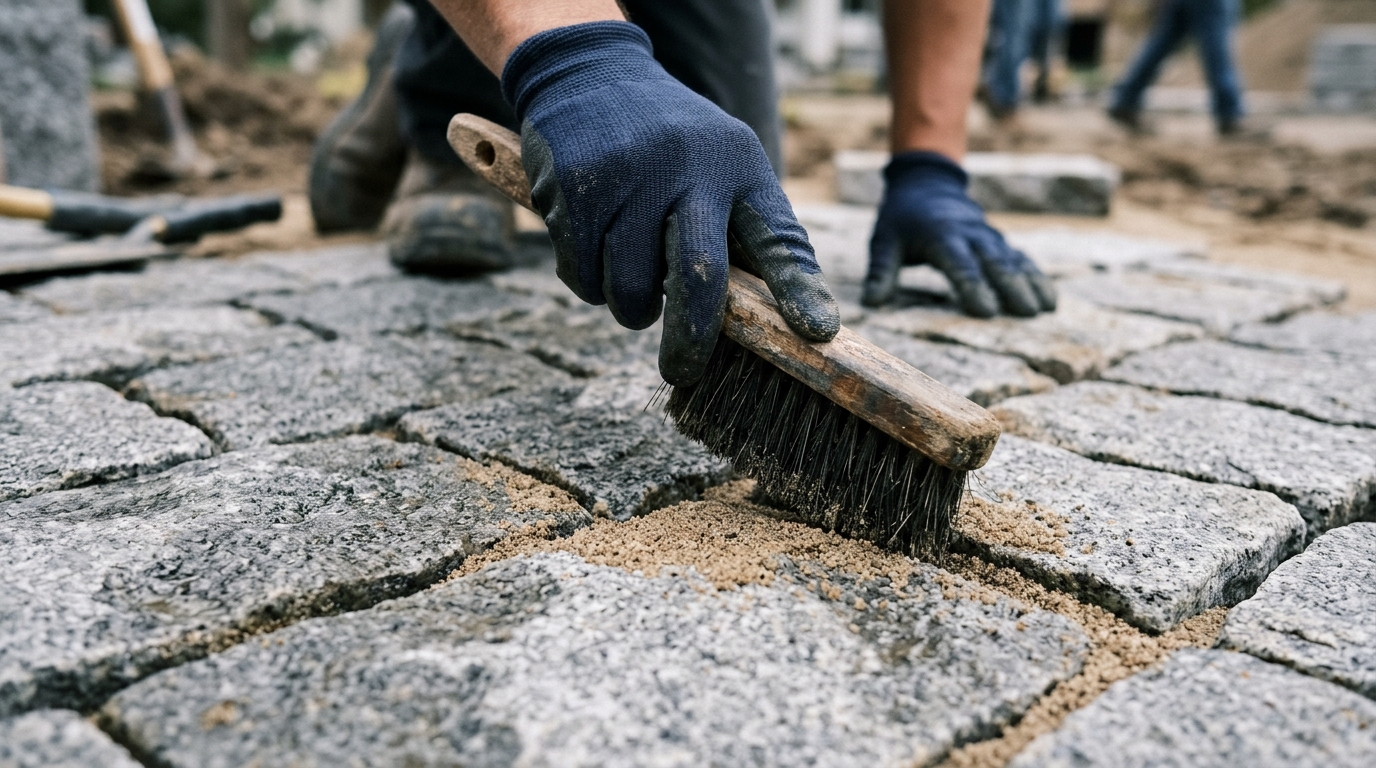
Polymeric sand is silica sand with polymer binders. You sweep it into joints, compact the pavers, mist with water, and the polymers activate and bind the grains. Sika’s Evolution Polymeric Sand, for instance, requires 24 rain-free hours after activation, or 48 hours for joints wider than half an inch. That cure window matters in a place where afternoon storms roll in with little warning from May through October.
Resin-based compound uses a synthetic resin (often epoxy) instead of water-activated polymers. The result is a harder, more durable joint that can last up to 20 years in the right conditions, compared to 3 to 10 years for polymeric sand. Some products allow wet application, which eliminates the rain-timing gamble. The trade-off is cost: resin compounds typically run two to three times the material price per square foot, and application takes longer.
Here is a practical comparison for the decisions we see homeowners facing:
| Factor | Polymeric Sand | Resin-Based Compound |
|---|---|---|
| Typical joint width | 1/16 to 1/2 inch (varies by product) | 1/8 inch to 2+ inches |
| Expected lifespan | 3 to 10 years | Up to 20 years |
| Rain sensitivity during install | High (24 to 48 hour dry window) | Low to moderate (some allow wet application) |
| Weed resistance | Good when joints are full | Better, due to harder cure |
| Approximate material cost | $20 to $90 per container | $50 to $75+ per container |
| Permeability | Varies by formulation | Some products are permeable; others are not |
| Repair | Remove old material, resweep, reactivate | Harder to remove; patching may be possible |
Neither product is universally better. A concrete paver patio with standard 3 mm joints on a well-drained crushed rock base does perfectly well with quality polymeric sand, reapplied as part of regular maintenance. A travertine pool deck with wider joints exposed to daily splash-out may justify the resin compound’s longer life and water tolerance.
But here is what every product comparison leaves out: neither material can compensate for what is underneath.
Why Joint Choice Starts Under the Pavers
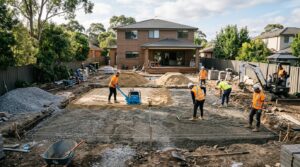
We have pulled up hundreds of failed paver installations in Sarasota and surrounding areas. In the overwhelming majority of cases, the joint material was not the root problem. The base was.
A joint compound sits inside a gap that is typically 2 to 5 mm wide and an inch or two deep. The base beneath the pavers can be 6 to 12 inches of compacted crushed rock supporting the entire structure. CMHA notes that joint sand stabilization is generally optional for many interlocking concrete pavements because a properly compacted base and bedding layer already handle the structural load. The joint compound helps with erosion, insect resistance, and aesthetics, but it does not hold the pavement together.
In Sarasota’s climate, three base factors determine whether any joint material will survive. Choosing the best base for pavers means accounting for drainage, compaction, and soil conditions:
Drainage slope. We grade every base at a minimum of 1/8 inch per foot of fall toward a drainage path. Standing water beneath pavers softens the bedding sand, allows the base to shift, and opens joints that no compound can hold together. During our rainy season, 7 to 9 inches of rain in a single month is routine. If that water pools under the pavers instead of draining through or away, the joints crack, separate, or wash out.
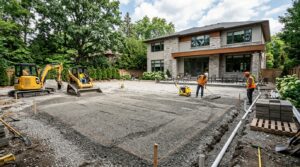
Base compaction. We compact our crushed rock base in 3 to 4 inch lifts using a plate compactor, reaching 95% or greater modified Proctor density. For projects where drainage and load-bearing are paramount, we often recommend a limestone base for pavers due to its superior compaction characteristics. If the base is undercompacted, the pavers settle unevenly, joints widen on one side and pinch on the other, and the compound fractures under the stress. This happens regardless of whether you use a $25 bag of polymeric sand or a $70 container of resin compound.
Sandy soil behavior. Sarasota sits on fine sandy soil that drains quickly but offers poor bearing capacity unless properly prepared. We excavate 8 to 12 inches below finished grade (more for vehicular driveways) and build up with compacted crushed rock so the pavers rest on engineered fill, not native sand that shifts with moisture. The joint material is the last thing that goes in. If everything beneath it is solid, the joint lasts. If not, the joint is the first thing to show the failure.
So before you spend time choosing between polymeric sand and resin compound, make sure the conversation starts with the base. A free estimate tells you exactly what your base needs, and that determines which joint material makes sense.
Once the base is right, the next question is matching the compound to what sits on top of it.
Matching the Compound to Your Paver and Joint Width
Not every product fits every gap. Techniseal’s EZ Sand lists a range of 1/16 to 1/2 inch and a minimum joint depth of 1.5 inches. That works for most standard brick pavers and concrete pavers set tight. But travertine or natural stone with irregular edges can produce joints of 3/4 inch or wider, which falls outside that product’s range entirely.
Here is how we think about the match:
Standard concrete pavers with uniform edges and 2 to 5 mm joints: polymeric sand is the default. Joint depth of at least 1.5 inches is achievable on a typical 2 3/8 inch paver, leaving room for the sand to bind properly.
Travertine and natural stone with wider, irregular joints: resin compound or a no-compaction formulation designed for 1/4 to 2 inch joints. Techniseal’s NOCO product, for example, is designed for flagstone and paving where mechanical compaction is difficult. We use this type of product on natural stone installations where a plate compactor would crack the material.
Porcelain pavers with tight 3 to 10 mm joints set on a mortar bed: a flowable porcelain jointing compound with a bonding primer. Standard polymeric sand does not adhere well to the non-porous surface of porcelain.
Permeable pavers with open joints designed for stormwater infiltration: angular aggregate (not a binding compound). CMHA specifies angular ASTM No. 8, 89, or 9 stone in open joints for permeable interlocking concrete pavement and warns that preventing sediment entry is a high maintenance priority. Putting polymeric sand in a permeable system seals the very openings the system depends on.
The pattern here is simple: check the technical data sheet for the specific product, not the marketing on the bag. Look for joint width range, minimum depth, base requirements, paver compatibility, and cure conditions. If any one of those does not match your project, that product is wrong regardless of how many stars it has online.
When you have the right product in hand, the installation method makes or breaks it.
How We Handle Joint Compound in Sarasota
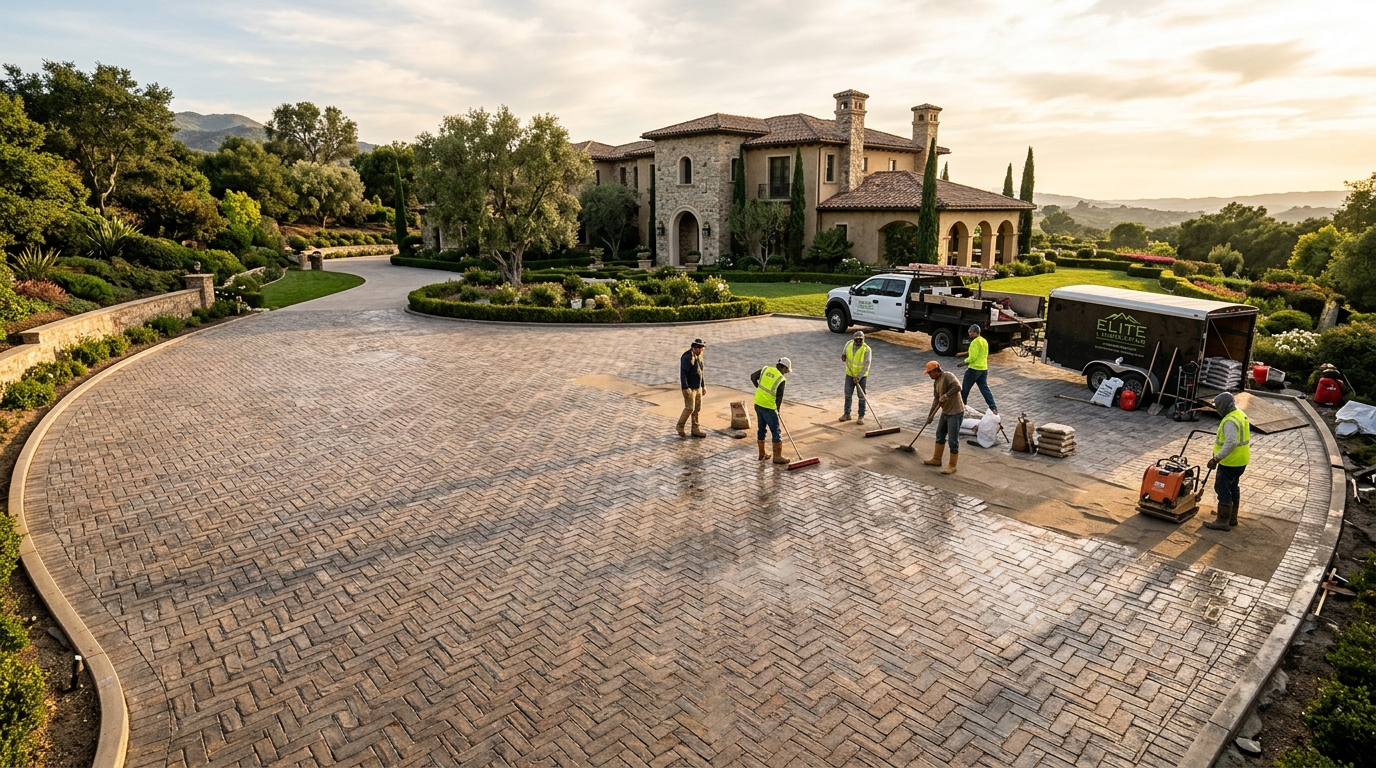
We have been filling paver joints in this climate since 2000, and the process we follow accounts for the conditions that ruin shortcuts. Here is what it looks like for a typical polymeric sand application, since that covers most residential work.
Surface prep. Every joint must be clean and dry to the depth specified on the product sheet (usually 1.5 inches minimum). Old sand, debris, and organic material come out first. On maintenance jobs where we are cleaning pavers before rejointing, we let the surface dry completely before sweeping in new material. Damp joints activate the polymers prematurely, and that is how haze happens.
Sweeping and filling. We sweep the sand across the surface with stiff brooms, working it into every joint. Then we compact with a plate compactor (rubber pad on to protect the paver face) so the sand settles to full depth. Sweep again, compact again. The goal is joints filled to within 1/8 inch of the paver chamfer, not heaped on top.
Surface cleaning before activation. Any sand granules left on the paver face will haze when water hits them. We blow the surface clean with a leaf blower set low enough not to pull sand from the joints. This step is not optional.
Water activation. A fine mist, not a jet. We water in passes, letting each pass soak in before the next, following the product’s specific instructions. Flooding the surface washes the binder to the top of the joint and leaves the bottom unbound.
Weather timing. We schedule polymeric sand work for mornings during the rainy season, checking radar for a 24 to 48 hour dry window. If the forecast is uncertain, we either shift the schedule or use a product rated for wet application. Installing a water-activated polymeric sand with rain two hours away is a recipe for a callback.
For resin-based compounds, the process differs: application may involve troweling or pouring rather than sweeping, and cure chemistry varies by brand. But the principle is the same. Follow the data sheet, not the shortcut.
Even with a correct installation, joints can fail over time. Knowing why helps you respond before the damage spreads.
When Joints Fail and What Fixes Them
Four common failures, and what we find when we pull things apart:
Washout. Sand disappears from joints after heavy rain. If the pavers are level and the base is solid, the cause is usually insufficient product depth, premature rain exposure during cure, or plain loose sand that was never stabilized. The fix: clean the joints to full depth, let them dry, and refill with the correct polymeric sand or compound.
Haze. A cloudy white film coats the paver surface. This is polymer residue that was activated on the face rather than in the joint. It is easier to prevent (by cleaning the surface before watering) than to remove. On textured pavers, haze can be stubborn. Paver sealers applied over haze lock it in permanently, so the haze must come off before any sealing.
Cracking. Joints split or crumble. A common failure sequence starts with a joint cracking under load, then fragments washing out in the first heavy rain. When we see cracking across a large area, we check the base first. If the pavers are shifting because the base settled, refilling the joints treats the symptom. The base needs to be corrected, or the new joints will crack the same way.
Weeds. Even a fully filled joint does not make a patio weed-proof. Wind-blown soil and leaf litter accumulate on top of joints, and seeds root in that surface layer. Regular cleaning and maintenance do more for weed control than the joint material alone. If weeds are growing inside the joints, that means the compound has degraded or was never properly filled.
The practical rule: if joints fail in one spot, the problem is usually installation or localized drainage. If joints fail everywhere, the problem is likely the base or the wrong product for the conditions.
Frequently Asked Questions
Can I use drywall joint compound on pavers?
No. Drywall joint compound is gypsum-based and dissolves in water. Paver joint compound refers to polymeric sand, resin mortar, or aggregate designed for outdoor exposure, load transfer, and drainage. They share a name but nothing else.
How often does polymeric sand need to be replaced?
In Sarasota’s climate, we typically see polymeric sand last 3 to 7 years on patios and pool decks, depending on drainage, sun exposure, and how often the surface is pressure washed. Resin-based compounds can last significantly longer, up to 15 to 20 years, but cost more upfront.
Does joint compound work on permeable pavers?
Standard polymeric sand or resin compound should not go in permeable paver joints. Those systems use open-graded angular stone so stormwater can pass through. A binding compound seals the joints and defeats the drainage design.
Can I apply polymeric sand myself?
You can, but the margin for error is narrow. Joints must be clean, dry, and filled to the correct depth. Sand left on the surface causes haze. Rain during the cure window can ruin the job. If you are comfortable with the process and can control the timing, it is a manageable DIY task on a small patio.
What causes the white haze after filling joints?
Polymer binder residue left on the paver face, activated by water. The fix is thorough surface cleaning (blowing, not just sweeping) before the water activation step. Once haze sets, removal requires specialized cleaners and sometimes professional equipment.
Is joint compound the same as paver sealer?
No. Joint compound fills the gap between pavers. Paver sealer coats the paver surface and can also help lock joint sand in place. They work together but serve different purposes. Sealer goes on after the joint material has fully cured.
If your paver joints are washing out, cracking, or sprouting weeds, the answer is not always a different bag of sand. Sometimes the base needs attention. Sometimes the product just needs to match the joint. Our crew can walk your patio or driveway and point out what a photo cannot show. Reach out for a free estimate before the rainy season tests your base again.