You’re about to spend a few thousand dollars on pavers, and you want them to stay level. The best base for pavers is what decides whether that happens, not the paver brand, not the color, not the laying pattern.
We’ve been installing driveways, patios, pool decks, and retaining walls across Sarasota, Venice, Bradenton, Nokomis, and Osprey since 2000. Our own crew, no subcontractors. In that time, we’ve torn out a lot of other people’s work. The pavers themselves are almost never the problem.
For most residential projects in Florida, the answer is a properly compacted dense-graded crushed rock base topped with about 1 inch of washed concrete sand for bedding. That’s the short version. The rest of this article explains why, when it changes, and what Sarasota’s soil and rain demand that a generic depth chart can’t tell you.
Jump to:
What a Paver Base Does and Why Florida Soil Changes the Equation
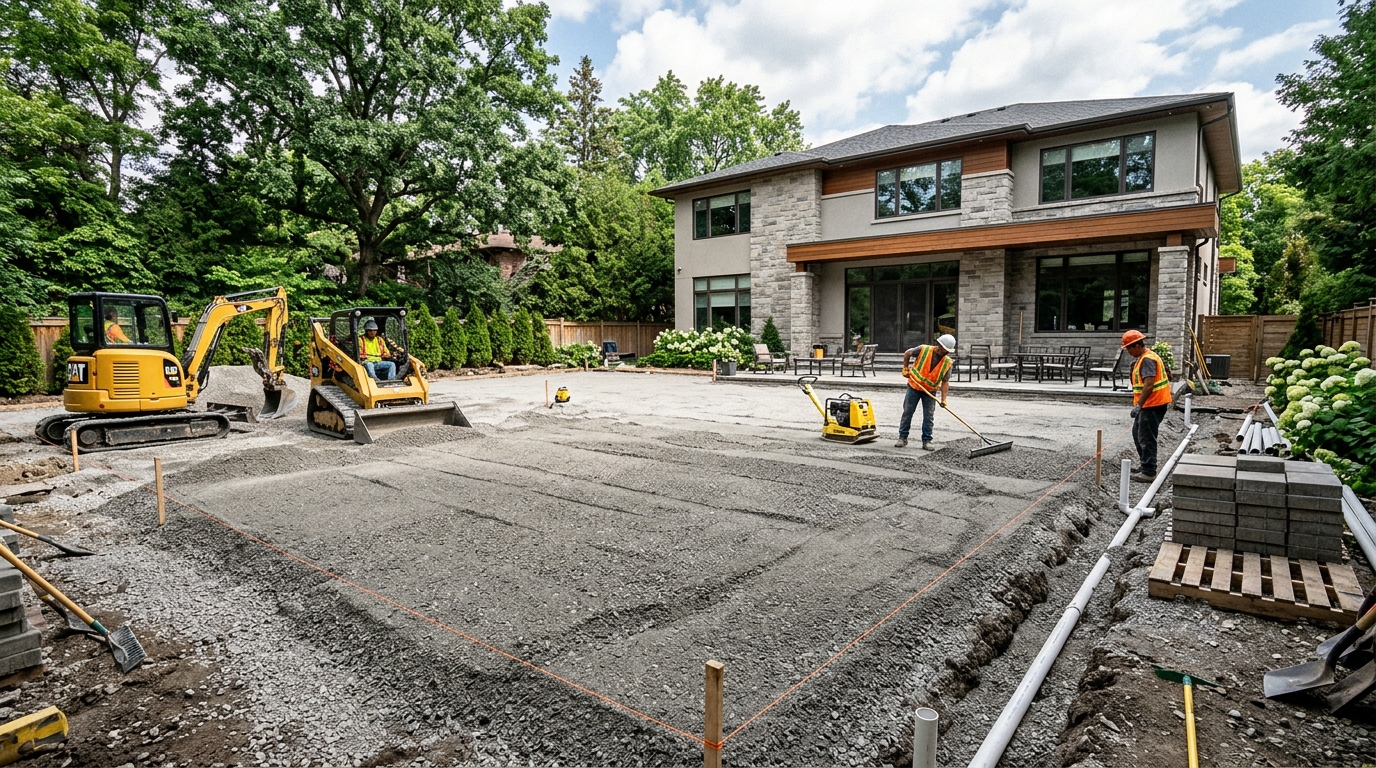
A paver installation has four layers, each with a specific job. The subgrade is your native soil; it supports everything above it. The crushed rock base distributes weight and handles drainage. The bedding course (a thin layer of sand) gives the pavers a uniform setting surface. And the pavers themselves, held tight with polymeric sand or standard joint sand, form the finished surface you walk and drive on.
Skip a layer, skimp on a layer, or swap one layer’s material for another, and the pavers move. Sometimes in months. Sometimes in weeks, if the timing is bad.
In Sarasota, two local conditions shape every base decision we make.
First, the rain. We get roughly 55 inches a year, and most of it falls between June and September in storms that can dump 2 to 3 inches in a single hour. Water has to move through or around the base fast. If it pools, it softens the subgrade, and the whole system sinks unevenly.
Second, the soil. Most of Sarasota County sits on well-drained sandy ground, which is actually a gift for paver work. But we regularly hit shell layers, pockets of clay (especially east of I-75 toward Myakka), and areas with a high water table near the bay. Each of those calls for a different response in base depth, material, and drainage strategy.
The base isn’t just a platform. It’s the drainage plan, the load-distribution system, and the long-term stability of the entire hardscape, all in one layer of rock.
Dense-Graded Crushed Rock: The Standard That Works
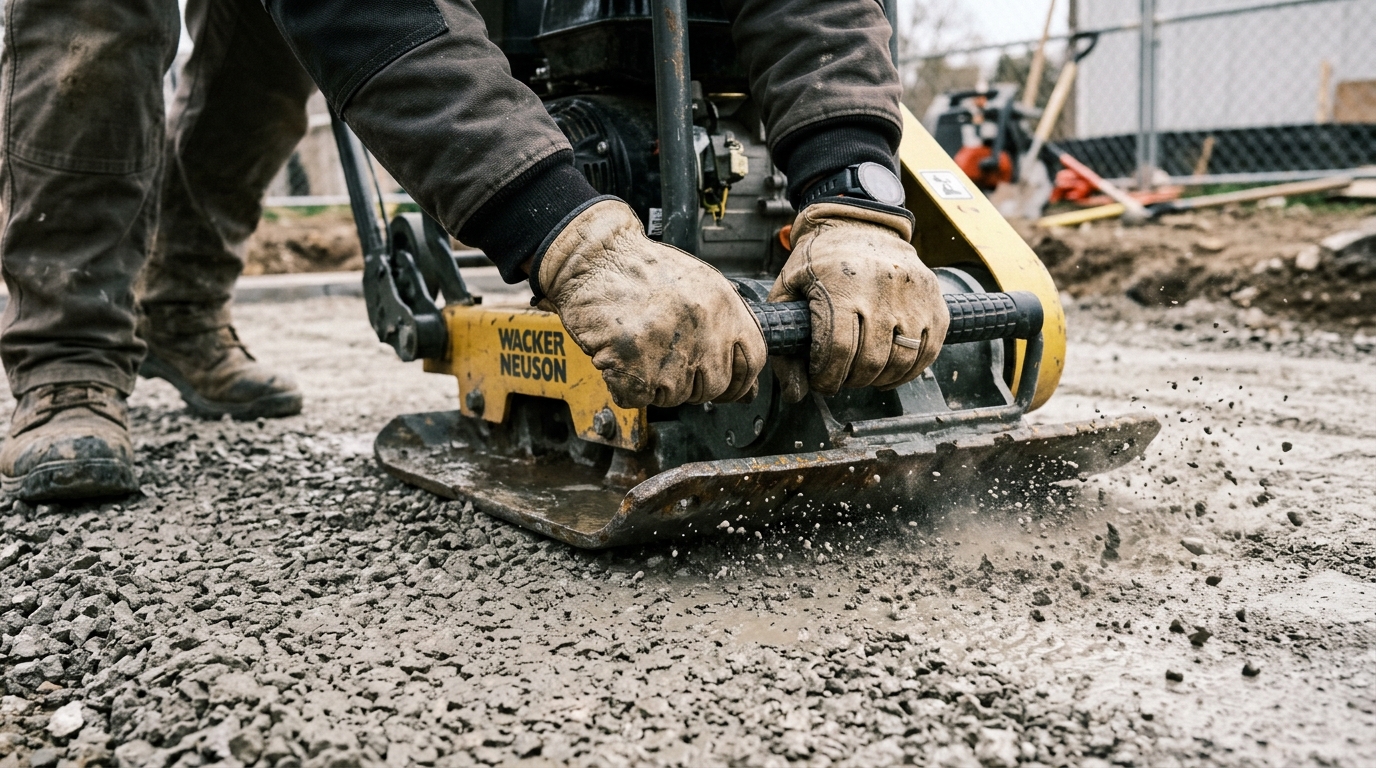
For the majority of patio, driveway, and pool deck projects we install, a dense-graded crushed rock base is the right call. “Dense-graded” means the aggregate contains a mix of particle sizes, from coarse stones down to fines, so it locks together tightly when compacted. You might hear it called “crusher run,” “road base,” or “3/4-minus” at a local yard.
What matters is the gradation, not the nickname. CMHA’s construction guidance accepts properly specified road-base aggregate meeting standards like ASTM D2940. The mix of particle sizes is what gives the layer its strength: fines fill the voids between coarse pieces, creating a stable, interlocking mass after compaction.
Here’s why we keep coming back to it for Florida residential work:
- It compacts predictably in lifts of 4 to 6 inches, building up reliable density layer by layer.
- It handles Sarasota’s concentrated summer rain well. The fines slow vertical drainage, but the compacted surface sheds water laterally toward the edges, where proper grading carries it away from the structure.
- It resists deformation under static loads: parked cars, planters, outdoor kitchens.
- It’s widely available from local quarries, which keeps cost and lead time reasonable.
Dense-graded aggregate does not drain freely through its profile the way open-graded stone does. That’s a feature for conventional installations, not a flaw. The bedding sand stays where you screeded it, the paver joints stay filled, and the surface drains by slope. We design for a minimum 2% cross slope on every project, which works out to roughly 1/4 inch per foot. On a 12-foot-wide patio, that means about 3 inches of fall from one side to the other.
Whether you’re laying concrete pavers, brick, or travertine, the base underneath follows the same structural logic. The paver material changes the finished surface; the base keeps all of them flat.
Open-Graded Aggregate: When Stormwater Management Is the Goal
Open-graded aggregate (clean crushed stone with a uniform particle size, like No. 57) is a different tool for a different job. The voids between the stones are large and unobstructed. Water passes straight through.
This is the foundation of permeable paver systems, and it’s increasingly relevant in parts of Sarasota County where stormwater codes are tightening. A properly engineered permeable interlocking concrete pavement (PICP) combines permeable joints, open-graded bedding (typically No. 8 stone), a No. 57 base course, and a larger subbase reservoir that temporarily stores rainfall. FHWA’s technical guidance describes these aggregate layers as both pavement support and a water-storage system, designed to drain within 48 to 72 hours.
But there’s an important distinction that gets blurred online. Laying standard sand-jointed pavers on open-graded stone is not the same as installing an engineered PICP system.
CMHA’s current guidance limits standard pavers on open-graded aggregate to residential pedestrian projects, not driveways or vehicular areas. The reason: joint sand migrates downward through the open voids. Polymeric sand can mask the problem by holding a crust at the surface while bedding sand disappears beneath it. We’ve seen this on service calls. The joints look intact from above, but the pavers rock when you step on them.
If your project genuinely needs stormwater infiltration (a pool deck near a retention pond, a driveway in a subdivision with impervious-surface limits), we design a complete permeable system with the right aggregate reservoirs, geotextile separation, and underdrains where the water table or clay require them. If you just want a patio that doesn’t puddle, a well-sloped dense-graded base handles that without the added complexity and maintenance.
Lightweight Panel Systems: Less Digging, Not Less Preparation
Products like Gator Base and Brock PaverBase are expanded-polypropylene panels, roughly 3/4 inch thick, designed to replace several inches of traditional crushed rock. The appeal is obvious: less excavation, less material to haul, faster installation.
The limits are just as important. Gator Base is designated for pedestrian use. It won’t support a car on your driveway or the concentrated load of a heavy stone fire pit. Brock’s own guidance warns about framed loads like hot tubs, which concentrate force at the edges and can compress the panel unevenly.
Both products still require the subgrade to be properly compacted, level, and well-drained. A panel does not fix a soft, uncompacted hole. It reduces the volume of aggregate you need to move, which helps in tight-access backyards or projects where a skid steer can’t reach the site. We occasionally use panels for small walkway or stepping stone projects where access drives the decision. For a driveway or a large pool deck, crushed rock remains our standard.
How Deep to Dig in Sarasota’s Soil
Base depth depends on what’s driving over it (or sitting on it) and what the soil looks like once you break ground. Here’s the framework we use, grounded in CMHA’s published construction minimums and adjusted for local conditions:
| Application | CMHA Minimum (Well-Drained Soil) | Our Typical Depth in Sarasota |
|---|---|---|
| Walkway or patio (foot traffic only) | 4 inches | 4 to 6 inches |
| Pool deck | 4 inches | 6 inches |
| Residential driveway | 6 inches | 6 to 8 inches |
| Driveway with heavy vehicles (RV, boat trailer) | 8 inches | 8 to 10 inches |
These depths are for compacted crushed rock base alone. Add roughly 1 inch for bedding sand and the paver thickness (typically 2-3/8 inches for standard pavers, 3-1/8 inches for driveway-rated units) to calculate total excavation depth.
For a typical Sarasota patio on clean sandy soil, total dig depth runs about 7 to 8 inches below finished grade. For a driveway, figure 10 to 12 inches.
When do we go deeper?
- When we hit clay or organic material. We remove thin lenses entirely. If it’s a deep layer, we excavate an additional 50% beyond the standard depth and place geotextile fabric to prevent the clay from migrating up into the crushed rock.
- When the water table is high. Parts of Siesta Key, Bird Key, and neighborhoods near Phillippi Creek sit on water that rises during rainy season. We may add a drainage layer of clean No. 57 stone beneath the dense-graded material or install French drains at the base perimeter.
- When we find fill or disturbed soil. New construction often leaves behind uncompacted fill. It has to be removed or re-compacted before the base goes down. There’s no shortcut here.
A quick volume estimate helps set expectations. A 300-square-foot patio with a 6-inch compacted base needs roughly 5.6 cubic yards of crushed rock (300 × 0.5 ÷ 27), plus about 0.9 cubic yards of bedding sand. The material alone typically runs a few hundred dollars at Sarasota-area pricing, but excavation, hauling, compaction, and disposal of native soil add up fast. Base preparation usually accounts for a third or more of total project cost. That’s normal, not a markup.
Bedding Sand Is Not Base Material
This is the mistake we see most often in DIY projects and in work done by crews who don’t specialize in hardscape: using the wrong sand in the wrong layer, or using too much of it.
The bedding course sits on top of the compacted base. Its only job is to provide a smooth, uniform setting surface for the pavers to nest into. Target thickness after the pavers are placed and compacted: about 1 inch. Not 2. Not 3.
CMHA’s bedding-sand guidance specifies washed concrete sand meeting ASTM C33 gradation with no more than 1% passing the No. 200 sieve. That upper limit on fines is critical. Fines hold water. During a heavy Sarasota summer storm, bedding with too many fines can saturate and soften. Under load, it migrates. The pavers above settle unevenly, joints open up, and sand pumps through the gaps.
How fast can this happen? CMHA’s technical bulletin recounts a documented case where a segmental pavement opened to buses encountered continuous heavy rain within hours of completion. Fine material in the bedding migrated into drainage holes, bedding liquefied, and sand pumped through the joints, causing immediate rutting. The pavement was rebuilt with sand containing zero percent passing the No. 200 sieve and reportedly performed well. Stronger pavers would not have fixed the problem. The bedding was the failure.
Stone dust (also called screenings or quarry dust) is even worse. It breaks down over time, generates more fines, and doesn’t drain. CMHA explicitly rejects it for vehicular bedding. We don’t use it for any bedding application.
If someone suggests “just add more sand” to fix a low spot in the base, that’s a red flag. Thick sand compresses and shifts. Fix the base, then screed a consistent 1-inch bedding layer on top.
Compaction, Slope, and Edge Restraint
Three things separate a base that lasts from one that doesn’t. They’re not glamorous, and you’ll never see them once the pavers go down. That’s precisely why they get skipped. Preparing base for pavers requires attention to compaction, slope, and edge restraint in specific sequence.
Compaction
We compact the crushed rock base in lifts: 4 to 6 inches of loose material at a time, using a reversible plate compactor producing at least 5,000 pounds of centrifugal force (our standard unit runs about 7,000 lbf). The target is 98% of standard Proctor density, meaning the material won’t settle further under normal residential loads.
You can’t compact a 10-inch base in one pass. The compactor’s energy doesn’t reach the bottom. You end up with a firm top crust over a soft middle, and the settling shows up six months later as dips in the paver surface. Two lifts of 5 inches each, compacted individually, solve what one 10-inch pass never will.
Open-graded stone compacts differently. It consolidates through particle interlock, not by squeezing out air and fines. A few passes with the plate compactor seats the particles, but overworking open-graded material can fracture the aggregate and create the fines you were trying to avoid.
Slope
Every paver surface needs to shed water. We build the slope into the base, not just the finished surface. Our standard is 2% cross slope (1/4 inch per foot), which exceeds CMHA’s minimum of 1.5%. In Sarasota, where a 2-inch-per-hour downpour is routine from June through September, that extra margin prevents ponding at low spots.
On a 16-foot-wide driveway, 2% means 4 inches of fall from the center crown to each edge. We set string lines at the base stage and verify grade before any bedding goes down. Fixing slope after pavers are laid means pulling them up and starting over.
Edge Restraint
Pavers interlock through their laying pattern, but they don’t resist lateral movement on their own. Without a rigid perimeter, the outer units creep outward under load, joints open, and the pattern loosens. We install L-shaped plastic or aluminum edge restraints spiked into the compacted base on every project. On driveways, concrete headers or a soldier course border set in concrete serve the same function.
Edge restraint is especially easy to skip against a house wall or existing concrete slab. That’s exactly where we see joints opening on older installations we’re called to repair.
How Your Base Choice Shows Up Five Years Later
Most guidance about paver bases stops at installation day. But the base you choose determines your maintenance reality for the next decade.
A well-compacted dense-graded base under a properly sloped paver surface requires very little base-level maintenance. The ongoing work stays at the top: re-sealing every 3 to 5 years, re-sanding joints as polymeric sand gradually weathers, and occasional spot cleaning. The base itself stays put.
Permeable systems require more attention. A USGS study in Madison, Wisconsin, found that roughly 65% of permeable paver and pervious-concrete surfaces were essentially clogged after about one year under deliberately heavy sediment loading. That was an extreme test (a 9.3-to-1 drainage ratio with an old parking lot contributing sediment), not a forecast for a typical backyard. But the principle holds: permeable joints and open-graded voids collect sediment, leaf debris, and pollen. Vacuum sweeping once or twice a year keeps infiltration working. Without it, a permeable system gradually becomes a conventional one, except with joints that no longer hold sand properly.
An undersized or poorly compacted base, regardless of material, eventually produces the same symptoms:
- Uneven settling, visible as dips or waves in the paver surface
- Joint separation, where pavers pull apart and sand washes out
- Water ponding where it shouldn’t
- Edge creep, where the perimeter shifts outward and the herringbone or running bond pattern loosens
Fixing these problems means lifting pavers, correcting the base, and re-laying. On a driveway, that can cost as much as the original installation. The base is the cheapest thing to get right the first time and the most expensive thing to fix later.
Choosing the Right System for Your Project
Rather than picking a single “best” material for every situation, match the system to the job:
| Your Project | Recommended Base System | Why |
|---|---|---|
| Patio, walkway, or pool deck on sandy soil | 4-6″ dense-graded crushed rock + 1″ bedding sand | Proven, cost-effective, lowest long-term maintenance |
| Residential driveway | 6-8″ dense-graded crushed rock + 1″ bedding sand | Handles vehicle loads with well-documented construction methods |
| Driveway or parking with stormwater requirements | Engineered PICP with open-graded reservoir layers | Meets infiltration codes; requires full system design, not just thicker stone |
| Small patio with tight backyard access | Panel system over prepared, compacted soil | Reduces material hauling; pedestrian loads only |
| Pool deck or patio on clay or high water table | Deeper dense-graded base + drainage layer + geotextile | Addresses site-specific soil and water conditions |
The first question isn’t “which stone should I order?” It’s “which complete assembly fits this soil, this load, and this drainage situation?”
If you’re comparing bids, ask each contractor to specify the aggregate type and gradation, compacted base thickness, bedding material, compaction method, drainage slope, and edge restraint. A bid that just says “6-inch base” without those details leaves too much room for shortcuts you won’t see until the pavers start moving.
Our crew can walk your property and tell you exactly what the soil and grade need. That’s the kind of detail a photo can’t show, and it’s the difference between a paver surface that settles in two rainy seasons and one that stays flat for twenty years. Reach out before the rainy season tests your base.
Frequently Asked Questions
Can I use regular sand as a paver base instead of crushed rock?
No. Sand shifts under load and doesn’t interlock the way graded crushed rock does. Sand belongs in the bedding layer (1 inch, ASTM C33 gradation) and in the joints. Using it as a structural base leads to settling, especially under driveways or during Sarasota’s heavy summer storms.
Is pea gravel or river rock acceptable for a paver base?
No. Rounded stones don’t interlock. They roll under pressure, which means the pavers above them shift too. A paver base needs angular, crushed aggregate with a range of particle sizes so it locks together during compaction.
How long does a properly built paver base last?
In our experience across Sarasota, a correctly compacted dense-graded base on stable sandy soil lasts the full life of the pavers, often 25 years or more with no base-level intervention. Maintenance stays at the surface: joint sand replenishment, sealer, and periodic cleaning.
Do I need geotextile fabric under my paver base?
It depends on the soil. On Sarasota’s typical sandy ground, fabric is often unnecessary. If we encounter clay, organic material, or fill, we place geotextile between the subgrade and the crushed rock to prevent fine particles from migrating upward and contaminating the base. It’s a site-specific decision, not a default for every project.
What is the difference between a paver base and a permeable paver base?
A conventional dense-graded base contains mixed particle sizes that compact tightly and shed water by surface slope. A permeable paver base uses uniform, open-graded stone (like No. 57 or No. 2) that lets water flow through and temporarily stores it underground. Permeable systems require wider paver joints, specific bedding aggregate, and often underdrains or infiltration design.
Should I compact the soil before adding the crushed rock base?
Yes. The subgrade needs to be firm and uniform before any aggregate goes down. We compact the excavated bottom with a plate compactor and check for soft spots. An uncompacted subgrade defeats everything above it, no matter how well you compact the rock on top.