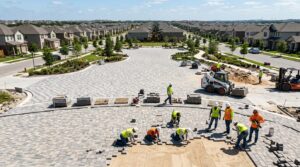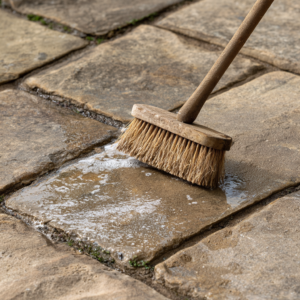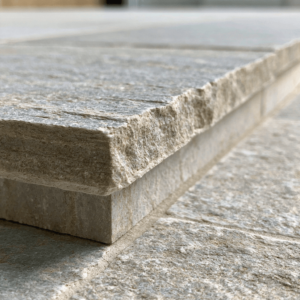
You’re scrolling product galleries or standing over sample boards, and every paver looks great in the photo. The real question is which one still looks right after five years of sun, rain, and daily use on your specific project. Six types of pavers cover nearly every residential hardscape job: concrete, brick, travertine, natural stone, porcelain, and permeable. Each behaves differently once it’s installed, rained on, and baked by Florida’s UV for a few seasons.
We’ve been installing all six across Sarasota, Venice, Bradenton, Nokomis, and Osprey since 2000 with our own crew, no subcontractors. What follows comes from that field experience: what each material delivers, what it costs once the base and labor are included, and what it asks from you after installation.
| Paver type | Best fit | Maintenance | Relative cost |
|---|---|---|---|
| Concrete | Driveways, patios, pool decks, walkways | Seal every 3 to 5 years | Lower to mid-range |
| Brick (fired clay) | Walkways, patios | Low; sealing optional | Mid-range |
| Travertine | Pool decks, covered patios | Seal every 2 to 3 years | Mid to upper range |
| Natural stone | Premium patios, accent areas | Varies by stone type | Upper range to premium |
| Porcelain | Patios, pool decks (pedestrian only) | Minimal; no sealing needed | Mid to upper range |
| Permeable | Drainage-critical driveways and patios | Annual vacuum sweeping | Mid to upper range |
Jump to:
Concrete Pavers
Concrete pavers are the most widely installed paver type in residential hardscape, and the one we lay most often. They’re manufactured from cement, aggregate, and integral pigment under hydraulic pressure. CMHA’s guide specification requires an average compressive strength of 8,000 psi under ASTM C936, with no individual unit below 7,200 psi and average water absorption at or below 5%. That is more than enough for driveways, patios, pool decks, and walkways.
What makes concrete pavers dominant is range. Dozens of colors, multiple surface textures (smooth, tumbled, antiqued, shot-blasted), and formats from small cobblestone shapes to large 24-by-24-inch slabs. The pigment is integral, mixed throughout the unit rather than painted on.
In Florida, two things matter most. First, UV: without paver sealer, the color lightens noticeably within two to three years. We seal most concrete paver installations 30 to 90 days after completion and recommend resealing every three to five years. That schedule keeps color saturated and slows algae growth, which is relentless in Sarasota’s humidity. Second, efflorescence: that white haze on new concrete pavers is calcium carbonate migrating to the surface as moisture moves through the unit. It’s cosmetic, not structural. It fades within the first year on its own or with a light acid wash.
For a general cost benchmark, Angi’s 2026 data puts typical installed paver work at $8 to $25 per square foot, with concrete pavers usually falling in the lower half of that range. Final cost depends on pattern, base depth, and site access.
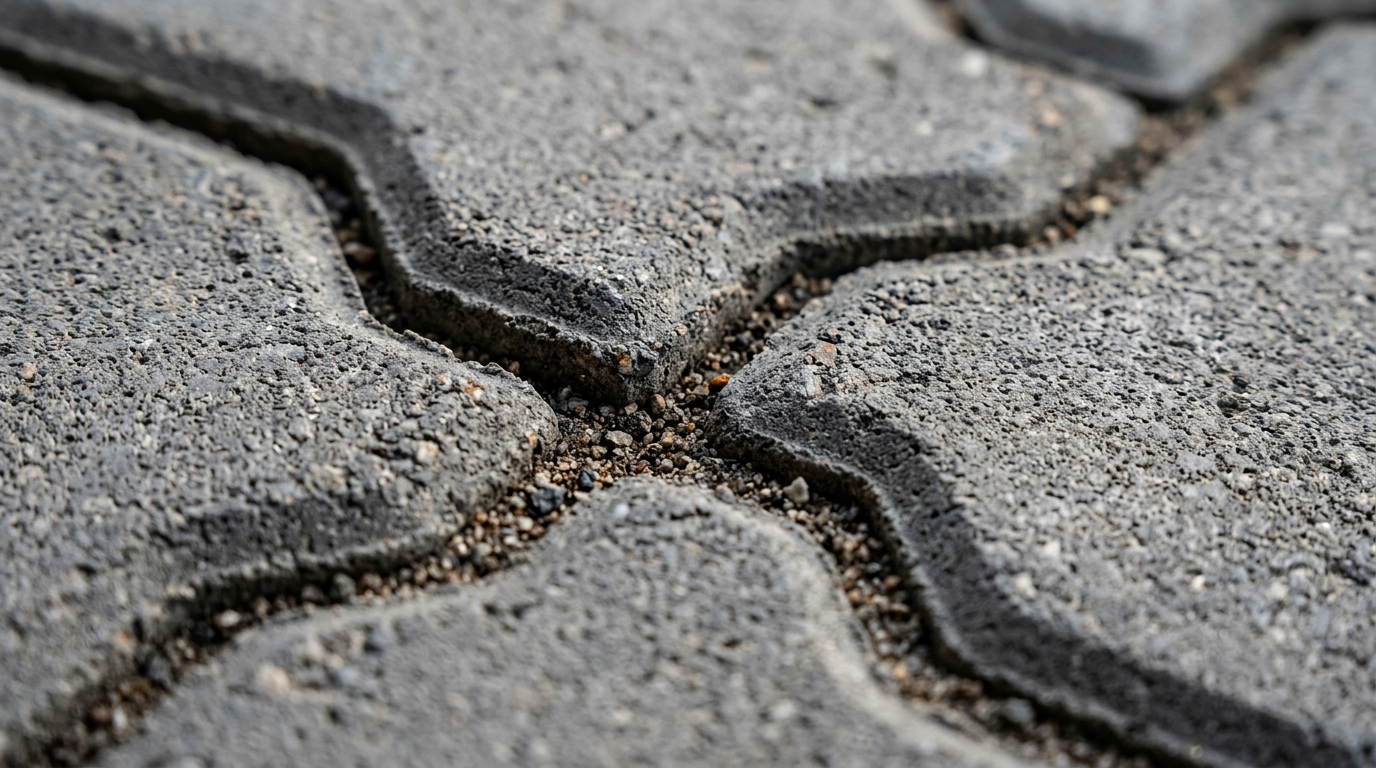
Brick Pavers (Fired Clay)
Brick pavers are kiln-fired clay, and their biggest advantage is color permanence. The color is the clay itself, all the way through the unit. No pigment to fade. After ten years in full Sarasota sun, a fired-clay paver looks essentially the same as day one.
The trade-off is a narrower palette. You’re choosing from earth tones: reds, browns, tans, and charcoals. If you want cool grays, coastal sand tones, or multi-tone blends, concrete gives you more options. Brick pavers for pedestrian use (patios, walkways) fall under ASTM C902. For heavy vehicular traffic, ASTM C1272 covers fired-clay brick for streets and heavy-vehicle areas, a distinct standard with different strength requirements.
In our climate, brick handles moisture well and holds up structurally. The concern is biological growth. In shaded areas (under live oaks, along north-facing walls), algae and mildew colonize the surface just like every other material down here. Routine paver cleaning with a low-pressure wash and an algae-inhibiting treatment keeps it manageable. Brick doesn’t strictly require sealing, but a breathable sealer slows biological growth and enriches the color for homeowners who want that look.
Brick is a strong choice for walkways, patios, and spaces where you want a traditional aesthetic that won’t ask much from you over the years.
Travertine Pavers
If you’ve walked barefoot across a pool deck in Florida in July, you already understand why travertine dominates that application. It stays noticeably cooler underfoot than concrete, brick, or dark-colored stone in direct sun. That single property makes it the most popular pool deck paver in our area.
Travertine is a natural limestone, and it comes in two common finishes: tumbled (softer edges, more surface texture) and honed (smoother, more formal). Tumbled travertine provides better wet grip, which matters around pools and spa areas. The natural voids and micro-texture create traction that polished or smooth-finished surfaces can’t match.
Maintenance is where expectations need to be realistic. Travertine is porous. Without sealer, it absorbs stains (leaf tannins, sunscreen, red wine) and grows algae in shaded spots faster than concrete. We seal travertine within 30 days of installation and recommend resealing every two to three years. It’s a tighter schedule than concrete, but the payoff is a surface that stays clean and ages gracefully.
Cost sits above concrete pavers. In our area, installed travertine pool decks typically land in the upper half of the general $8 to $25 range, or above it for premium grades and complex layouts. For pool decks and covered outdoor living areas, most homeowners find the comfort premium worth it.
Natural Stone Pavers
Natural stone is the broadest category and the one that creates the most confusion. It includes flagstone, bluestone, granite, limestone, sandstone, marble, and slate. Each has different density, porosity, slip resistance, and thermal behavior. “Natural stone paver” is not one product. It’s a family with very different members.
Flagstone works well for patios with an organic, irregular layout and wide joints filled with groundcover or polymeric sand. Bluestone (a dense sandstone, typically gray-blue) is popular in the Northeast but absorbs significant heat in Florida’s direct sun. Granite is nearly indestructible, but material cost alone can reach $25 to $45 per square foot. Marble looks striking on day one but etches easily and gets slippery when wet, making it a poor choice for pool decks or any regularly wet surface.
For Florida projects, the deciding question with any stone paver is absorption. Stone that takes in more water holds moisture longer, breeds algae faster, and can deteriorate in freeze-thaw climates. (That last concern is less pressing here, but relevant if you’re reading from further north.) Selecting stone for low absorption, freeze-thaw durability, and flexural strength is sound practice anywhere.
Stone pavers also come in variable thicknesses. A concrete paver is manufactured to exact dimensions. A split flagstone piece can vary by half an inch within a single stone. That means more bedding adjustment per unit, more labor, and a higher installation cost per square foot.
If your budget supports it and you want a one-of-a-kind surface where every piece is unique, natural stone delivers something no manufactured product can replicate. Just confirm the specific stone matches the application’s moisture, slip, and load requirements before you commit.
Porcelain Pavers
Porcelain pavers are the newest option in outdoor hardscape, and on maintenance alone, they outperform everything else on this list. Near-zero water absorption (typically under 0.5%). Excellent UV stability. Stain resistance that makes cleanup almost effortless. No sealing required.
For patios, pool decks, and covered outdoor living spaces, porcelain is hard to beat on long-term upkeep. The surface is fired at extremely high temperatures, producing a dense, non-porous face that shrugs off food stains, oil, mold, and algae. A hose and mild detergent handle most cleaning.
The limitation is structural. Belgard does not recommend its outdoor porcelain line for driveways, and that restriction is common across manufacturers. Porcelain pavers are thinner than concrete or brick units (typically 20mm, roughly 3/4 inch) and require either a mortar bed over a concrete slab, a pedestal system for elevated decks, or a carefully prepared compacted base with specific bedding specifications.
Porcelain works beautifully where feet walk. It is not engineered for where tires roll. If you want the aesthetic of porcelain on a surface that also handles vehicles, concrete pavers in a stone-mimicking finish are a better engineering match.
Permeable Pavers
Permeable pavers solve a different problem than the five types above. They manage water. Most permeable paver units are structurally similar to standard interlocking concrete. What changes is the joint design and everything beneath the surface.
In a conventional installation, polymeric sand fills the paver joints and sheds water across the surface toward drains. In a permeable system, the joints are wider (10 to 12mm is typical) and filled with open-graded aggregate that lets water pass through. Below the pavers, instead of compacted limestone screenings and dense-graded base, the system uses an open-graded crushed stone reservoir that stores stormwater temporarily. That water either infiltrates the subsoil or drains through an underdrain pipe.
FHWA’s permeable interlocking concrete pavement guidance details this layered approach and notes that where soil conditions make direct infiltration inappropriate, a lined storage-and-drainage configuration is the alternative. In Florida, where annual rainfall frequently exceeds 50 inches, permeable systems can reduce runoff volume significantly when properly maintained.
That maintenance is the catch. Published field studies document how sediment clogs aggregate-filled joints over time, reducing or eliminating infiltration. One North Carolina installation needed aggressive vacuum sweeping to partially restore function. An Ohio installation needed retreatment after just one year. FHWA recommends inspections one to two times annually.
We recommend permeable pavers where drainage is a genuine site problem or a code requirement, and where the homeowner commits to the annual cleaning schedule. Without that maintenance, a permeable system becomes an overbuilt, overpriced conventional installation.
Choosing the Right Paver by Project
Knowing the six materials is half the decision. The other half is matching material to application. Here’s how we approach it after more than twenty-five years of installations.
| Project | Our go-to | Strong alternative | Key requirement |
|---|---|---|---|
| Driveway | Concrete (80mm, herringbone) | Vehicular-rated brick | 80mm minimum thickness; herringbone for lateral interlock under tire loads |
| Patio | Concrete or travertine | Brick, porcelain, flagstone | 60mm units are sufficient; choose by aesthetics and maintenance preference |
| Pool deck | Travertine (tumbled) | Light-colored porcelain or concrete | Cool surface temperature, wet-slip resistance, finished coping edge |
| Walkway | Concrete or brick | Porcelain, stepping stones | Most flexible application; budget and style lead the decision |
| Stormwater area | Permeable concrete | Permeable brick (where available) | Engineered reservoir base; annual maintenance commitment |
Laying pattern matters as much as material for driveways. A 45-degree or 90-degree herringbone creates the tightest unit-to-unit interlock, which is why industry guidance consistently recommends it for vehicular applications. Running bond or stacked bond patterns look clean on patios and walkways but lack the lateral resistance vehicle tires demand. We finish most paver fields with a soldier course or sailor course border for visual definition and structural edge interlock.
What Matters More Than the Paver on Top
The paver is the top inch of a system that goes 8 to 12 inches deep. If the base fails, it does not matter whether you chose $3 concrete or $40 granite. The surface will settle, shift, and open.
In Sarasota’s sandy soil, we excavate a minimum of 8 inches for patios and walkways and 10 to 12 inches for driveways. The paver base is compacted crushed rock (limerock in our area), installed in lifts and compacted with a plate compactor to at least 95% density. On top of that goes 1 inch of coarse bedding sand, screeded to a consistent level. CMHA’s construction guide details this layered approach with specifications for different base types and load conditions.
Edge restraints go in before the pavers. Without them, the perimeter units migrate outward over time, opening joints and destabilizing the entire field. We use aluminum or heavy-duty plastic restraints spiked into the compacted base.
After the pavers are set, the paver joints get filled with polymeric sand: a blend of calibrated sand and polymer binder that hardens when misted with water. It locks units together, resists weed growth, and discourages ant intrusion into the joints. Getting polymeric sand right means sweeping it into completely dry joints, misting (not flooding) with water, and keeping traffic off for 24 hours. Rushed or wet application causes hazing on the paver surface or incomplete bond.
Drainage slope is the detail most DIY guides skip. We grade every paver surface at a minimum 1% to 2% slope away from structures: that’s 1/8 to 1/4 inch per foot. Without adequate slope, water pools against the foundation, stands on the surface, and accelerates algae growth. No sealer or cleaning schedule compensates for flat grading.
Frequently Asked Questions
Which pavers stay coolest around a pool?
Travertine consistently runs cooler underfoot than concrete, brick, or dark stone in direct sun. Light-colored porcelain is the next best option. Dark-toned concrete and bluestone absorb the most heat and are poor choices for barefoot pool areas in Florida. If a cool surface is the priority, travertine in a tumbled finish is the standard recommendation.
Do all pavers need sealing?
No. Porcelain pavers generally need no sealer because of their near-zero absorption. Concrete pavers benefit from sealing every three to five years to hold color and resist algae. Travertine needs sealing every two to three years. Brick is optional but recommended in humid climates to slow biological growth.
Can I use any paver type on a driveway?
No. Driveways need units rated for vehicular loads: 80mm-thick concrete pavers or heavy-vehicular-rated brick at minimum. Porcelain and thin natural stone are not designed for tire loads. Pattern matters too. Herringbone provides the interlock that resists lateral force from turning and braking.
What is a permeable paver, and is it worth the cost?
A permeable paver system uses mostly solid concrete units with wider, aggregate-filled joints over an open-graded stone reservoir. Water enters through the joints, not through the paver itself. The system is worth it where drainage is a documented problem or a code requirement, and where you commit to annual vacuum sweeping. Without that maintenance, the joints clog and the drainage benefit disappears.
How much do pavers cost to install?
Angi’s 2026 guide puts typical installed paver work at $8 to $25 per square foot, with higher-end flagstone reaching $50. Material, pattern complexity, base depth, and site access all shift the total. The only reliable number for your project is an itemized local estimate that specifies excavation, base, drainage, edging, joint fill, and cleanup.
How long do pavers last compared to poured concrete?
A well-installed paver system can last 25 years or longer. Poured concrete typically develops cracks within 5 to 10 years in Florida’s climate because it has no joints to absorb movement. When a paver settles or breaks, you lift and replace individual units. When poured concrete cracks, you patch or tear out an entire slab. The trade-off: pavers have joints and bedding that need periodic attention (polymeric sand refill, sealing), while poured concrete needs less routine maintenance until it fails.
Every project starts with what’s already on the ground: the soil, the slope, the drainage path. A free estimate tells you exactly what your patio, driveway, or pool deck needs before a single paver goes down. Browse our before-and-after gallery to see what each type looks like in finished projects, or reach out before the rainy season tests your base.