The cost of stone pavers is one of those topics that seem straightforward at first glance but quickly become more complex once you start planning a real project. Many homeowners begin their research expecting a simple price per square foot, only to realize that the final investment depends on a wide range of factors that go far beyond the stone itself.
Stone pavers, as well as any paver system, are not just a surface you see; they are part of a complete hardscape system designed to perform over time. A well-built paver installation must handle daily foot traffic, vehicle loads, changing weather conditions, and natural ground movement.
That means the visible stone is only one piece of the puzzle. Beneath it lies a carefully constructed foundation that supports durability, stability, and drainage. Ignoring these elements can lead to costly repairs down the road, which is why understanding the full scope of the cost of stone pavers is so important.
Because of all these variables, it is more accurate to think of the cost of stone pavers as a combination of decisions rather than a fixed number. Each choice you make, from the type of stone to the installation method, contributes to the final result.
So let’s take our time to understand these elements in this article – not only to help you plan a realistic budget but also to ensure that your investment delivers long-term value, performance, and visual appeal.
Jump to:
Cost ofOne Stone Pavers: How it Changes From One Project to Another
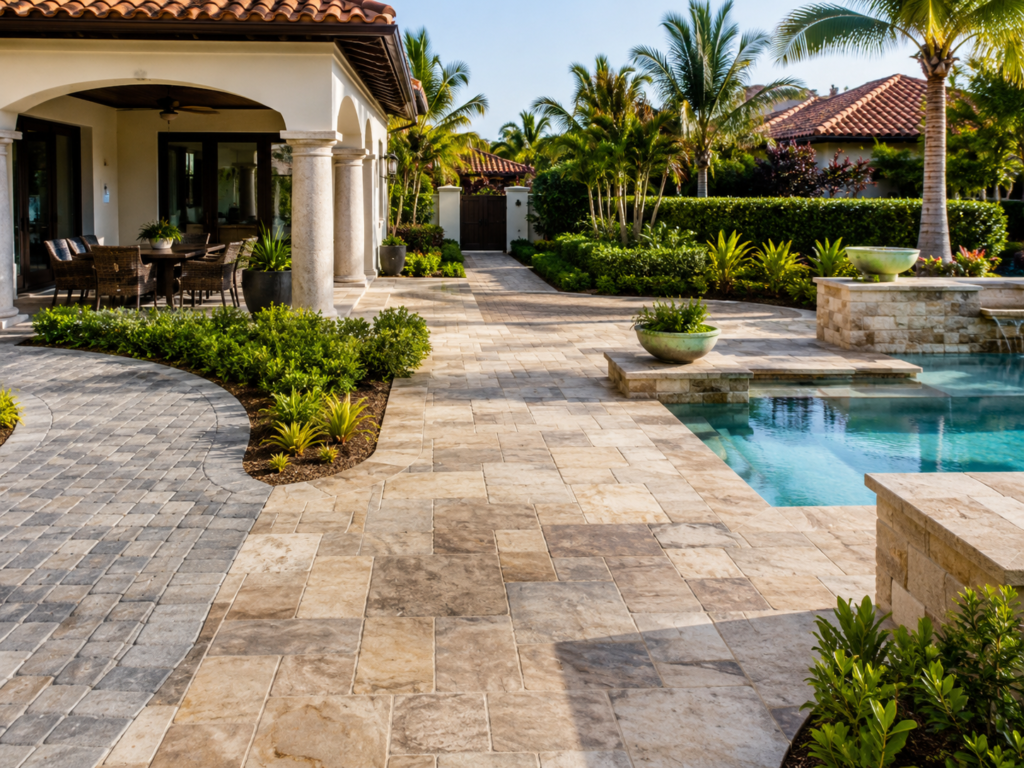
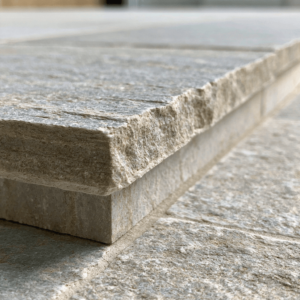
The first reason the cost of stone pavers varies is, of course, the stone itself. Natural stone can include travertine, marble, granite, limestone, sandstone, bluestone, flagstone, and other materials, each with its own price range, density, finish, color variation, and installation behavior.
The second factor is the project application. A walkway, patio, pool deck, and driveway do not demand the same base. A patio for chairs and a grill may need less structural preparation than a driveway that receives daily vehicle loads.
The Concrete Masonry and Hardscapes Association explains that aggregate base thickness depends on soil strength, drainage, climate, and traffic loads, with thicker bases commonly used for driveways than for walks. That base is invisible after installation, but it is one of the main reasons a paver project succeeds or fails.
The third factor is site preparation. When we evaluate a project, we pay close attention to excavation, soil condition, existing concrete, root systems, slope, drainage, and access for equipment. If the old surface must be removed, hauled away, and replaced with a properly compacted base, costs increase.
If the yard has poor drainage, the cost of stone pavers may also include grading improvements or drainage solutions.
The truth is, material price is only part of the real cost of stone pavers. Material is important, but installation is just as important. In practice, the lowest material price is not always the lowest project cost.
How Installation Quality Affects the Cost of Stone Pavers
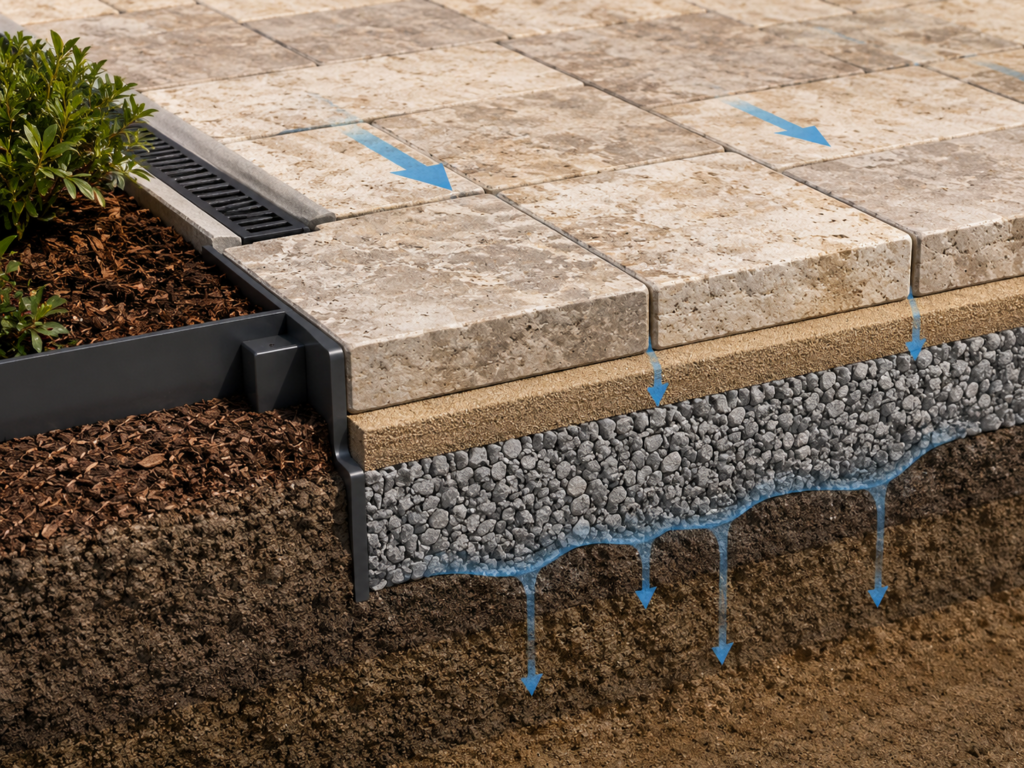
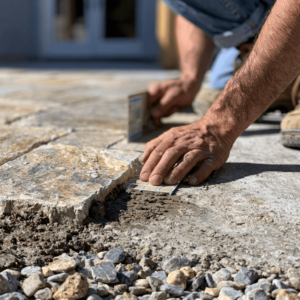
Simple: a cheap installation that shifts, sinks, stains, or drains poorly can become expensive very quickly. Pavers are built in layers, and each layer has a job:
- excavation creates room for the structure;
- the base distributes weight;
- bedding sand helps with final leveling;
- edge restraints hold the system in place;
- joint sand stabilizes the surface;
- sealing can help protect color and reduce staining.
This is where professional installation makes a clear difference. A paver may look perfect on day one, but if the base was rushed, the edges were weak, or the drainage was ignored, the problems usually show up later. Sometimes they show up right where everyone walks (dramatic timing is a thing).
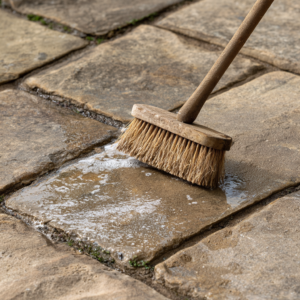
Maintenance also belongs in the conversation. Natural stone may need cleaning, joint sand attention, and sealing at intervals based on exposure, traffic, and the type of stone.
More on paver maintenance here: How long do pavers last? Installation and maintenance tips
Realistic Budget for the Cost of Stone Pavers
A realistic budget starts with measuring the area correctly. Square footage gives the foundation for estimating materials, labor, base aggregate, sand, waste factor, edge restraints, and sealing.
However, the shape of the project matters too. A simple rectangle is easier to calculate and install than an irregular patio wrapping around landscaping, steps, and a pool cage. More cuts mean more labor and more waste.
The next step is choosing the right stone for the setting. A stone that looks beautiful in a photo may not be the best option for a driveway, pool deck, or shaded patio. Some stones stay cooler underfoot. Some offer better slip resistance. Some handle heavy loads better. Some require more sealing attention.
A Better Estimate Starts With a Real Conversation
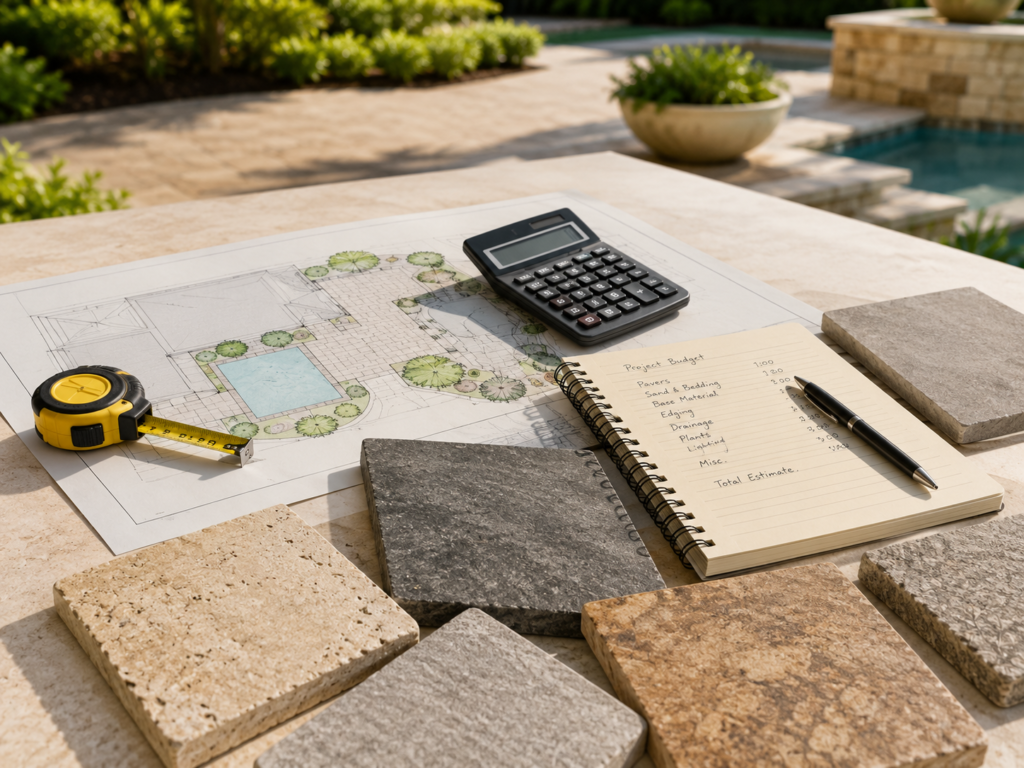
The cost of stone pavers becomes clearer when the project is evaluated as a whole. Size, stone type, access, base depth, drainage, pattern, borders, sealing, and maintenance all work together. And for that, the help of a hardscape professional is pivotal, so find one you can trust in your area to help you.
And if you happen to be around Sarasota County, in FL, we here at JS Brick have been helping since 2000 homeowners around the area to reach their dream hardscape. Our goal is to make the process easier, more transparent, and less stressful.
So if you are planning a patio, driveway, walkway, or pool deck, reach out to us so we can help you understand the options and choose a solution that fits your property, your budget, and the way you actually live outdoors!