You swept polymeric sand into every joint, activated it with water, and waited for it to cure. Two weeks later, ants are pushing small cones of debris through what should be hardened paver joints. So can ants get through polymeric sand? Under certain conditions, yes. The sand binds into a firm mass that deters excavation, but Techniseal’s own EZ Sand data sheet uses the word “deters” rather than “eliminates.” That gap between “deters” and “eliminates” explains most of the ant problems we see on Sarasota patios. If you’re considering whether you can make your own polymeric sand, understanding the product’s formulation and binder chemistry becomes even more important when dealing with ant pressure.
We’ve been installing and maintaining pavers across Sarasota, Venice, Bradenton, and Osprey since 2000, and ant activity in paver joints is one of the most frequent calls we get. The answer rarely comes down to the sand alone. It starts with understanding what the ants are doing beneath your hardscape.
Jump to:
Why Ants Show Up in Polymeric Sand Joints
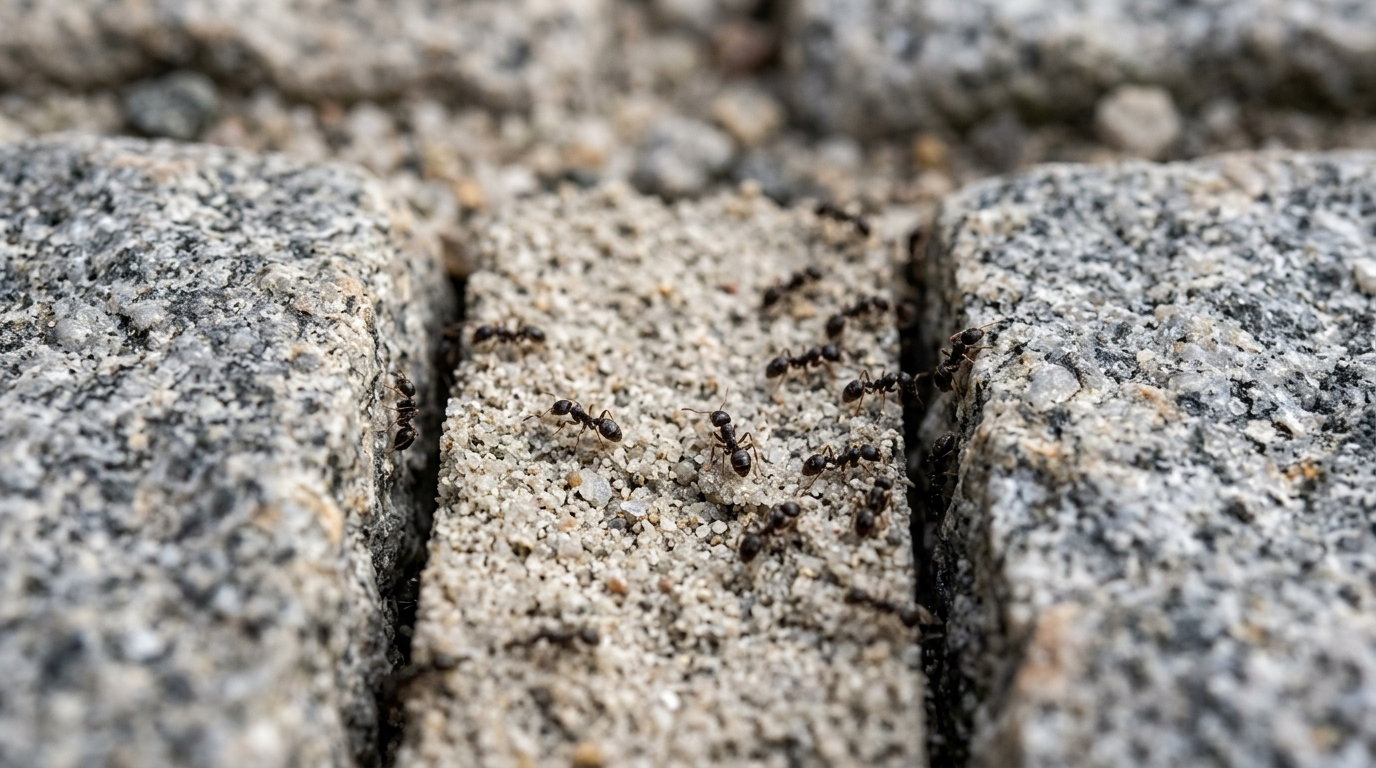
Pavement ants nest underneath flat, warm surfaces: slabs, sidewalks, paver patios, driveways. Penn State Extension describes pavement ant workers as roughly 2.5 to 4 mm long, small enough to find gaps invisible to the naked eye. A single colony can hold thousands of workers, so the dozen ants you spot at the surface rarely represent the full population living beneath your paver base.
The small mounds between your pavers are excavation debris: grains tunneled upward through the bedding layer and through whatever fills the joint, then deposited at the surface. Those tiny “volcanoes” usually mean the colony found a route. A joint not filled to its full depth. A spot where the binder didn’t fully cure. A crack at the paver edge. A section that eroded after a few years of Florida afternoon storms.
This distinction changes the fix. If ants are bypassing hardened sand through a gap that already existed, more sand on top won’t seal it. If they’re exploiting a deteriorated section, a contact spray won’t rebuild the barrier. The real question is what gave them the opening in the first place.
Where Polymeric Sand Gives Ants an Opening
When polymeric sand fails against ants, the cause almost always traces back to how it was installed, how long it’s been in place, or what was already underneath.
Joint depth is the most common issue we encounter in the field. Most products require a minimum of 1 to 1.5 inches of filled depth. Alliance Gator’s MAXX G2 specifies at least 1.5 inches (38 mm). When sand only reaches the top quarter-inch of a 2.5-inch-deep joint, the hardened layer is a thin crust sitting on loose bedding material. Ants push through that crust from below with almost no effort. We’ve pulled pavers on “failed” jobs and found the polymeric sand barely below the chamfer, with the remaining joint full of unbound bedding sand.
Moisture at the time of installation ranks close behind. Polymeric sand needs to be swept into dry joints on dry pavers. If the joints are damp from overnight condensation or morning dew (both unavoidable in Sarasota from May through October unless you plan around them), the binder begins activating before the material settles to full depth. The result is a surface cap with voids beneath it. Alliance Gator’s instructions specifically warn that dampness interferes with dense filling.
Time and weather take their toll as well. Sarasota averages over 50 inches of rainfall per year, much of it in intense summer downpours. Pool splash-out, power washing, and regular foot traffic all erode joint material over time. Polymeric sand joints can soften when saturated and reharden when they dry, but repeated wet-dry cycles accelerate wear. A joint that was solid three years ago may now have enough erosion to let ants through.
Pre-existing colonies create a different scenario entirely. If pavement ants were already established under or beside the paver base before the polymeric sand went in, the ants don’t need to penetrate the joint from above. They tunnel upward from below, through the bedding layer, and push through whatever resistance the joint offers at that depth.
Real homeowner reports show how these factors overlap. One Reddit user reported ant hills through Techniseal polymeric sand less than two weeks after installation. Another described persistent ant activity despite a full year of quarterly pest-control visits on a roughly six-year-old patio. Neither account isolates a single cause, and that’s the pattern we see in the field: usually, it’s a combination of installation gaps, aging material, and established colonies. Knowing which factors overlap tells you where to focus the fix.
How to Stop Ants in Paver Joints for Good
A lasting solution addresses the colony and the compromised joint. Treating one without the other leaves the door open for the next season’s foragers.
Start with the colony. Utah State Extension explains trophallaxis, the food-sharing behavior that makes bait effective. Workers carry slow-acting bait back to the nest, where it reaches nestmates that never come to the surface. This process can take two weeks or longer, so judging a bait station after three days misses the point. UC IPM cautions that bait alone usually won’t control pavement ants and recommends identifying which food type (protein or sugar) the colony prefers, then refreshing bait stations regularly.
Avoid combining slow-acting bait with fast-acting repellent sprays. If foragers die on contact before returning to the nest, the bait never reaches the queen. University of Maine Extension reports that boiling water and horticultural vinegar generally fail to eliminate enough ants to make a lasting difference. Targeted, label-compliant bait placed near active trails works better than any home remedy we’ve seen homeowners try. Clemson University entomologist Eric Benson reinforced this point in a 2026 interview, noting that killing visible ants misses the colony living beneath the pavers.
Once colony activity drops, turn to the joints. And “repair” here means more than adding fresh sand over damaged material. Sakrete advises removing old polymeric sand rather than layering a thin top coat, and CMHA’s maintenance guide does not recommend polymeric sand for simply topping up existing joints. A thin layer bonds to the old surface rather than to the paver walls, and the first heavy storm or foraging ant exposes the difference.
For detailed guidance on this critical first step, see our article on how to remove polymeric sand.
Joint restoration on a Sarasota patio or driveway requires getting the sequence right.
- Remove compromised material down to the bedding layer using a controlled pressure wash or a manual joint scraper.
- Let the joints and paver faces dry completely. In Sarasota’s summer humidity, that often means waiting a full day with no rain.
- Sweep new polymeric sand into the joints and compact with a plate vibrator (using a rubber pad to protect the paver face). Repeat sweeping and compacting until joints are filled to within 1/8 inch of the paver chamfer.
- Blow or sweep every grain of excess off the paver surface before water activation. Residue left on the face bonds during curing and becomes very difficult to remove.
- Activate with a gentle mist, following the product’s data sheet for water volume and soak cycles. Over-watering flushes binder out of the joint. Under-watering leaves uncured sand at depth.
After the sand cures (typically 24 to 72 hours depending on the product), applying a paver sealer adds a surface barrier that helps retain joint sand and makes the opening less accessible to ants from above. Sealing won’t stop a colony already established beneath your base, but it protects a properly restored joint against future erosion and new access attempts.
If the damage runs deeper than joints (pavers are shifting, the base has settled, you see voids when you lift a paver), the problem has outgrown joint maintenance. A proper paver installation in our area starts with a compacted crushed-rock base, typically 6 inches for a patio and 8 to 12 inches for a driveway, graded at a minimum 1% slope for drainage. When ants have excavated enough bedding material to cause settlement, resanding the joints treats the symptom while the cause continues underneath.
One additional note for permeable paver owners: CMHA’s permeable-pavement guide specifies aggregate-filled joints rather than standard polymeric sand. Adding polymeric sand to a permeable system to deter ants can compromise its drainage design. The jointing fix needs to match the system.
Whether you’re dealing with a surface ant trail or a colony undermining your base, our crew can walk the area and check what a photo won’t show. A free estimate gives you the full picture (joint condition, base integrity, drainage) before Sarasota’s rainy season puts everything to the test.

Frequently Asked Questions
Does polymeric sand kill ants?
No. Polymeric sand stabilizes paver joints by bonding grains together. It deters excavation but contains no pesticide and does not eliminate colonies. If ants are already nested beneath your pavers, you need targeted bait and integrated pest management alongside properly installed joints.
Why did ants appear just days after polymeric sand was installed?
The most common causes are incomplete joint filling, activation on damp surfaces, and pre-existing colonies beneath the base. Alliance Gator’s MAXX G2 requires completely dry joints for proper packing. Inspect joint depth and check for entry points at paver edges before concluding the product failed.
Can I add more polymeric sand on top of the ant holes?
A thin top coat over old or excavated material rarely holds. Sakrete and CMHA both advise against simply topping up polymeric sand joints. Remove the compromised material, let the joints dry, and refill to the product’s specified minimum depth (typically 1 to 1.5 inches) with fresh material, compacted and properly activated.
Will sealing my pavers permanently keep ants out?
Sealing retains joint sand and makes surface access more difficult, but it does not eliminate an underground colony. It works best as one layer in a complete system: proper base, fully filled joints, colony management when warranted, and periodic cleaning to maintain joint integrity over time.
Are boiling water or vinegar effective against pavement ants?
University of Maine Extension reports these generally fail to kill enough ants to control a colony. Slow-acting bait exploiting trophallaxis (food sharing among workers) is more effective, though results can take two weeks or longer to appear.
How long does polymeric sand last before ants become a problem?
There is no universal lifespan. One homeowner reported over 11 years of ant-free performance, while another saw ants the year after replacing with a different product. In Sarasota’s heavy-rain climate, we recommend annual joint inspections and budgeting for maintenance every few years depending on exposure and traffic.