
Installing pavers against the house foundation is a common practice in patios, walkways, and driveways. However, many homeowners do not realize that improper installation near the foundation can lead to serious structural and drainage issues over time. What may appear to be a simple landscaping improvement can, if poorly executed, contribute to moisture buildup, soil instability, foundation cracks, and costly repairs.
If you are considering installing pavers against the house foundation, or if you already have pavers installed and are concerned about potential risks, this guide will walk you through everything you need to know: from proper slope requirements and drainage planning to base preparation, expansion spacing, and moisture control. You’ll see that each factor plays a critical role in protecting your home’s structural integrity!
Read as well: The best paver step design ideas to elevate your outdoors
Jump to:
Hour of truth: is it safe to install pavers against the house foundation?
Yes, pavers can safely be installed against the house foundation when proper construction techniques are followed. The key factors include slope direction, drainage management, expansion spacing, and base compaction.
When installed incorrectly, pavers may trap water near the foundation wall. Over time, this moisture can seep into the soil surrounding the foundation, increasing hydrostatic pressure. Excess pressure can lead to cracking, shifting, or settlement.
Proper planning prevents these issues before they develop, so let’s discuss each of these key factors in detail.

Proper slope and drainage requirements
One of the most critical aspects of installing pavers against the house foundation is maintaining the correct slope. Hardscape surfaces should slope away from the structure to direct water runoff away from the foundation.
A general recommendation is a slope of approximately one-quarter inch per foot away from the home. This gradient allows rainwater to flow outward instead of pooling near the foundation.
An inadequate slope may result in standing water, which increases soil saturation. Excess moisture weakens the soil supporting the foundation and can cause gradual settlement.
In regions with heavy rainfall, additional drainage solutions such as channel drains or French drains may be required to manage water effectively.
Read more about slope here: What’s the recommended slope for a paver patio?
Base preparation near the foundation
The base beneath pavers against the house foundation must be carefully prepared. Excavation depth should account for proper aggregate layering and compaction.
A well-compacted crushed stone base provides stability and allows controlled drainage. If the base is insufficient or poorly compacted, pavers may shift toward the structure over time.
Soil type also plays a role here. Expansive clay soils, for example, expand and contract with moisture fluctuations, increasing the risk of movement.
Ensuring proper base thickness and compaction minimizes these risks and protects the structural integrity of both the pavers and the foundation.
Expansion gaps and spacing
Leaving a small expansion gap between pavers and the house foundation is an important precaution. Direct, tight contact may transfer movement or pressure to the foundation wall.
A slight separation allows for natural expansion and contraction caused by temperature changes. This spacing also prevents friction between hardscape materials and structural walls.

In some installations, flexible joint material may be used between the pavers and foundation to absorb minor movement.
Ignoring expansion considerations may lead to surface cracking or unnecessary stress on the foundation edge.
Moisture management and foundation protection
Water management is the primary concern when installing pavers against the house foundation. Hardscape surfaces alter natural water flow patterns.
Without proper drainage design, water may collect at the interface between the pavers and the structure. Over time, repeated exposure to moisture can deteriorate foundation materials, particularly in older homes.
Permeable paver systems offer improved drainage by allowing water to infiltrate through joints into a controlled base system. This approach reduces surface runoff and helps manage water responsibly.
Managing moisture properly significantly reduces the risk of foundation damage.
More on permeable pavers: How much do permeable pavers cost? A sustainable investment
Risks of improper installation
Improperly installed pavers against the house foundation can result in multiple issues. These include water infiltration, uneven settlement, surface shifting, and long-term structural stress.
If pavers settle toward the house, they may create reverse slope conditions that direct water inward rather than away.
Foundation cracks caused by prolonged hydrostatic pressure are far more expensive to repair than correcting slope or drainage during installation.
Prevention is always more cost-effective than structural repair.
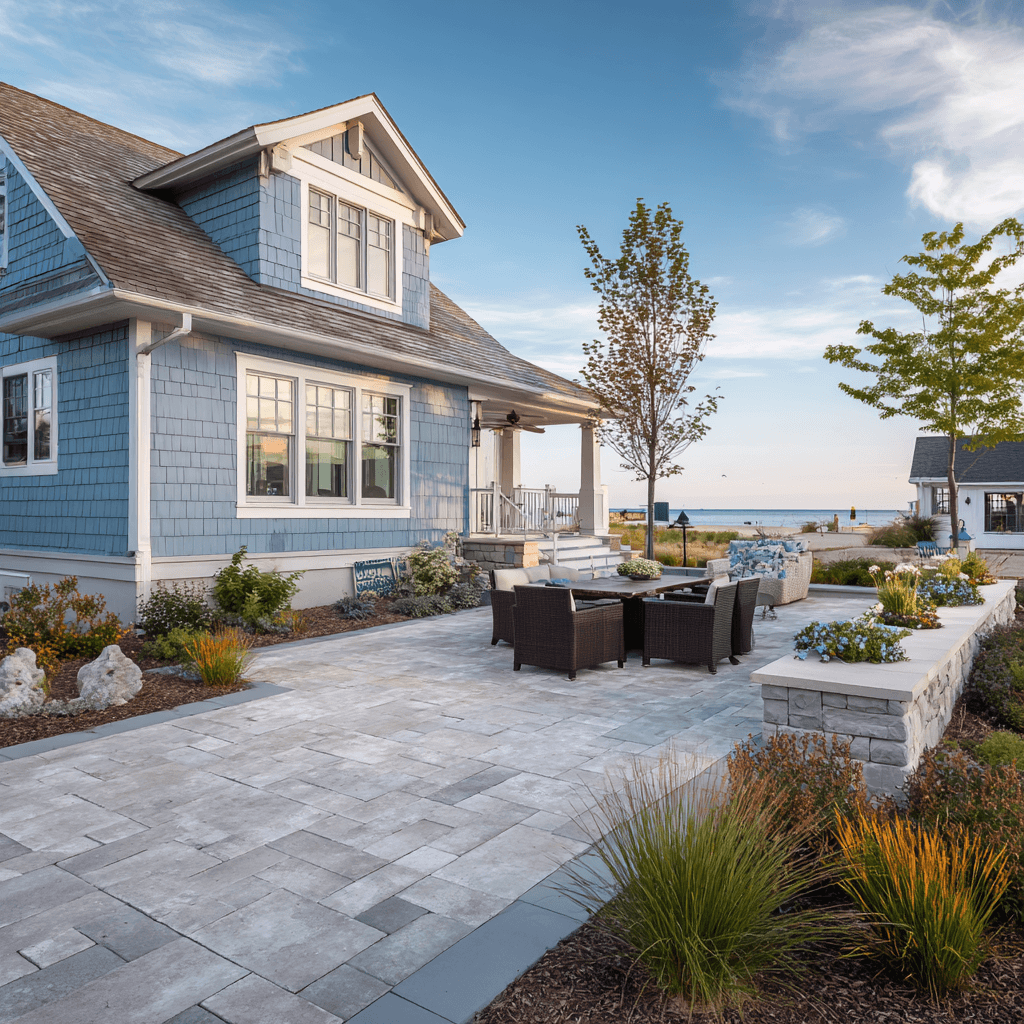
Considerations for a professional installation
Any paver installation is more complex than it may initially appear.
What seems like a straightforward process of laying bricks on the ground actually involves careful excavation, precise grading, correct base layering, proper compaction, edge restraint installation, and accurate joint stabilization. Each of these steps directly affects long-term durability.
Even in open patio or driveway installations, mistakes in base thickness, compaction levels, or slope calculation can lead to uneven settling, shifting surfaces, and drainage problems.
Proper paver installation requires understanding soil conditions, load distribution, and water management. Without this technical foundation, even visually appealing installations may fail prematurely.
When installing pavers against the house foundation, this complexity increases significantly. Unlike standalone patios, this type of installation interacts directly with the structural integrity of the home.
Any miscalculation in slope may direct water toward the foundation instead of away from it. Even a slight grading error can create long-term moisture accumulation.
Additionally, working near the foundation requires careful excavation depth control to avoid disturbing the structural base of the home.
Over-excavation can destabilize soil adjacent to the foundation, while under-excavation can lead to insufficient base support. Both scenarios increase the risk of settlement or stress on the foundation wall.
Drainage planning becomes even more critical in this context. Professionals evaluate water flow patterns, roof runoff discharge points, and soil absorption characteristics before installing pavers near a structure.
They ensure that the finished surface slopes properly and that any necessary drainage systems are incorporated into the design.
Expansion spacing also demands precision. Leaving appropriate separation between the pavers and the foundation wall prevents pressure transfer caused by thermal expansion or minor ground movement. This level of detail is often overlooked in DIY installations.
For these reasons, installing pavers against the house foundation is not simply a landscaping project. It is a structural consideration that affects the long-term health of the home.
Professional installers like ourselves understand how to balance aesthetics with engineering principles, ensuring that the hardscape enhances the property without introducing structural risk. And that’s why you should consider hiring someone to help you out.
JS Brick: hire a hardscape professional to help you

All in all, pavers against the house foundation can be a stunning hardscape project. But, as we mentioned, it is one that needs to be handled with extreme care, so as not to end up damaging the foundation itself. For this reason, hiring a professional hardscape contractor you can trust in your area to help you is a pivotal part of the process.
And if you happen to be around Sarasota, in FL, we here at JS Brick can provide you with expert advice and quality workmanship that is sure to amaze you. Get a free estimate by contacting us today!
We’ll be waiting for you.