You are looking at a strip of grass between your patio and garden that turns to mud every afternoon from June through September. Or a side yard where guests pick their way across bare sand to reach the pool deck. Pathway stones seem like the obvious fix, and they can be, but only when the material, base, and layout match the ground underneath them.
We have installed pathway stones and stepping stones across Sarasota, Venice, Bradenton, Nokomis, and Osprey for over twenty years. In that time, we have pulled up just as many poorly set stones as we have laid new ones. The difference between a path that stays firm and one that sinks, shifts, or grows a lip you trip over almost always comes down to what is below the surface.
Jump to:
What “Pathway Stones” Actually Means
Merriam-Webster defines flagstone as layered stone that splits into flat paving pieces, but the term “pathway stones” covers far more than quarried rock. It includes concrete stepping stones, natural flagstone, travertine, porcelain pavers, and even rubber composite units sold in garden centers. The word “stone” on the label does not tell you what you are buying.
Here is the practical breakdown of what we see homeowners choosing in the Sarasota area:
- Concrete stepping stones are the most common starting point. A single 16 x 16-inch unit runs around $5.97 at retail. They are uniform, easy to source, and work well for a basic garden path.
- Travertine pavers stay cooler underfoot in direct sun, which matters when your path runs next to a pool deck in July.
- Natural stone like flagstone gives you organic shape variation, but thickness varies from piece to piece, which changes how you prepare the base.
- Porcelain pavers resist staining and do not need routine sealing. They require a different installation approach: you never use a plate compactor on porcelain, and cutting demands a wet-cut tile saw with a porcelain blade.
- Concrete pavers in standard formats give you the widest selection of colors, textures, and laying patterns.
The point is not that one material wins in every situation. The point is that picking a material before understanding your soil, drainage, and foot traffic is working backward. Learn more about types of pavers and their specific characteristics to make an informed decision.
Why Sarasota’s Ground Makes the Base Non-Negotiable
Most of Sarasota County sits on fine sand over limestone. That sand drains fast when dry and shifts easily when saturated. During rainy season, we get 7 to 9 inches of rain per month. A pathway stone placed directly on top of that sand will tilt, rock, or sink within one wet season.
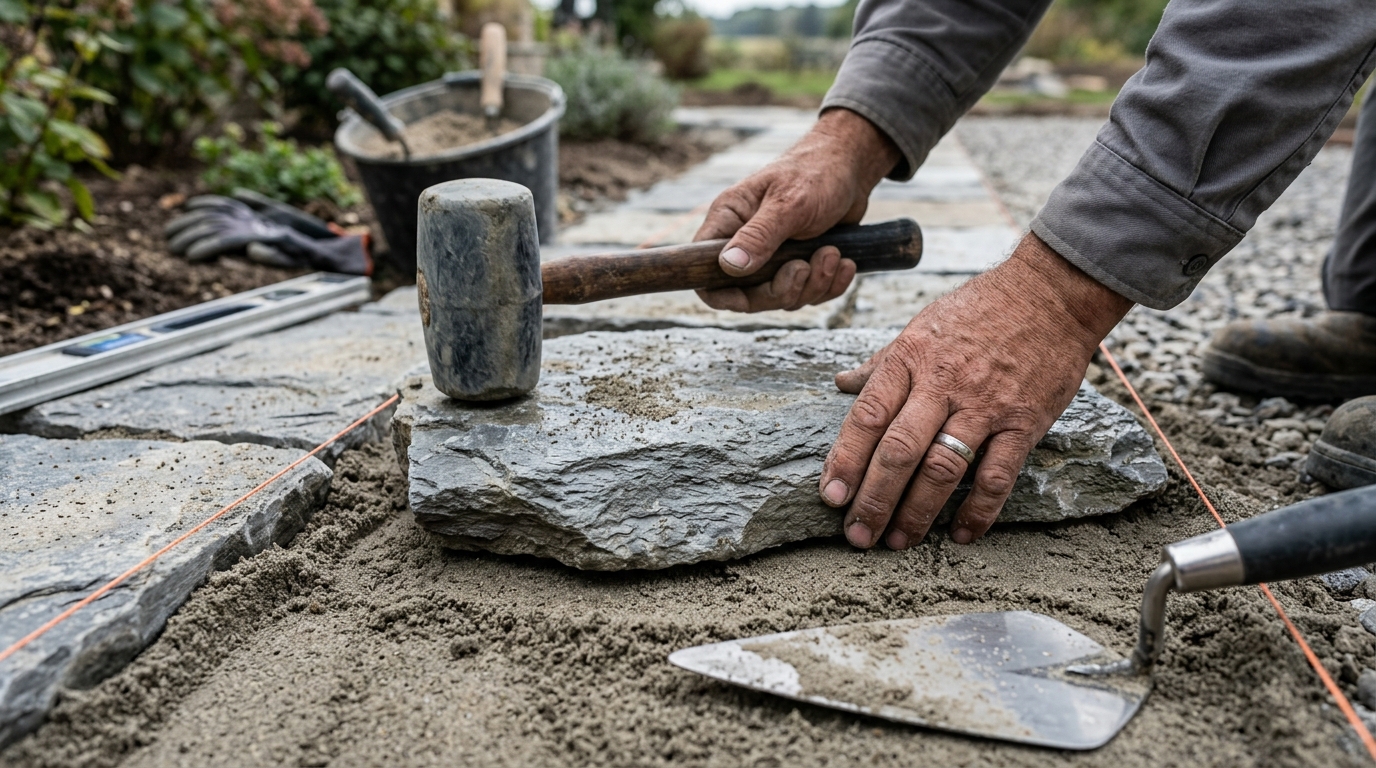
We dig a minimum of 6 inches for a pedestrian pathway. The first 4 inches get filled with compacted crushed rock base, tamped in 2-inch lifts. On top of that goes a 1-inch bedding layer of coarse concrete sand, screeded level. The stone sits on that bedding layer. For reference, manufacturer technical guides call for at least 8 inches of excavation in many conditions, with 4 to 8 inches of base material.
In our sandy soil, compaction is the real work. You can set a beautiful travertine stepper on loose sand and it will look perfect for two weeks. Then the first heavy rain channels water underneath, erodes the contact points, and the stone tips forward. We have seen this dozens of times on service calls.
The minimum drainage slope we maintain is 2%, which translates to about a quarter-inch of fall per foot. On a 20-foot garden path, that means the far end sits roughly 5 inches lower than where you step on. We grade that slope into the base layer before any stone goes down. If the water cannot leave the path, it pools under the joints and loosens everything.
Choosing Pathway Stones by How You Use the Path
Before comparing colors and textures, answer three questions:
Who walks it? If the path serves as a primary route for someone using a walker or wheelchair, ADA guidelines limit ground-surface openings to no larger than a half-inch sphere. Widely spaced stepping stones with grass gaps do not meet that standard. A continuous paver path with tight joints does. Even in a private home, building a primary walkway that excludes a family member or frequent guest is a design failure.
How much rain hits it? A path cutting through an open yard collects runoff from the surrounding landscape. EPA research shows that sediment loading can clog permeable surfaces over time, especially at the uphill edge. If your path receives sheet flow from a garden bed with exposed mulch, either redirect the water or plan for periodic joint maintenance. Permeable pavers can help manage stormwater, but only as part of a designed drainage system, not just because their joints are open.
What is already around it? Houzz’s 2026 outdoor study found 73% of renovating homeowners choosing low-maintenance plants and 49% choosing drought-resistant plants. If you are moving toward a low-water landscape, your pathway material should not need constant rinsing. Porcelain and sealed concrete both clean easily with a garden hose. Unsealed natural stone in a shaded, humid spot near landscaping will grow algae faster and require more frequent attention.
Pathway Stones vs. Full Paver Walkways: When Each Makes Sense
Individual stepping stones and continuous paver walkways solve different problems.
| Feature | Individual pathway stones | Continuous paver walkway |
|---|---|---|
| Base prep | Spot excavation under each stone | Full excavation across the entire width |
| Edge restraint | Usually unnecessary | Required to prevent lateral spread |
| Joint material | Grass, gravel, or open gaps | Polymeric sand locks pavers together |
| Accessibility | Gaps may limit wheelchair or walker use | Tight joints with polymeric sand create a continuous surface |
| Drainage | Water flows through gaps naturally | Requires graded slope; permeable options available |
| Installed cost range | Lower material cost, but per-stone prep adds labor | Higher total, but professionally installed flagstone walkways model at $29.53 to $37.75 per sq ft |
| Best fit | Secondary garden paths, decorative routes through landscaping | Front walkways, pool deck connections, high-traffic routes |
We often combine both on the same property. A continuous paver walkway from the driveway to the front door handles daily traffic and heavy deliveries. A series of stepping stones through the side garden handles weekend strolls. Different routes, different solutions, same property.
Spacing and Layout: Test It Before You Set It
One of the most common mistakes we see is spacing pathway stones based on how they look from above rather than how they feel underfoot. A 24-inch center-to-center spacing looks tidy in a plan view. Walk it, and you are either shuffling or stretching.
The practical method: lay your stones loose on the ground and walk the path at your normal pace. Have someone else walk it too, especially if they are shorter or taller. Adjust until the center of each stone naturally catches your foot. For most adults, that lands somewhere between 22 and 26 inches center to center, but stride length varies. There is no universal number.
For curves, fan the stones slightly so the inside edge tightens. This keeps the walking line natural instead of forcing an abrupt direction change where the path bends.
Once you confirm the layout, mark each position with landscape paint before pulling the stones up to excavate. This step takes ten minutes and prevents the frustration of re-digging holes that are six inches off.
How Florida’s Climate Affects Each Material Over Time
Sarasota does not freeze, so we skip the frost-heave concerns that drive base depth in northern states. What we deal with instead is intense UV, daily summer rain, high humidity, and sandy soil that holds almost no moisture between storms.
- Concrete pathway stones can develop efflorescence (a white mineral haze) in their first year as moisture pulls calcium salts to the surface. It fades on its own or washes off. After that initial period, concrete holds up well here if the base stays solid.
- Travertine is calcium carbonate, which means acidic cleaners will etch it. In our climate, the bigger issue is biological growth in shaded areas. We seal travertine paths with a penetrating paver sealer every 2 to 3 years to slow algae and staining. The Natural Stone Institute recommends neutral cleaners and notes that acidic products like vinegar damage calcareous stone.
- Porcelain resists staining, UV fade, and biological growth better than most alternatives. The trade-off is installation precision. Porcelain is hard and brittle. Field cuts with an angle grinder leave chipped edges. A wet-cut tile saw is not optional.
- Brick pavers used as pathway stones develop character over time. Their color deepens slightly, and the surface wears to a soft texture. In our experience, clay brick is the most forgiving material to maintain in humid conditions because it does not need sealing to look good.
None of these materials fail because of Sarasota’s heat or rain alone. They fail when the base shifts, the joints wash out, or the maintenance is wrong for the material.
What a Pathway Stone Installation Actually Costs
The gap between a retail stone price and a finished installed path is where most budget surprises hide.
A single concrete stepping stone costs around $6. You need roughly 20 of them for a 40-foot garden path at 24-inch spacing. That is $120 in materials. But each stone needs a prepared pad underneath: excavation, crushed rock, bedding sand, compaction. By the time you add base material, delivery, and labor, the installed cost per stone is several times the retail price.
A continuous paver walkway costs more upfront because you are excavating and preparing the full width, adding edge restraints, filling joints with polymeric sand, and potentially grading for drainage. But that complete system lasts longer with less maintenance than stones set on bare ground.
The honest way to budget: get a scope-based estimate that lists excavation, base material, bedding, the stone or paver itself, edge treatment, joint material, and any drainage work. If someone quotes you a single number per square foot without walking the site, they have not accounted for your soil, slope, or access conditions.
Maintenance That Keeps Pathway Stones Level and Clean
The number one maintenance issue we see on pathway stones in Sarasota is settlement. One stone sinks a quarter inch, catches a toe, and suddenly the whole path feels unreliable.
For individual stepping stones, check each one annually by stepping on its edges. If it rocks or has settled below the surrounding grade, lift it, add bedding sand underneath, re-level, and tamp it back into place. This is a 15-minute fix per stone if you catch it early.
For continuous paver walkways, cleaning and re-sanding joints every 2 to 3 years keeps the surface stable. Polymeric sand hardens in the joints and locks pavers together, but Florida’s driving rain can erode it over time. When joints open up, pavers shift. Refilling with polymeric sand before that happens is cheaper than resetting shifted pavers.
Sealing depends on the material. Concrete and travertine benefit from a penetrating sealer reapplied every 2 to 3 years. Porcelain typically does not need it. The Natural Stone Institute notes that many stones do not require sealing, and common impregnators act as repellents rather than impermeable coatings. Ask what your specific stone needs rather than applying a universal product.
Pathway Stones and Drainage: They Are the Same Project
In Sarasota, installing pathway stones without thinking about drainage is like hanging a picture without checking for a stud. It might hold for a while, but the failure is built in.
Every path either sheds water or collects it. A properly graded path with a 2% slope sends rainwater to the landscape on either side. A flat or low-spot path pools water, which saturates the base and destabilizes the stones.
If your path connects two hardscaped areas (say, a patio and a pool deck), the drainage plan for the path needs to work with both surfaces. We often install a shallow swale along one side of the path to channel runoff toward a landscape bed or dry well.
Permeable pavers are worth considering for paths that cross low areas or receive heavy runoff. But permeability is a system property, not just a surface feature. EPA emphasizes that performance depends on underlying-layer design and surrounding conditions. A permeable stone on compacted clay is not permeable. The open-graded base below the stone is what stores and infiltrates water.
How We Approach a Pathway Stone Project
When our crew walks a property for a pathway project, we check:
- Soil type at the planned depth (sandy, organic, fill material)
- Existing drainage patterns during and after rain
- Slope across the path route
- Root systems from nearby trees that could lift stones later
- How the path connects to existing hardscape (driveway, patio, pool deck)
- Who uses the path daily, including anyone with mobility needs
That site visit tells us more than a photograph can. A photo shows the surface. We need to see what is underneath it and what is flowing across it.
From there, we match the material to the conditions: travertine for a sun-exposed pool path where cool footing matters, concrete pavers in a herringbone pattern for a high-traffic front walkway, natural stepping stones through a garden where the path is part of the landscape design. Every material we install goes onto a base built for Sarasota’s soil and rain, not a generic spec sheet written for a different climate.
If you are comparing pathway stone options for your property in Sarasota, Venice, Bradenton, Nokomis, or Osprey, a free estimate gives you specifics: material, base depth, drainage plan, and cost for your actual site. Our crew can walk your yard and point out what a photo cannot show. Reach out before the rainy season tests whatever is under your path right now.
Frequently Asked Questions
Can I lay pathway stones directly on grass or sand?
You can, but they will shift. In Sarasota’s sandy soil, even a single stepping stone needs a compacted pad of crushed rock and bedding sand underneath to stay level through rainy season. Stones placed on bare ground commonly sink or tilt within months.
How far apart should pathway stones be?
There is no single correct number. Lay the stones loose and walk the route at a normal pace. Most adults land comfortably with 22 to 26 inches center to center, but test it with the people who will actually use the path. For accessible routes, gaps must be small enough that a half-inch sphere cannot pass through.
What is the best pathway stone material for Florida?
It depends on the location and use. Travertine stays cooler near pools. Porcelain resists staining and algae without sealing. Concrete pavers offer the widest range of colors and patterns. Clay brick ages well in humidity. The base preparation and drainage matter more than the surface material.
Do pathway stones need to be sealed?
Not always. Porcelain typically does not require sealing. Concrete and travertine benefit from a penetrating sealer every 2 to 3 years in our climate. The Natural Stone Institute notes that many natural stones do not need sealing and that impregnators repel contaminants rather than making the surface waterproof.
How much do installed pathway stones cost?
A single concrete stepping stone retails for around $6, but the installed cost per stone is significantly higher once you include excavation, base material, sand, and labor. Professionally installed flagstone walkways model at $29.53 to $37.75 per square foot including site preparation. Get a site-specific estimate that itemizes every component.
Are permeable pavers better for pathways?
Permeable pavers help manage stormwater, but only when installed over an open-graded base designed for infiltration. A permeable surface on compacted soil will not drain. EPA research confirms that performance depends on the entire underlying system and that sediment can clog the surface over time without proper maintenance.