
You want to know how much weight pavers can support because something specific is on your mind. A boat trailer on the driveway. A hot tub on the patio. An electric SUV that weighs 2,000 pounds more than your old sedan. The question feels simple, but the answer depends on what sits beneath the surface, not on the stone on top.
Here’s the short version: a properly installed concrete paver driveway handles passenger vehicles, pickup trucks, and delivery traffic without issue. Individual concrete pavers test above 8,000 PSI in compressive strength. But that number, taken alone, tells you almost nothing about what your specific driveway or patio can hold.
We’ve installed and repaired paver systems across Sarasota, Venice, Bradenton, Nokomis, and Osprey since 2000. The weight-related failures we see almost never start with a paver cracking under pressure. They start below: the base shifting, the bedding sand displacing, the subgrade soil giving way after a rainy season. Understanding the full system is how you avoid a costly repair two years from now.
Jump to:
Why 8,000 PSI Does Not Equal 8,000 Pounds
PSI stands for pounds per square inch. It measures how much compressive force a laboratory specimen can withstand before it fails. CMHA’s construction specification requires concrete pavers to average at least 8,000 PSI, with no individual unit falling below 7,200 PSI per ASTM C936 standards.
That is the material’s strength. It is not the weight your driveway can support.
When a 5,000-pound SUV parks on your driveway, each tire contacts roughly 25 to 35 square inches of surface. That translates to about 35 to 50 PSI on the paver face, nowhere near the 8,000 PSI threshold. The paver itself is not the weak link. The real question is whether the bedding sand stays stable, whether the crushed rock base distributes the load evenly, and whether the subgrade soil holds firm underneath.
Multiplying 8,000 PSI by a paver’s face area does not produce a safe load rating. That arithmetic ignores the bedding layer, the base, and the soil. A paver can test at 8,000 PSI and still sink into the ground if the base was compacted poorly or the sand layer is too thick.
Think of it this way: the paver is the roof of the system. Nobody asks how much weight a roof shingle can hold without asking about the rafters first.
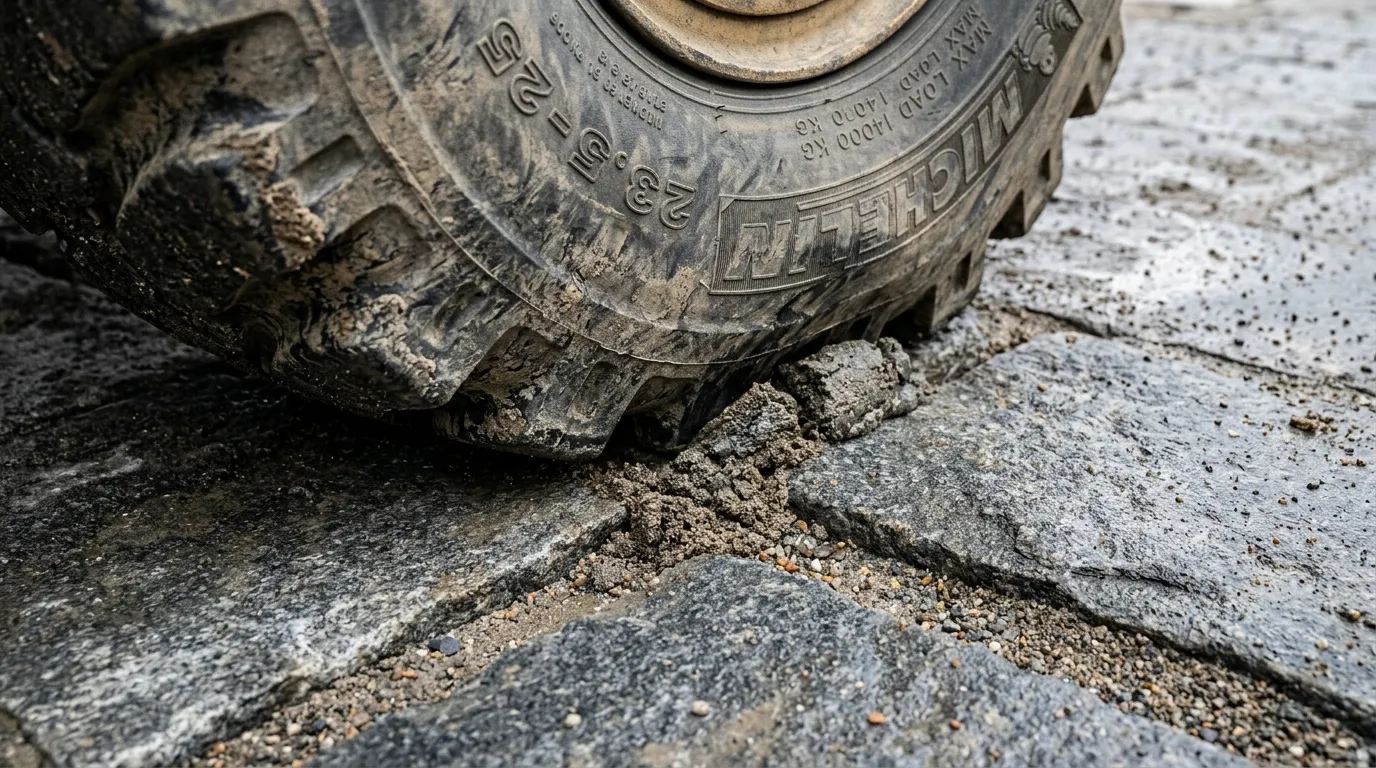
Paver Thickness by Application
Thickness is the first screening tool. It tells you what type of traffic a paver was designed for, though it does not guarantee performance without the right base beneath it. CMHA’s application guide breaks it down by intended use:
| Application | Minimum Paver Thickness | Typical Base Depth | Key Detail |
|---|---|---|---|
| Walkways and patios | 2 3/8 in. (60 mm) | 4 to 6 in. | Pedestrian traffic only |
| Residential driveways | 2 3/8 in. (60 mm) | 6 to 8 in. (CMHA); 10 to 14 in. (some manufacturers) | Interlocking shape required; max 4:1 length-to-thickness ratio |
| Commercial vehicular | 3 1/8 in. (80 mm) | 8 to 12 in. | Herringbone pattern required for vehicular interlock |
| Heavy-duty (ports, industrial) | 4 in. (100 mm) or thicker | Engineered per project | Requires project-specific pavement design |
Understanding the types of pavers suitable for each application helps avoid common mistakes we see regularly in our area:
- Large-format slabs on driveways. CMHA classifies slabs (ASTM C1782) separately from interlocking pavers (ASTM C936). Slabs are tested for bending strength, not compression, and generally are not rated for vehicular traffic without a concrete or asphalt sub-base.
- 60 mm pavers under boat trailers. The trailer’s tongue weight concentrates on the jack foot, not across tires. That single contact point can indent bedding sand even when the paver itself is perfectly sound.
- Thin overlay pavers (30 to 45 mm) on any surface with vehicles. These are decorative resurfacing products. They lack the interlock that thicker units provide under lateral forces from braking and turning.
In Sarasota, the Base Carries the Load
Every installation manual says the base matters. In our area, it matters more than most because of two factors: sandy subgrade soil and five months of afternoon thunderstorms.
Sarasota’s subgrade is predominantly fine sand. It drains well when dry, but it does not compact into the dense, stable platform you would get from a clay-gravel mix farther north. Without adequate base depth and thorough compaction, the soil shifts under repeated loading. We have torn out driveways built over only 4 inches of crushed rock that looked fine for a year and showed ruts by the second summer, right where the tires tracked.
The paver base course is typically crushed limestone compacted in lifts of 2 to 3 inches at a time. Each lift gets a plate compactor pass before the next layer goes down. For a residential driveway in our area, we build a minimum of 6 inches of compacted base and often go to 8 or 10 depending on what we find after excavation. Some manufacturer guides recommend 10 to 14 inches for driveways, which makes sense in areas with weak subgrade or heavier traffic expectations.
Then comes the bedding layer: roughly 1 inch of coarse concrete sand, screeded level. This is not a structural layer. If someone piles on extra sand to compensate for a poorly graded base, the result is a soft spot that settles under any sustained weight. We have pulled up pavers and found 3-inch bedding layers on failed installations. That is triple what the system is designed for.
The load path runs from the paver, through the paver joints and bedding sand, into the crushed rock base, and finally into the compacted subgrade. Each layer does its job. The paver transfers load through shear in the joint sand, which is why tight joints and polymeric sand matter. The base spreads that load over a wider footprint. The subgrade receives a distributed, manageable pressure instead of a concentrated one.
During Sarasota’s rainy season (June through October), water saturation weakens subgrade support. Proper drainage slope, at a minimum 1% grade away from structures, and well-draining base material prevent ponding beneath the pavers. Standing water under a loaded base is how ruts start.
Contact Area Changes Everything
Total weight does not determine whether pavers fail. Contact area does. Two loads can weigh the same and stress your hardscape in completely different ways.
| Load Scenario | Total Weight | Contact Points | Approximate Pressure |
|---|---|---|---|
| Sedan (4 tires, ~30 sq in. each) | 4,000 lb | 4 tires | ~33 PSI per tire |
| Full-size SUV or electric SUV (4 tires, ~35 sq in.) | 6,500 lb | 4 tires | ~46 PSI per tire |
| Trailer tongue on jack stand (~4 sq in.) | 500 lb | 1 point | ~125 PSI |
| Hot tub, filled with occupants | 3,500 to 4,500 lb | Full cabinet (~50 sq ft) | ~70 to 110 PSF (under 1 PSI) |
| Construction dumpster on steel feet | 8,000 lb | 4 feet (~6 sq in. each) | ~333 PSI per foot |
Look at the dumpster. Eight thousand pounds is not remarkable for a paver system, but concentrated on four small steel feet, it can punch through bedding sand and crack individual pavers. Now look at the hot tub. The pressure per square inch is trivial because the weight spreads across the entire cabinet footprint.
Hot tubs present a different problem: they sit in one spot permanently, and any settlement in the base shows up as a visible tilt. For a patio that will hold a spa, we either pour a 4-inch reinforced concrete pad beneath the pavers or build the base to handle sustained static load without settling. Most spa manufacturers specify a concrete slab for long-term use. Hot Spring, for example, lists its BEAM model at 3,860 pounds filled and about 110 PSF, and excludes foundation-related damage from the warranty.
One factor worth planning for now: electric vehicles. A gas-powered midsize SUV typically weighs around 4,500 pounds. The electric version of the same vehicle can hit 6,000 to 7,000 pounds because of the battery pack. That is a meaningful jump for a driveway built a decade ago. If you own or plan to own an EV, mention it during the estimate. The answer is almost always a thicker base, not a different paver.
What Actually Causes Pavers to Fail Under Weight
After more than two decades of installations and repairs, here is what we find when homeowners call about pavers that “can’t hold the weight.”
Insufficient base depth. The most common issue. The paver looks fine on top. Beneath it, the base did not distribute the load far enough, and the subgrade compressed. You see ruts in tire tracks, or one section sitting lower than the rest.
Poor compaction. Each base layer needs mechanical compaction. Skipping a pass, or compacting material that is too wet, leaves voids. Weight finds the voids.
Excess bedding sand. More than about 1 inch of setting bed, and the sand acts as a cushion instead of a rigid platform. Under repeated tire loads, it displaces sideways. An ASCE case study of a container logistics site identified excessive bedding thickness as one of three principal failure causes, alongside poor edge restraint and unsuitable sand selection.
Wrong laying pattern. A herringbone pattern (45° or 90°) provides the strongest interlock for vehicular areas. Running bond or stacked bond allows pavers to shift laterally under braking and turning forces, especially on sloped driveways.
Missing or failed edge restraint. Without a soldier course or concrete edge restraint, the outer pavers creep outward over time. That loosens the entire field, joints open, polymeric sand washes out, and individual pavers start rocking under load.
Undermined drainage. In Florida, rain is the silent structural enemy. If water cannot exit the base, it softens the subgrade beneath. A system without adequate slope or drainage fabric traps water exactly where the load concentrates.
Notice what is absent from this list: the paver itself cracking from insufficient compressive strength. With concrete pavers meeting ASTM C936, that failure mode is rare. When we find a cracked paver under a driveway, we almost always find a void beneath it. The paver did not fail from compression. It failed from lack of support, bridging a gap that should not have existed.
For perspective on what a well-designed system can handle: a port terminal at Tampa’s Berth 208 has run 80 mm concrete pavers under container handlers with a 106,000-pound front axle load since 1992. A condition survey found a Pavement Condition Index of 78 after three decades. Those pavers survived because the pavement system was engineered for the load, not because the paver material was extraordinary.
The industry continues to refine the science behind all of this. CMHA completed the first phase of a major research initiative this year, developing mechanistic-empirical design methods that model how paver and bedding layers work together as a structural system. Full-scale testing with millions of simulated truckloads is underway, with final recommendations expected by 2028. That ongoing research confirms a point we have seen on every job site: installation quality matters more than a single PSI number.
A free estimate tells you exactly what your driveway, patio, or pool deck needs to carry what you plan to put on it. Our crew can walk your property and assess what a photo cannot show: soil conditions, drainage patterns, base adequacy, and whether your current pavers match the load you are planning for. Reach out before the rainy season tests your base.

Frequently Asked Questions
Can pavers hold the weight of a car or truck?
Yes. A properly installed interlocking concrete paver driveway supports passenger vehicles, SUVs, and pickup trucks. The key is adequate base depth (6 to 12 inches of compacted aggregate depending on traffic and soil), correct paver thickness (minimum 60 mm for residential), and a herringbone laying pattern for interlock. A tire applies roughly 35 to 50 PSI to the surface, well below the paver’s 8,000 PSI compressive rating.
Can I put a hot tub on pavers?
It depends on the foundation beneath them. A filled hot tub typically weighs 3,500 to 4,500 pounds, but the surface pressure is low because the weight spreads across the cabinet footprint. The real risk is settlement over time. Most spa manufacturers require a reinforced concrete pad or equivalent level surface. Check your spa’s specific foundation requirements before assuming patio pavers will work long-term.
Will an RV or boat trailer damage my paver driveway?
Driving over interlocking pavers on an adequate base is generally fine. The concern is parking: stabilizer jacks and trailer tongue jacks concentrate thousands of pounds on a few square inches. Place load-distribution pads under any jack foot to spread the weight. For frequent heavy parking, consider 80 mm pavers with a base depth of 10 inches or more.
What paver thickness do I need for a driveway?
CMHA recommends a minimum of 2 3/8 inches (60 mm) for residential driveways, using interlocking shapes with a maximum 4:1 length-to-thickness ratio. For heavier traffic or commercial use, 80 mm is standard. Thin overlay pavers (under 60 mm) and large-format slabs are not rated for vehicular traffic without additional structural support.
How deep should the base be under driveway pavers?
CMHA’s general guidance calls for 6 to 8 inches of compacted aggregate base for residential driveways. Some manufacturer specifications recommend 10 to 14 inches. The right depth depends on subgrade soil, drainage, and traffic. In Sarasota’s sandy soil, we install a minimum of 6 inches, compacted in 2 to 3-inch lifts, and add depth when conditions call for it.
Do pavers crack under heavy weight?
Rarely, if they meet ASTM C936 standards (8,000 PSI average). Most weight-related failures appear as settling, rutting, or shifting rather than surface cracking. When a paver does crack under load, the cause is almost always a void or soft spot beneath it. The paver breaks because it lost support, not because it was overloaded in compression.