
A standard 4 x 8 in. concrete paver weighs about 6 lbs. A 24 x 24 in. concrete slab can push past 100. How much pavers weigh depends on three things: material, thickness, and actual dimensions. That range affects everything from delivery logistics to base depth to whether your truck makes it home in one piece.
We’ve been installing pavers across Sarasota, Venice, Bradenton, Nokomis, and Osprey since 2000. Weight comes up on nearly every project. It determines how we plan deliveries through narrow side yards, how deep we compact the crushed rock base, and which materials we recommend for pool decks versus driveways. Below is every number you need, organized by material, size, and what the weight actually means once those pavers hit the ground.
Jump to:
Paver Weight by Material and Size
This table covers the most common paver types and sizes used in Florida residential work. Where available, weights come directly from manufacturer spec sheets. Where not, they’re calculated from published density values.
| Material | Common Size | Thickness | Approximate Weight |
|---|---|---|---|
| Concrete (interlocking) | 4 x 8 in. | 60 mm (2-3/8 in.) | ~6 lbs |
| Concrete (interlocking) | 4 x 8 in. | 80 mm (3-1/8 in.) | ~8 lbs |
| Concrete (square slab) | 12 x 12 in. | 40 mm (1.57 in.) | ~18 lbs |
| Concrete (square slab) | 12 x 12 in. | 1.75 in. | 20 to 22 lbs |
| Concrete (large slab) | 16 x 16 in. | 1.75 in. | 36 to 39 lbs |
| Concrete (large slab) | 24 x 24 in. | 2 in. | 93 to 100 lbs |
| Clay brick | 4 x 8 in. | 2.25 in. | 5.5 to 6 lbs |
| Clay brick (heavy vehicular) | 4 x 8 in. | 2.75 in. | 7 to 8 lbs |
| Travertine | Various | 1.25 in. | 15 to 17 lbs/sq ft |
| Travertine | Various | 2 in. | 23 to 25 lbs/sq ft |
| Porcelain | 24 x 24 in. | 20 mm (0.79 in.) | ~36 lbs |
| Natural stone (limestone) | 24 x 24 in. | 1.5 in. | ~77 lbs |
| Natural stone (granite) | 24 x 24 in. | 1.5 in. | ~81 lbs |
The concrete interlocking weights come from Pavestone’s Holland Stone cut sheet, which lists the 60 mm unit at 6 lbs and the 80 mm at 8.1 lbs. Clay brick weights match manufacturer published specs at 5.5 to 6 lbs for the standard 4 x 8 unit. Larger concrete slab weights are calculated using normalweight concrete density of 140 to 150 lbs per cubic foot (more on that formula below). Natural stone figures are derived from manufacturer crate shipping data, which includes packaging, so bare units weigh slightly less.
Travertine comes in so many cut sizes that weight per square foot is more practical than weight per piece: about 15 to 17 lbs/sq ft at 1.25 in. (a common pool deck thickness here in Florida) and 23 to 25 lbs/sq ft at 2 in.
One comparison trips people up: a 24 x 24 in. porcelain paver weighs about 36 lbs, while the same footprint in 2 in. concrete can hit 100. But per square foot of installed surface, porcelain runs about 9.3 lbs/sq ft versus roughly 23 for concrete at a comparable application thickness. The savings are real, though not as extreme as single-piece comparisons suggest.
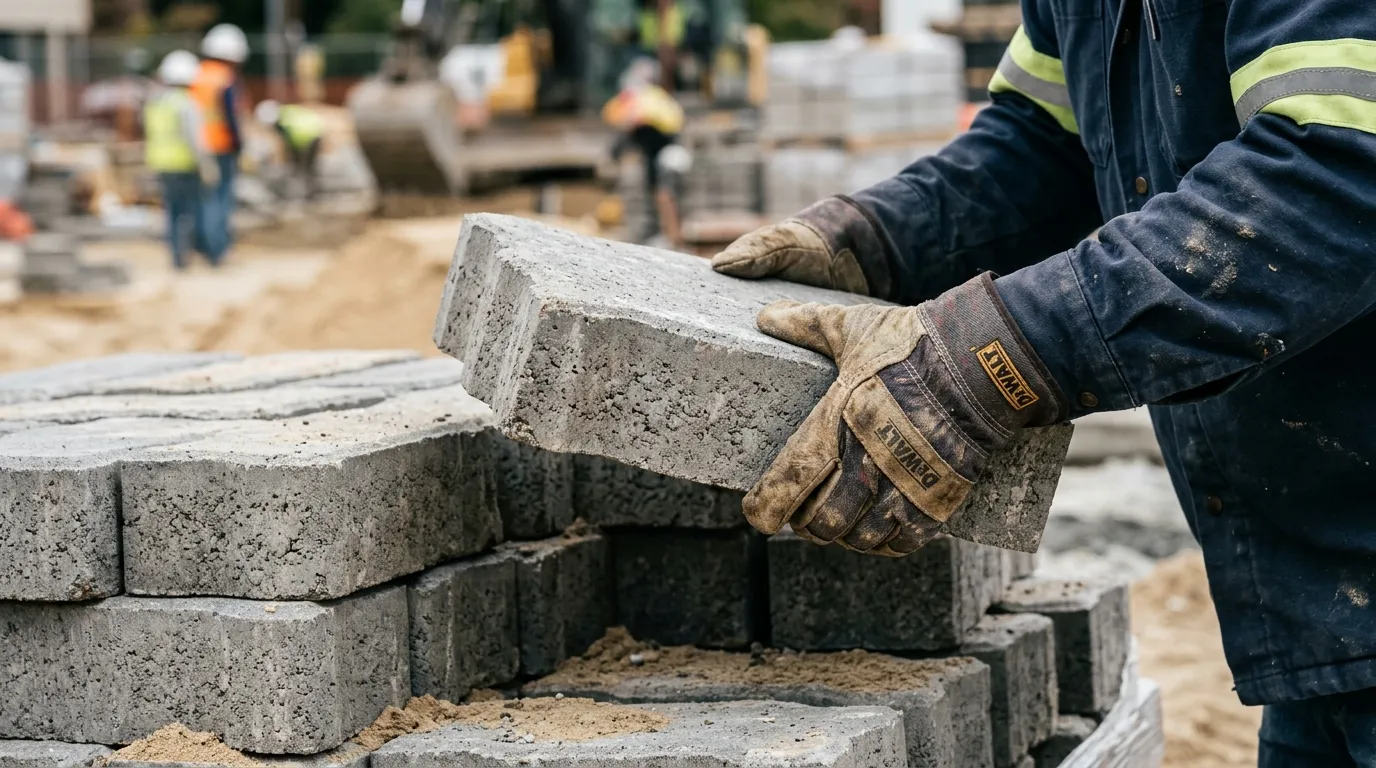
How to Calculate Any Paver’s Weight
Not every product lists its weight on the label. This formula gets you close for any solid rectangular paver:
Weight (lbs) = Length (in.) × Width (in.) × Thickness (in.) × Density (lbs/cu ft) ÷ 1,728
The 1,728 converts cubic inches to cubic feet. For normalweight concrete, NRMCA gives a density of 140 to 150 lbs per cubic foot. Natural stone varies more: limestone runs about 150 to 170, granite around 160 to 175.
Worked example for a 12 x 12 x 1.75 in. concrete paver:
12 × 12 × 1.75 = 252 cubic inches
252 × 145 (midpoint density) ÷ 1,728 = 21.1 lbs
That lines up with published specs in that size range. Chamfered edges, textured surfaces, and aggregate blends can shift the real number a few percent either way. When we’re estimating total weight for a driveway or patio, we use the manufacturer’s published figure first and this formula as a sanity check.
Pallet Weights and What Your Truck Can Handle
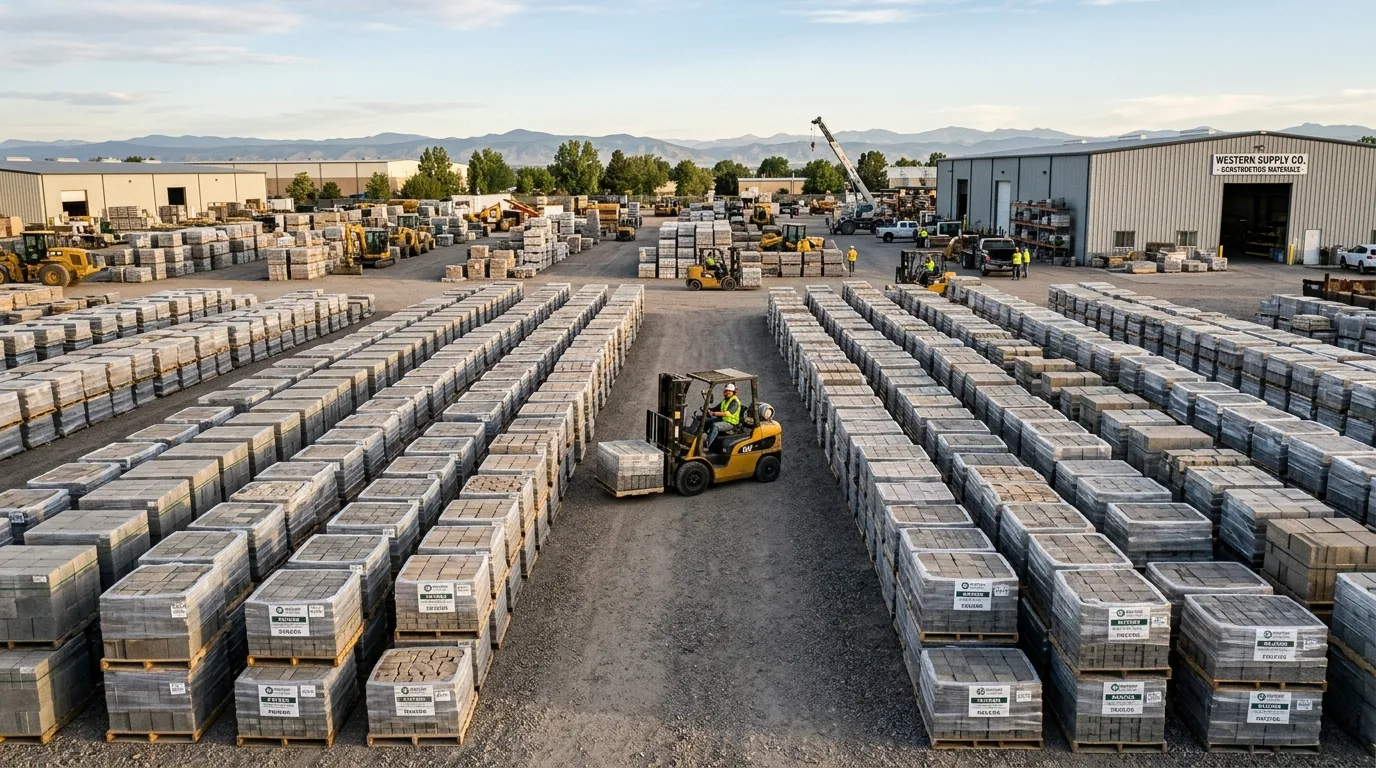
Individual paver weight matters for your back. Pallet weight matters for your truck. Most residential paver pallets land between 2,200 and 3,500 lbs.
| Product Example | Pieces Per Pallet | Coverage | Pallet Weight |
|---|---|---|---|
| Concrete interlocking, 60 mm | 480 | 103 sq ft | ~2,884 lbs |
| Clay brick, 2.375 in. | 594 | 128 sq ft | ~3,506 lbs |
| Porcelain, 24 x 24 in. | 72 | 279 sq ft | ~2,700 lbs |
Concrete data comes from Pavestone’s specification sheet. The Mutual Materials clay pallet total includes a 50 lb pallet. Porcelain data is from the manufacturer’s product sheet.
Can your half-ton pickup handle a full pallet? Almost certainly not. Ford defines payload as the combined weight of passengers and cargo, listed on the Tire and Loading label on your driver’s door. After subtracting two passengers (roughly 400 lbs), most half-tons have 1,000 to 1,200 lbs of remaining capacity. That covers about one-third of a typical pallet.
For projects here in the Sarasota area, we coordinate delivery and mechanical offloading directly. If you’re hauling pavers yourself, plan on partial loads or budget for a delivery fee. A 300 sq ft patio in concrete interlocking pavers totals roughly 8,400 lbs of material. That’s three full pallets.
One more practical note: manufacturers often round unit weights on spec sheets, and multiplying those rounded numbers by the piece count won’t always match the listed pallet total. Use the published pallet weight for logistics, not your own arithmetic.
What Changes a Paver’s Weight: Thickness and Moisture
Two factors shift weight beyond what the label says.
Thickness is the primary variable. A 4 x 8 in. concrete paver at 60 mm weighs 6 lbs. The same footprint at 80 mm weighs 8.1 lbs. That’s a 35% increase from just 20 mm of extra material. The CMHA application guide for interlocking concrete pavements recommends 60 mm for pedestrian use and residential driveways, 80 mm for heavier vehicular traffic, and 100 to 120 mm for heavy-duty applications. Choose the thickness your project requires, then plan handling around it.
In Sarasota, we install 60 mm pavers on the vast majority of residential driveways, patios, and pool decks. We move to 80 mm when the driveway regularly supports a boat trailer or heavy equipment.
Moisture is the other factor, and one that no spec sheet accounts for. Manufacturer specifications for clay pavers typically set cold-water absorption below 8%. That means a 6 lb clay unit can absorb roughly half a pound of water. Multiply that across 500+ units stored outside, and a pallet that sat through one of Sarasota’s June afternoon thunderstorms weighs noticeably more than the printed spec. Concrete absorbs water too.
For installed pavers, absorbed water drains quickly when the paver joints are filled with polymeric sand and the surface is graded at a minimum 1% slope away from structures. Permeable pavers handle this even more aggressively by letting water pass straight through the surface. But for transport and staging during Florida’s rainy season? Budget for wet weight.
How Paver Weight Connects to Your Base and Installation
Paver weight alone doesn’t determine base depth. Soil conditions, drainage requirements, and traffic load do. But weight is one input in how the whole system performs over time.
For a standard residential patio or pathway in Sarasota’s sandy soil, we install 6 inches of compacted crushed rock base topped with 1 inch of coarse washed bedding sand. That specification holds whether you’re setting 6 lb interlocking pavers or 25 lb travertine tiles. The base handles load distribution and drainage in soil that can shift during heavy summer rains.
Heavier pavers actually help during installation. When we compact units into the bedding sand with a plate compactor, each paver’s mass contributes to a solid seat. Lighter overlay pavers (under 40 mm) can shift during the sanding process if they’re not placed on a bonded surface, which is why thin overlays work best over an existing concrete slab.
Edge restraint matters regardless of weight. Without solid aluminum or concrete edging secured with 10-inch spikes, the outer soldier course or sailor course migrates over time. Once that edge moves, paver joints open, polymeric sand washes out, and the surface starts to come apart. We’ve seen it happen on projects where everything else was done right except the edges.
Weight affects crew planning too. A 200 sq ft patio in 60 mm concrete interlocking pavers means moving roughly 5,600 lbs of material by hand. The NIOSH Revised Lifting Equation uses a 51 lb load constant as its starting point under optimal conditions. Individual 6 lb pavers fall well within safe limits, but cumulative lifting over a full day of installation is real physical work. That’s one reason an experienced crew with the right equipment finishes faster and safer than a weekend warrior making repeated trips to the truck.
If you’re comparing paver materials for a project in Sarasota, Venice, Bradenton, Nokomis, or Osprey, a free estimate from our crew covers more than weight. We walk your site, check soil and drainage conditions, and build a plan that accounts for the paver, the base, and everything between. Reach out before the rainy season tests your base.
Frequently Asked Questions
How much does a 12 x 12 concrete paver weigh?
Between 18 and 22 lbs, depending on thickness. A typical 40 mm (1.57 in.) square concrete product averages about 18 lbs per unit. A thicker 1.75 in. slab calculates to approximately 21 lbs using standard concrete density. Always check the specific product spec sheet before estimating your order.
How much does a pallet of pavers weigh?
Typically 2,200 to 3,500 lbs depending on material and unit thickness. Concrete interlocking paver pallets commonly land around 2,900 lbs. Thicker clay paver pallets can reach 3,500 lbs. Use the manufacturer’s published pallet total for delivery planning rather than multiplying rounded per-piece weights.
Are porcelain pavers lighter than concrete?
Per square foot of installed surface, yes. Porcelain runs about 9.3 lbs per sq ft compared to 15 to 28 lbs for concrete depending on thickness. However, porcelain installed on a pedestal system often requires backing trays that can add 25% or more to bare tile weight. Compare the complete installed assembly, not just the tile alone.
How much does travertine weigh per square foot?
About 15 to 17 lbs per sq ft at 1.25 in. thickness and 23 to 25 lbs per sq ft at 2 in. Travertine is a popular pool deck material in Florida because it stays cool underfoot, but at 2 in. thickness its weight per square foot matches standard concrete pavers.
Can my pickup truck carry a full pallet of pavers?
Almost certainly not. Check your vehicle’s Tire and Loading label (usually on the driver’s door edge) for actual payload capacity. After passengers and gear, most half-ton pickups have 1,000 to 1,200 lbs remaining. A typical paver pallet weighs two to three times that. Plan for professional delivery or multiple partial loads.
Does paver weight affect what base I need?
Less than you might think. In Sarasota’s sandy soil, we install a 6-inch compacted crushed rock base for most residential paver installations regardless of material. The base handles drainage and load distribution. Heavier pavers actually seat more firmly during compaction, which adds stability over the life of the surface.