
You see “soldier course” and “sailor course” on a paver proposal, a YouTube walkthrough, or a product spec sheet, and the terms blur together. They shouldn’t. The difference between a soldier course vs sailor course is a single 90-degree rotation of the border paver, but that rotation changes border depth, how many pavers you need, how well your edge restraint performs, and how the finished surface handles Sarasota’s afternoon rain.
We’ve installed both configurations on driveways, patios, pool decks, and walkways across Sarasota, Bradenton, Venice, Nokomis, and Osprey since 2000. Here’s what the distinction means on a real job site, not just on a diagram.
Jump to:
What Soldier Course and Sailor Course Mean in Paver Work
Both terms describe how a rectangular paver sits along the perimeter of your field pattern. The paver stays flat in both cases. Only its orientation relative to the edge changes.
Soldier course: each paver’s long side runs perpendicular to the border edge, pointing inward toward the field. Neighboring soldiers touch along their long sides.
Sailor course: each paver’s long side runs parallel to the border edge. Neighboring sailors touch at their short ends.
The mnemonic that sticks on our crew: soldiers stand shoulder to shoulder; sailors line up single file, bow to stern.
For a standard 4 x 8-inch paver, the soldier border is 8 inches deep. The sailor border is 4 inches deep. Same paver. Half the border depth. Since paver weight varies by size and material, border depth also affects the total weight your edge restraint system needs to confine.
| Feature | Soldier Course | Sailor Course |
|---|---|---|
| Long axis relative to edge | Perpendicular (points inward) | Parallel (runs along edge) |
| Border depth (4 x 8-in. paver) | 8 inches | 4 inches |
| Units per linear foot (before joints) | 3 | 1.5 |
| Neighbor contact | Long side to long side | Short end to short end |
| Visual effect | Bold, deep frame | Subtle, narrow frame |
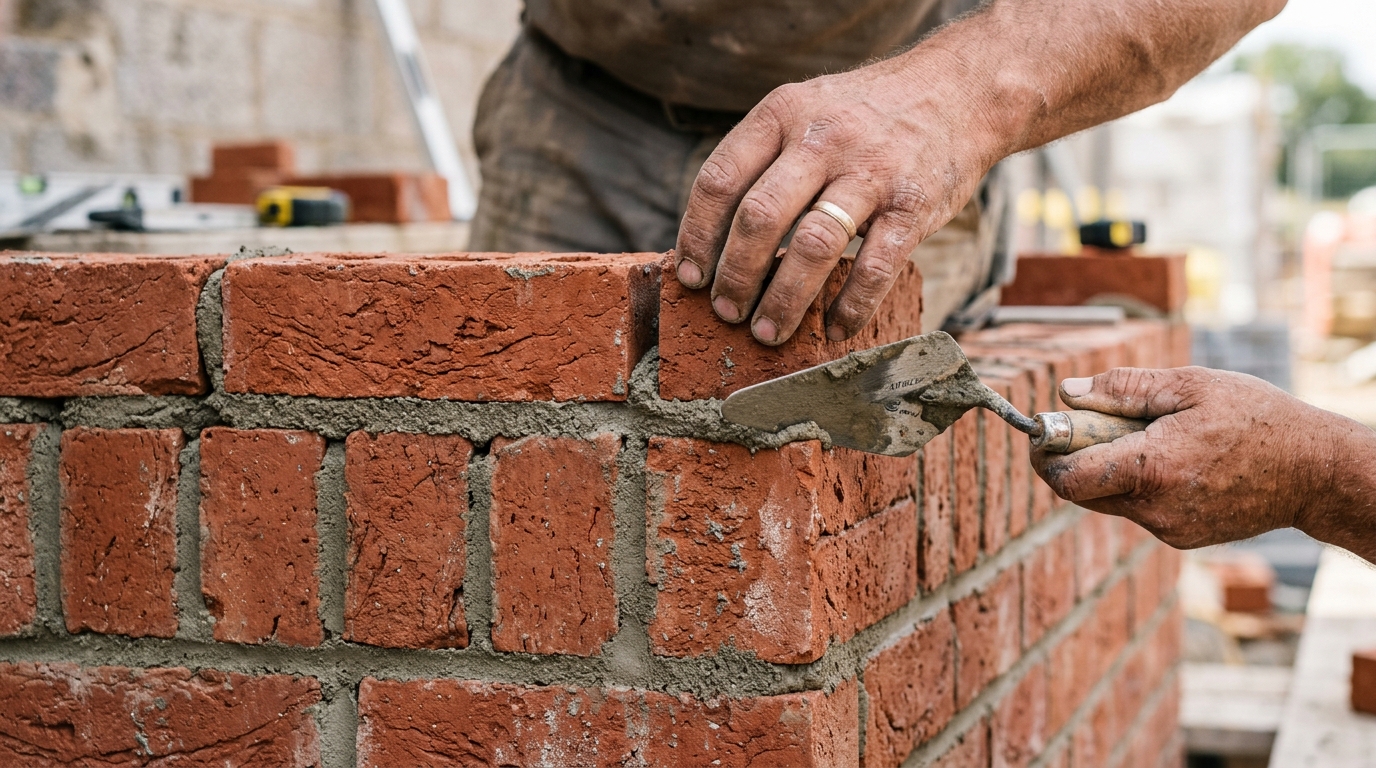
One note for anyone researching masonry walls: soldier and sailor have different definitions in vertical brickwork. BIA’s 2026 terminology update defines a wall soldier as a brick on end showing its narrow face, and a wall sailor as a brick showing its broad bedding face. We’re focused on paving here, but knowing the distinction prevents confusion when you’re reading specifications that cross both contexts.
How Border Orientation Changes Your Paver Layout
Border depth sounds minor until you see what it does to your field area. A deeper border eats into the space available for your herringbone, running bond, or basketweave pattern. On a large patio, the trade-off is purely visual. On a narrow walkway, it controls whether your field pattern looks clean or forced.
Here’s the math on a straight 30-foot edge using 4 x 8-inch pavers, ignoring joint spacing:
| Measurement | Soldier | Sailor |
|---|---|---|
| Paver length along the border line | 4 inches | 8 inches |
| Units along 30 feet | 90 | 45 |
| Border depth | 8 inches | 4 inches |
| Total border area (one side) | 20 sq. ft. | 10 sq. ft. |
The sailor option uses half as many units along this edge because it covers half the border area. That’s not the same as half the installed cost, but it is a real material difference.
Where it matters most: a 48-inch-wide walkway. Two soldier borders consume 16 inches of width, leaving a 32-inch field. Two sailor borders take 8 inches total, leaving 40 inches. Those 8 extra inches often mean the difference between a clean field pattern and awkward cuts down the center.
On a 20 x 20-foot patio, the proportion flips. A soldier border’s 8-inch depth looks intentional and grounded against 220+ inches of field. A 4-inch sailor border on the same patio can read as an afterthought. Scale drives the choice.
Edge Restraint: The Structural Job Behind the Border
This is where the conversation moves past looks. A border isn’t decoration. Installed correctly, it’s the last line of defense in your edge restraint system—and understanding how much weight pavers can support helps clarify why proper edge confinement matters so much for load transfer.
CMHA’s guidance on interlocking concrete pavements is clear: the perimeter needs restraint to maintain interlock, and soil backfill alone does not qualify. Restraints hold the entire paver field tight so units transfer load from one to the next. Without that confinement, pavers creep outward, joints open, and bedding sand washes out. In Sarasota, where summer storms dump an inch of rain in 20 minutes, joint failure shows up within one season.
A soldier border, pinned against a concrete or plastic edge restraint, creates a firm transition between field and perimeter. But the sailor course has a specific structural advantage most design articles skip. CMHA recommends running whole pavers between the restraint and any cut pieces exposed to tire traffic. Cut pieces should be at least one-third of a full unit. A sailor border naturally fills this role: it runs whole pavers along the edge, buffering the field’s cut ends from vehicle loads.
On driveways we install in Sarasota and Venice, we pair a herringbone field with a border selected for the driveway width and paver size. BIA’s clay paving guidance recommends herringbone specifically because continuous joints are susceptible to creep under horizontal tire loading. The border finishes the system. Neither a soldier nor a sailor border rescues a weak base, but the right border completes a strong one.
Cuts, Waste, and Installation Time
Border orientation affects how many cuts you make, how much material you lose, and how long the job takes. These factors rarely appear in design articles, but they show up on your invoice.
Unit consistency. A soldier border demands uniform paver length across every unit. If you’re working from a multi-size tumbled concrete paver bundle, you’ll need to sort out matching units or purchase single-size pieces separately for the border. Mixed lengths in a soldier course create an uneven inner edge that complicates the field. A sailor border is more forgiving with mixed-length bundles: the long dimension runs along the edge, and minor length differences shift the joint spacing along the line rather than disrupting the border depth.
Corners. Where two soldier borders meet at 90 degrees, you need mitered cuts or a carefully planned transition piece. Sailor borders at corners are simpler: the end of one run butts against the side of the perpendicular run. Fewer cuts, less waste, faster installation.
Curves. Tight radii require trimming regardless of orientation. Soldiers on a convex curve open wedge-shaped joints on the outer edge, which need filling and can look unfinished. Sailors on the same curve open joints along the border’s inner side, which the field pattern typically covers.
Labor time. Based on our crew’s experience, a sailor border on a straightforward rectangular patio installs roughly 15 to 20 percent faster than a soldier border of the same length. The difference isn’t the paver count. It’s the reduced sorting, fewer cuts at transitions, and simpler corner details.
Why Sarasota’s Climate Makes the Border Choice Matter More
A paver border in Phoenix deals with heat. A border in Minneapolis deals with freeze-thaw. In Sarasota, we deal with water: summer storms that test drainage every afternoon, followed by dry stretches where heat bakes the joints.
Joint orientation and drainage. A soldier border’s joints run perpendicular to the edge. Water hitting those joints flows inward toward the field, which works fine if the field slope moves it to a collection point. A sailor border’s joints run parallel to the edge, channeling small volumes laterally along the perimeter. On pool decks where splash water hits the edge constantly, that lateral flow matters.
We install every paver surface with a minimum 2% slope away from the structure (a quarter-inch per foot). The border doesn’t override that slope, but it channels small volumes along predictable paths.
Polymeric sand performance. Wider joints in a sailor course (the short-end-to-short-end gaps) accept polymeric sand more easily and cure more uniformly. Tight soldier-to-soldier joints sometimes underfill, leaving gaps that let sand wash out in the first heavy rain. We see this on jobs other installers have done: the border joints fail before anything else because the polymeric sand never fully seated.
After sealing, joint width becomes less critical. But if your project won’t be sealed right away, the border’s joint geometry is another variable to weigh.
Which Border Fits Which Project
Here’s the decision framework we work from on every estimate:
| Project Type | Our Default | Why |
|---|---|---|
| Driveway, 12 ft. or wider | Soldier | Deep frame anchors the scale; field width absorbs the border depth easily |
| Driveway, single-car or narrow | Sailor | Preserves field width for a clean herringbone pattern |
| Large patio (200+ sq. ft.) | Soldier | Bold frame separates patio from surrounding landscape |
| Small patio or courtyard | Sailor | Avoids overwhelming the field; keeps proportions balanced |
| Walkway (36 to 48 in.) | Sailor | Every inch of field width counts |
| Pool deck | Sailor | Cleaner transition to coping; wider joints handle splash water |
| Fire pit surround | Combination | Soldier outer ring with sailor inner ring adds depth on a circular layout |
These are starting points, not rules. Paver size, color contrast, and the field laying pattern all shift the equation. A double border (soldier outside, sailor inside, or the reverse) creates a layered frame that works well on large patios and fire pit seating areas. We’ve done this on several projects in Osprey and Nokomis where the homeowner wanted a formal look without shrinking the usable space.
The one constant: the border should match the edge restraint plan. If the restraint isn’t designed first, the border is cosmetic, and cosmetic borders move.
Every border choice starts with actual dimensions: your paver size, your project footprint, your drainage slope. A photo can show you the look. A site visit shows you the grade, the soil, and where the water goes. A free estimate lets our crew walk the project with you before a single paver gets cut.
Frequently Asked Questions
Can I use the same paver for both soldier and sailor borders?
Yes. Any rectangular paver works in either orientation. The difference is direction, not material. If you’re pulling from a multi-size bundle, sorting for consistent length matters more in a soldier course, where uneven units disrupt the inner edge.
Is a soldier course stronger than a sailor course?
Not automatically. Pavement strength comes from the base, edge restraint, and interlock, not border orientation alone. CMHA guidance actually identifies a whole-paver running (sailor) course as useful for stabilizing cut pieces near vehicle traffic. A properly confined sailor border can outperform an unsupported soldier border.
Which border works better on a curved patio?
Both require trimming on tight curves. Soldiers on a convex curve open wedge joints on the outer edge, which are harder to fill cleanly. Sailors push those gaps to the inner side where the field pattern typically covers them. For gentle curves, either orientation works with minor adjustments.
Does the border affect how much my paver project costs?
It can. A soldier border uses roughly twice the material area per linear foot compared to a sailor border with the same paver. It also takes more labor at corners and curves. The difference usually amounts to a modest percentage of the total project cost, but on long perimeters it adds up.
Do I still need edge restraint if I have a border course?
Yes. A border is a layout arrangement. Edge restraint is a structural element (concrete curb, plastic channel, or aluminum rail) that holds the pavers in place. A decorative row of pavers without restraint behind it will shift under load. The two work together, not interchangeably.
Can I combine soldier and sailor borders on the same project?
Absolutely. A soldier outer course with a sailor inner course (or the reverse) creates a layered frame that works on large patios, pool decks, and fire pit surrounds. The key is making sure total border width stays proportional to the field area so the pattern has room to read.